New York Times: Iran is challenging America with its drones
The New York Times highlighted one of the Pentagon’s most complex dilemmas in its conflict with Iran: the uneven cost race between cheap Iranian drones and expensive US air defense systems.
The report reveals that the equation isn’t in America’s favor, as the mathematical equation of the current war isn’t in the long-term interest of the United States.
Since the start of the military escalation, Iran has launched more than 2,000 suicide drones in record time.
Despite the superiority of US air defense systems, some of these drones have succeeded in reaching their targets, raising questions about the sustainability of defense.
According to Arthur Erickson, CEO of the American drone manufacturer Hylio, explains the essence of the problem: “Surely shooting down a drone is more expensive than launching it… This is a money game, and the cost-per-interdiction ratio could be as high as 10:1, maybe 60 or 70:1 in favor of Iran”.
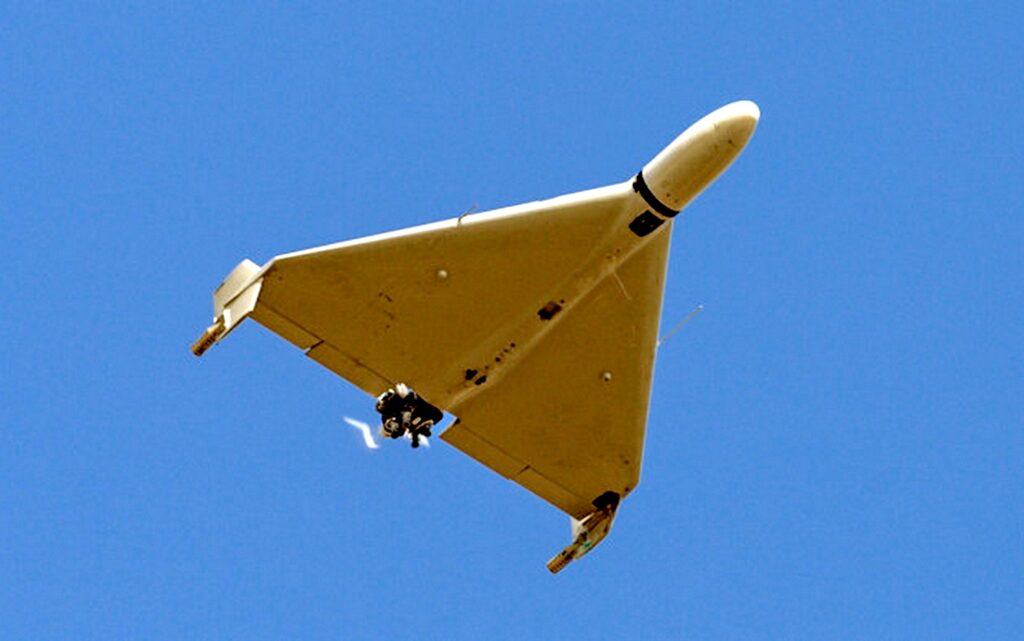
The report focuses on the most famous Iranian model, the Shahed 136, which has become a nightmare for defense systems.
The specifications of this aircraft make it an ideal weapon for war of attrition:
Shape and design: Triangular in shape, about 3.35 meters long, and makes a distinctive sound that resembles a lawn mower.
How it works: It carries an explosive device that explodes on impact, and can be launched from behind a normal truck, making it difficult to detect and track.
Range: Up to about 1,930 kilometers, covering most of the Middle East.
Its production cost: It ranges from only $20,000 to $50,000 per aircraft, and it is made with ready-made commercial electronics, allowing it to be produced in the thousands.
In contrast, the cost of an objection is incomparably high: as the Patriot system, the gold standard for US air defense, uses interceptor missiles that cost more than $3 million per shot.
Even less expensive systems, such as the Raytheon Coyote, cost about $126,500 per interception, which is still exponentially the cost of an Iranian drone.
Other systems rely on jamming or lasers, but their effectiveness varies and may be limited in civilian environments.
The problem doesn’t stop at the financial cost, but extends to the scarcity of interceptor munitions themselves.
In 2025, Lockheed Martin delivered 620 PAC-3 missiles, a record, but still very small in the thousands of drones Iran can launch.
A report by the Center for Strategic and International Studies (CSIS) indicates that there is a large gap between annual US procurement (measured in hundreds) and what an intensified war requires.
Senior US officials have made no secret of the magnitude of the challenge.
Defense Secretary Pete Hegsey implicitly acknowledged the difficulty of the equation by saying that they had pushed all anti-drone systems forward without considering the cost.
Its noteworthy that the report conveys Ukraine’s experience in confronting Russian drones (inspired by Iranian Shahed drones), where the Ukrainians have sometimes used rudimentary solutions such as fishing nets and machine guns, but these methods are difficult to generalize in the Middle East.
The irony of the report is that the United States, despite its decades of technological superiority and sanctions on Iran, has developed a modified version of the Iranian Shahed drone named Lucas, which is being produced by SpektreWorks in Arizona and is currently being used in the conflict.
This is a move that reflects an implicit admiration for a simple and effective Iranian innovation.
The New York Times report concludes that this imbalance in the cost-production equation is an emerging global problem in the age of cheap drones.
If the escalation continues at this intensity, the defense of US bases and interests may become unsustainable, both financially and logistically, forcing a radical rethinking of war and deterrence strategies.