To avoid a Hormuz crisis… German exporters are turning to land routes through Syria and Türkiye
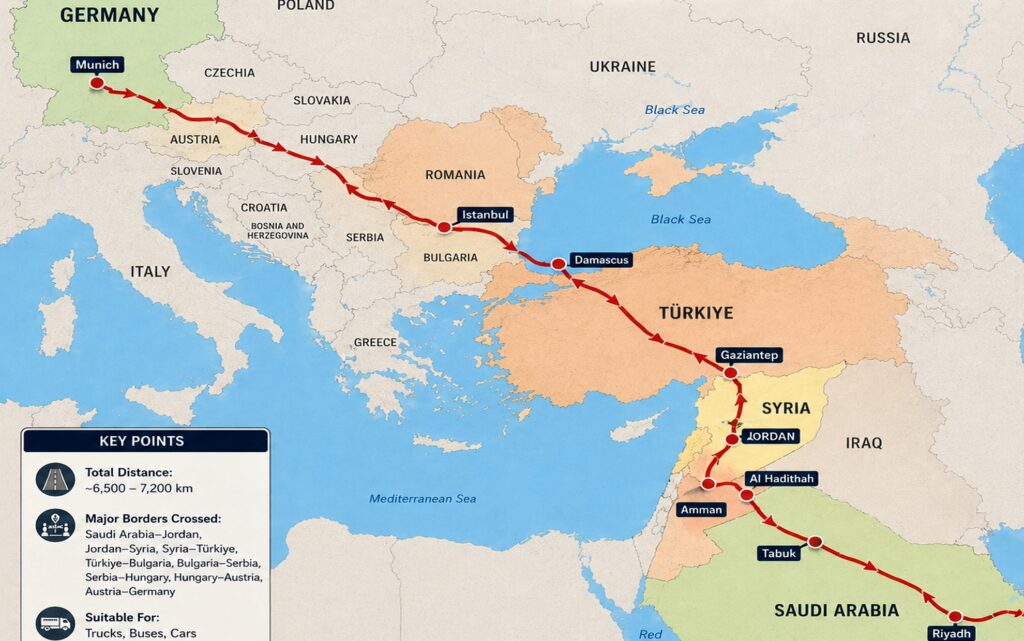
German exporters, who have relied on Gulf markets for decades, are looking for alternatives to traditional sea routes after the ongoing US-Iran war caused shipping and insurance costs to rise to unprecedented levels, prompting them to explore new options via Syria.
According to Hans-Ulrich Dicke, project manager at the logistics company Derda, the recent developments have spurred interest in transporting goods through Syria.
Dicke stated, “There is no doubt that the Iranian war is hindering all trade with the Middle East… Container ships can no longer pass through the Strait of Hormuz, so we are looking for alternative solutions every day”.
Dicke explained that with the outbreak of the conflict, logistics companies turned to the port of Fujairah on the UAE’s east coast as an alternative to avoid the Strait of Hormuz, but he noted that the port is experiencing increasing congestion.
He added, “Then we tried the Jeddah option, but it wasn’t viable due to its exorbitant cost, which is four times higher”.
The Gulf region is a high-value destination for German exporters in the machinery, automotive and chemical sectors, with German exports to the six Gulf Cooperation Council (GCC) countries (UAE, Saudi Arabia, Qatar, Kuwait, Oman and Bahrain) reaching around 25 billion Euros ($29 billion) in 2025.
Consequently, disruption to shipping traffic in the Strait of Hormuz threatens losses estimated at billions of Euros.
Dicke explained that the ongoing conflict has harmed German companies, particularly those exporting non-durable goods such as pharmaceuticals, food, and beverages, and has also made it difficult for machinery manufacturers to plan ahead.
He warned: “The longer this blockade lasts, the more dangerous it becomes, because companies invest and ultimately cannot sell their goods… If this war continues much longer, it will have a catastrophic impact on all of us”.
German exporters seeking alternative routes to the Middle East and the Gulf, with more than 50% of companies are directly affected by the current conflict.
Syria’s location is extremely strategic, but without Türkiye, it won’t work.
The local logistics companies started shifted some of their logistical operations to overland transport through Türkiye and Syria, then on to Jordan, Saudi Arabia, and other destinations in the region.
They use a different route combining sea and land transport from European ports to the Turkish port of Mersin, and from there overland through Syria.
The land transport from Germany to Saudi Arabia takes at least three weeks, while combined land and sea transport takes about 35 days.