Washington and London impose sanctions on 12 individuals and entities linked to Iran over oil sales to Beijing

The United States and Britain on Monday imposed sanctions on 12 individuals and entities linked to Tehran, accusing them of facilitating the sale and shipment of Iranian oil to China, days before US President Donald Trump’s visit to Beijing.
A statement issued by the US Treasury Department said, “The Iranian Revolutionary Guard relies on front companies in permissive economic environments to conceal its role in oil sales and the transfer of proceeds to the Iranian regime”.
The statement named a number of individuals residing in Iran and companies based in the UAE and Hong Kong, among those subject to the sanctions.
Any assets in the United States belonging to the sanctioned entities will be frozen, and US entities and individuals will be prohibited from dealing with them.
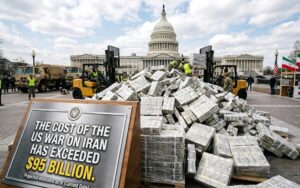
As part of its war on Iran, the United States has tightened sanctions on Tehran and the Revolutionary Guard in an attempt to drain the country’s economy.
“As the Iranian military desperately tries to regroup, Operation Economic Wrath will continue to deny the regime funding for its weapons programs, terrorist proxies, and nuclear ambitions,” said US Treasury Secretary Scott Bessent, referring to the economic measures the United States is imposing on Iran alongside its military pressure.
The war has affected global energy markets, after Tehran effectively closed the vital Strait of Hormuz, through which about 20% of the world’s oil and gas production usually passes.
Washington had eased some sanctions on Iranian oil in March in an attempt to address the global supply shortage, but then tightened restrictions again.
A large portion of Iran’s oil goes to Asia, with China being a major importer, and Beijing is one of Tehran’s largest trading partners overall.
The US president arrives in Beijing later this week for talks with Chinese President Xi Jinping, with an agenda packed with trade disputes.
The US-Israeli war on Iran will also top the agenda, as Washington seeks to exert further pressure on Tehran through Beijing.
On Friday, the US State Department imposed sanctions on three Chinese satellite communications companies, accusing them of supporting Iranian forces in their operations.
The US Treasury Department had previously imposed sanctions on several companies based in mainland China and Hong Kong for helping Iran supply weapons.
Britain also imposed sanctions on Monday on 12 individuals and entities with links to Iran, accusing them of involvement in hostile activities targeting the United Kingdom or other countries.
The British Foreign Office imposed a travel ban to the United Kingdom and a freeze on the assets of nine individuals and two money exchange companies operating within a “shadow banking network” and the Zandashti criminal network.
The British and US governments had previously imposed sanctions in 2024 on Naji Ibrahim Sharifi-Zandashti, whom they described as the leader of an international drug smuggling gang.
Last year, the European Union imposed sanctions on its network, which London, Washington and Brussels concluded was linked to the Iranian Ministry of Intelligence and Security and involved in assassinations and kidnappings of figures opposed to the regime in Tehran.
The latest British sanctions come in the wake of a series of attacks in recent months targeting the Jewish community in the United Kingdom, and repeated warnings that hostile states are seeking to use proxies for this purpose.
A relative of Zindashti, the Turk Akram Abdulkarim Oztunuk, is among the nine people on whom Britain imposed sanctions on Monday.
London also imposed sanctions on five members of the Zarrin Qalam family: Farhad, Fazlollah, Mansour, Nasser, and Pouria.
They are accused of helping to fund efforts aimed at destabilizing the United Kingdom.
Last year, the United States imposed sanctions on Mansour, Nasser, and Fazlollah Zarrin Qalam for their involvement in Iran’s shadow banking network.
The US Treasury Department said the three collectively laundered billions of dollars for Iran through a network of shell companies in the United Arab Emirates and Hong Kong.
London added to its sanctions list the companies “Berlian Exchange” and “GCM Exchange”, both of which are subject to US sanctions.
In addition to these, the British Foreign Office imposed a travel ban to the United Kingdom and a freeze on any assets owned by the Iranians Nihat Abdulqader Asan and Reza Hamidiravari and the Azerbaijani Namiq Salifov.