Tom Barrack: The SDF will face problems with the Turkish and Syrian governments if it doesn’t move quickly on the integration issue
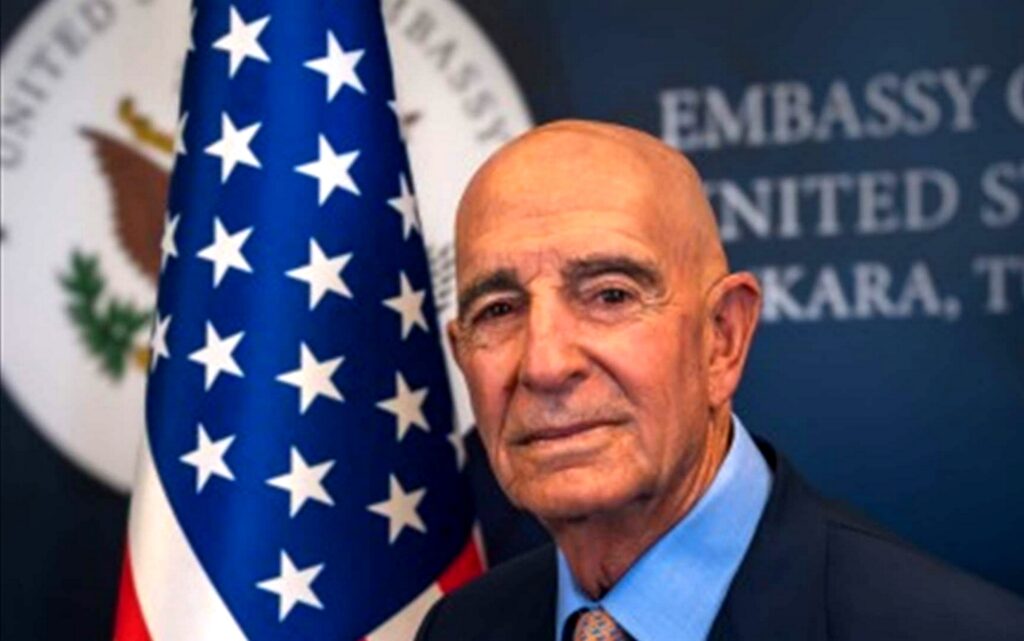
US Ambassador to Ankara and Special Envoy to Syria Tom Barrack said that the SDF will face problems with both the Turkish and Syrian governments if it doesn’t move quickly on the integration issue.
“The United States will do everything in its power to ensure that the [aforementioned organization] makes a fair and correct decision… If they want to come to America and live with us, they can do so,” he added in a statement to Turkish offical Anadolu Agency at the conclusion of a press conference held Friday evening in New York City.
Regarding a previous statement in which he said, “The Syria Democratic Forces (SDF) are the YPG, and the YPG is a branch of the PKK… I never said that the SDF is derived from the PKK,” Barrack said.
He added, “The YPG emerged from various branches of the PKK, while the Syria Democratic Forces emerged from various branches of the YPG”.
Regarding the reasons for the lack of results from the talks between the terrorist PKK/YPG, which uses the name “Syria Democratic Forces (SDF), and the Damascus government… The crux of the matter is whether or not to stand on the same side as the Syrian Arab Republic,” Barrack said.
He continued, “One state, one nation, one army… That is what that nation decides, and we accept that… That is the issue,” adding, “All minorities may want a federal environment, but it’s not up to us, and we don’t have the right to judge intellectual discussions”.
Barrack pointed out the need not to impose a form of government from abroad in Syria, or to integrate and protect the rights of minorities.
“We’re all saying, especially the United Nations: If you want to help us, this is really important… We want to see the conditions you set… We want to see what you’re going to do with the foreign fighters… Are you going to integrate them or not? Or are you going to bring them home or not?” he said.
Regarding the US military presence in Syria, Barrack indicated that the battle against the terrorist organization ISIS continues.
He added, “We’ve a military presence in that area, and we will maintain it… The goal isn’t to maintain this presence indefinitely”.
He continued, “We’ll decide over time to reduce the number of these forces, and the number of all forces must be reduced if a new independent Syrian government is formed”.
He highlighted the risks surrounding the integration process in Syria, saying, “I believe this is a transitional period in which no consensus has been reached for seven months, and there is concern that previous concerns will persist into the future”.
Barrack asked, “Will the Syrian government act fairly? We’re not here to impose that, but to begin this process”.
Barrack noted that the Pentagon had requested a budget for local armed groups in the al Tanf area of Syria, just as it had for the aforementioned organization in the north.
In response to a question, “Will these groups be integrated into the Syrian army, or does the United States plan to continue separate cooperation there for a longer period?” Barrack replied: “Our intention isn’t to establish a permanent presence anywhere in Syria… Our bases are for defensive purposes”.
He stressed that Syria needs a large-scale military presence internally and externally, and the logical thing to do is to integrate the SDF.
He added that the aforementioned merger process will take time due to the lack of mutual trust between the Damascus government and the organization, adding that the agreement between the two parties isn’t specific enough to make this situation successful.
Finally, Barrack indicated that Washington is trying to clarify some details to reach an agreement, expressing his belief that the two sides will reach a “successful and beautiful” agreement.