Geoscience Meets Geopolitics: The First GEO-SUSTAINABILITY BRICS 2026 Conference and the New Frontiers of Scientific Cooperation
By: Contribution for Syrializm
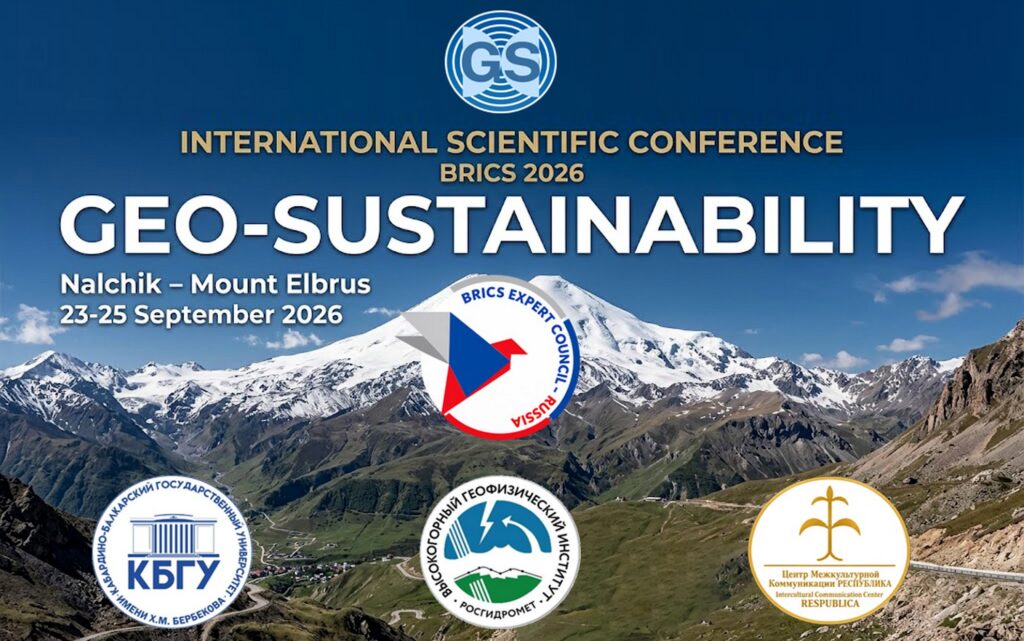
The first GEO-SUSTAINABILITY BRICS 2026 International Scientific Conference concluded on 25 September 2026 in Nalchik, the capital of the Kabardino-Balkarian Republic, marking a significant milestone in the institutionalization of scientific cooperation among BRICS nations and their partners.
Held from 23 to 25 September under the official support of the BRICS Expert Council–Russia, with scientific activities extending to the Mount Elbrus region, the conference brought together researchers and experts across geophysics, climatology, ecology, and sustainable natural-resource management.
While framed as a scientific gathering, the event carried considerable economic and geopolitical significance.
It reflects a broader shift in the global research landscape, where BRICS countries are increasingly seeking to build independent scientific and technological capacities, reduce reliance on Western-dominated academic and funding networks, and align research agendas with their own developmental and strategic priorities.
The conference was organized as a joint initiative involving Kabardino-Balkarian State University (KBSU), the High-Mountain Geophysical Institute in Nalchik, and the Intercultural Communication Center “Respublica” with the BRICS Expert Council–Russia as official partner.
Participation included academics, professors, researchers, and experts from BRICS members Brazil, China, India, and Russia, as well as partner countries such as Türkiye and Uzbekistan.
From a geopolitical standpoint, this composition is notable; It signals an effort to create a scientific cooperation architecture that parallels — and in some respects competes with — established Western-led frameworks.
By convening specialists in climate science, geophysics, glaciology, ecology, environmental monitoring, natural-hazard assessment, and sustainable technologies, the conference positioned BRICS as a collective actor capable of addressing global environmental challenges on its own terms.
The involvement of Türkiye and Uzbekistan further indicates that the BRICS scientific space is not limited to full member states but is evolving into a broader coalition of like-minded partners.
This expansion has strategic implications, particularly in regions where Russia, China, and India seek to deepen influence through educational, technological, and infrastructural cooperation.
The conference’s thematic focus — geophysics, climate change, atmospheric and environmental processes, mountain ecosystems, and sustainable development — is deeply intertwined with economic interests.
BRICS economies collectively account for a substantial share of global natural-resource extraction, industrial production, and energy consumption.
Understanding geophysical processes, climate risks, and ecosystem dynamics is therefore not merely an academic pursuit but a prerequisite for stable economic planning.
Mountain regions such as the Greater Caucasus, where the conference was held, serve as critical water towers for agriculture, hydropower, and urban supply.
Glaciological research and high-mountain climatology have direct implications for water security, energy generation, and disaster risk reduction — all of which carry significant economic costs if mismanaged.
Moreover, the emphasis on sustainable natural-resource management speaks to a central tension within BRICS economies: the need to reconcile resource-driven growth with environmental sustainability.
As global markets increasingly price in carbon risks and environmental, social, and governance (ESG) criteria, BRICS nations have a vested interest in developing their own scientific metrics, monitoring systems, and technological solutions rather than relying on frameworks shaped by Western institutions.
The conference’s focus on combining fundamental and applied research approaches, and on advancing modern methods for studying climate and geophysical processes, can be read as an effort to build indigenous capacity in areas that have direct bearing on economic resilience — from early-warning systems for natural hazards to climate-adaptive infrastructure planning.
A distinctive feature of GEO-SUSTAINABILITY BRICS 2026 was its location in the Kabardino-Balkarian Republic, in the central Greater Caucasus and in close proximity to Mount Elbrus.
The region offers an exceptional natural laboratory for research into atmospheric processes, glaciology, high-mountain climatology, geophysical phenomena, environmental change, and mountain ecosystem dynamics.
The choice of venue is geopolitically resonant, as the Caucasus is a region where Russian, Turkish, Iranian, and broader Eurasian interests intersect.
By hosting a BRICS scientific conference in the North Caucasus, Russia signals both its domestic scientific capacity and its ability to convene international partners in strategically sensitive territories.
The presence of Turkish and Uzbek participants adds a layer of regional diplomacy, potentially opening avenues for scientific and technical cooperation that complement broader economic and infrastructural engagements.
The conference also highlighted the scientific and environmental significance of Kabardino-Balkaria and the Greater Caucasus more broadly.
The region’s combination of high-mountain landscapes, glaciers, forests, alpine ecosystems, rivers, and diverse climatic conditions makes it an important environment for studying interactions between natural systems, climate processes, and human activity.
In economic terms, this translates into research that can inform land-use planning, tourism development, hydropower management, and climate adaptation strategies — all sectors with measurable fiscal and employment impacts.
Beyond the academic program, the conference sought to move beyond conventional academic presentations by encouraging open scientific dialogue, interdisciplinary exchange, the development of new research hypotheses, and international research partnerships.
Organizers expressed the expectation that the conference would contribute to new collaborative initiatives within the BRICS framework and establish a foundation for sustained professional and scientific cooperation.
This ambition has a clear soft-power dimension, as scientific diplomacy is increasingly recognized as a tool for building trust, shaping narratives, and creating durable networks of influence.
By positioning itself as a facilitator of international scientific dialogue, BRICS can project an image of cooperative, development-oriented multilateralism — contrasting with perceptions of Western scientific institutions as exclusionary or politicized.
The participation of established scientists alongside early-career researchers further suggests an effort to build long-term epistemic communities.
Such networks can shape research agendas, standards, and technological trajectories for years to come, with downstream effects on trade, investment, and regulatory cooperation.
The successful conclusion of GEO-SUSTAINABILITY BRICS 2026 marks an important step in strengthening international scientific dialogue on geophysical processes, climate change, environmental research, and sustainable development.
By connecting scientific expertise from BRICS countries and partner states with the unique research environment of the Greater Caucasus, the conference established a platform for continued interdisciplinary exchange and potential future research cooperation.
Yet the real test will be whether this initial gathering evolves into a durable institutional architecture — with joint funding mechanisms, shared data platforms, mobility programs, and coordinated research agendas.
If it does, the economic and geopolitical implications could be substantial, with a BRICS-led scientific ecosystem capable of generating credible, policy-relevant knowledge on climate, geophysics, and sustainability wouldn’t only serve the developmental needs of member states but also enhance their collective bargaining power in global environmental governance.
The organizers expressed their appreciation to all participating scientists, experts, academic institutions, partner organizations, and delegates whose contributions made GEO-SUSTAINABILITY BRICS 2026 a substantive international scientific forum.
As the conference series looks to future editions, its trajectory will be closely watched — not only by the scientific community but also by policymakers, investors, and strategists who understand that in the twenty-first century, scientific cooperation is inseparable from economic competitiveness and geopolitical influence.
Visit the official conference website: GEO-SUSTAINABILITY BRICS 2026 — Official Conference Website