Ukraine and Europe: Who is the Master and Who is the Subordinate?
By: Contribution for Syrializm
NATO’s relationship with Ukraine in the military and strategic spheres may seem entirely different from its relationship in the political and economic arenas.
Since the beginning of the Russian-Ukrainian war, the West in general—and specifically the European NATO countries, effectively the European Union—have provided Ukraine with everything: weapons, money, and media support.
They even opened the door for volunteers to fight in the ranks of the Ukrainian army against Russia. Some European countries even changed their military doctrines, which they had maintained for decades.
Countries like Finland and Sweden joined NATO after spending decades outside the military sphere.
A country like Germany began openly discussing rearmament and military buildup, whereas before the war, the mere mention of the military and the army was practically taboo; Germans would look at you with disgust if you spoke of the army and weapons.
Suddenly, after the war, all Europeans became soldiers.
They all became military enthusiasts, preparing themselves as if war were breaking out tomorrow and the Russian army were invading.
Of course, this exaggeration, this fear, and this practically unjustified anxiety are fueled by propaganda successfully disseminated by certain Western powers with a vested economic interest in perpetuating hostility and demonizing Russia—as if Russia were about to conquer Europe.
This rhetoric from all sides is illogical, at least given the circumstances we have witnessed in the world over the past few years.
On the contrary, Russia seeks cooperative, integrated, and mutually respectful relations with its European neighbors. European countries have genuine economic interests in relying on Russia, and Russia has very important economic interests with Europe.
We are now seeing the state of European economies since they stopped buying Russian gas and oil; their situation is dire, yet they remain in denial.
Their economies are practically collapsing, and even their military stockpiles are being depleted, having been exhausted in Ukraine.
In Germany, according to recent reports, a company files for bankruptcy every 20 minutes.
One of the key aspects of European support for Ukraine was training Ukrainians to fight.
However, a recent scandal revealed that the ones who will practically train NATO in modern warfare are the Ukrainians, not the other way around, as NATO’s military doctrine has become outdated.
It is clear that NATO’s military structure is highly backward and no longer understands what modern warfare looks like.
On the contrary, Russians and Ukrainians alike have learned quickly how to adapt.
There is always a competition between the two sides; we constantly find one adopting a certain tactic, and after a while, we see the other learning and implementing the same style.
Meanwhile, Western media—particularly German and British—ridicule the methods adopted by the Russian army, which they consider backward or laughable.
They supplement this with nonsensical speculation about manpower shortages, tank and fuel deficits, and other trivialities that suggest those running the Western media are living on another planet.
The embarrassing thing is that when the Ukrainians discover that Russian tactics are working and succeeding, they begin to imitate them.
Yet, here we find the Western media silent.
There is no ridicule of the Ukrainians, even though they are using the exact same methods the media mocked when they were used by the Russians.
The West is belatedly discovering that the tactics employed by Russia and Ukraine are well-suited to a modern hybrid war, blending old and new methods, especially considering the location, field conditions, and geography of the theater of operations.
In practical terms, any war that might erupt in Europe would bear a striking resemblance to the ongoing conflict between Russia and Ukraine.
The most important aspect of modern warfare is the decisive role of drones, which have become capable of significantly altering the battlefield.
This is something that the Europeans have not grasped, nor has NATO, nor even the United States of America.
In May 2025, NATO gathered 16,000 troops in Estonia for Exercise Hedgehog, a large-scale military drill designed to simulate a modern battlefield contested by swarms of drones.
The scenario was meant to test the alliance’s ability to maneuver in an environment where the skies are no longer safe, and where conventional armored advances face constant surveillance and precision attacks from above.
What happened instead was a humiliation so profound that NATO took nearly a year to fully disclose the details, because by then, the damage to NATO’s credibility was already done.
A small team of ten Ukrainian drone operators—veterans returning from the front lines of the war with Russia—had effectively destroyed two full NATO battalions in a matter of hours.
They did so not with advanced weapons systems or classified technology, but with commercial drones, tactical patience, and a deep understanding of a war that NATO had only watched from a distance.
The Ukrainian contingent at the Hedgehog 2025 drills consisted of bomber drone operators and FPV drone crews.
Their mission was to act as the adversary and test the ability of a NATO mechanized battle group—comprising a British brigade and an Estonian division—to break through a wall of drones. Ukrainian drone operators observed NATO armored vehicles moving in large, exposed columns, with infantry units failing to disperse or take cover.
Within half a day, the Ukrainian team had conducted 30 strikes and destroyed 17 armored vehicles.
Two NATO battalions were effectively eliminated—not in a prolonged engagement, but in a series of surgical drone attacks that left the alliance’s mechanized forces pinned down and unable to maneuver.
One NATO commander overseeing the exercise was quoted as saying, simply: “We’re fucked!”
What made the defeat even more embarrassing was the fact that the Ukrainians were holding back, as the drone saturation on the actual Russian-Ukrainian front is twice as intense.
Nowadays, the FPV drone plays a vital role, utilizing what can be described as a “triangle of effectiveness”—these drones are cheap, lethal, and operated by small teams.
They can loiter, track, and strike with precision, making traditional armored maneuvers all but impossible without comprehensive electronic warfare support and decentralized infantry tactics.
Since 2022, an estimated 200,000 Ukrainian soldiers have received some form of NATO military training across Europe.
On paper, this was a noble effort to prepare Ukraine’s forces for the rigors of modern combat, but in practice, much of the training was dangerously out of touch.
In the United Kingdom, the initial curriculum focused heavily on urban warfare—even as the fighting in Ukraine bogged down into static trench lines.
When trench warfare was finally added to the syllabus, Norwegian instructors were filmed demonstrating tactics so rudimentary that they appeared to have no practical experience in clearing dug-in positions.
Ukrainian soldiers reportedly asked their British instructors what to do when pinned down.
The answer was: “Call in an airstrike!” When German instructors trained Ukrainian tank crews on Leopard tanks, the Ukrainians asked about enemy minefields.
The response was: “Just go around them!”
Official footage from NATO militaries throughout 2023 and 2024 revealed a persistent failure to adapt to new methods.
French tanks deployed in Romania maneuvered in open ground without camouflage, reactive armor, or drone cages.
French infantry was filmed packed tightly behind armored vehicles—a formation that would be obliterated by a single FPV drone.
German Panzergrenadiers conducted assaults using Cold War reconnaissance tactics, with soldiers popping out of vehicles to scan the horizon with binoculars.
Even the United States, long considered the gold standard of military innovation, stumbled.
Back in July 2025, the US Army proudly released a video showing soldiers practicing drone grenade drops.
The footage showed them repeatedly missing their targets—a spectacle so embarrassing that the US Army deleted the post shortly after receiving overwhelming mockery online.
Meanwhile, NATO armies have increasingly become aware of their own deficiencies; thus, they have started bringing Ukrainian veterans in as instructors.
The Hedgehog exercise and the years of training failures that preceded it point to a deeper structural problem within NATO. Despite being an alliance of the world’s most advanced militaries, NATO has struggled to internalize the lessons of the war in Ukraine because its training doctrines are built around assumptions of air superiority, uncontested logistics, and the ability to mass forces for decisive maneuver.
These assumptions no longer hold in an environment where soldiers, vehicles, and command posts are all under constant surveillance from drones.
Changing doctrine requires unlearning decades of ingrained practice—a process that military institutions naturally resist.
Adding to that is the lack of actual experience, as armies only truly learn when they face combat themselves.
European NATO members have not fought a conventional war in generations, and their officers may observe, but they do not experience the daily reality of drone warfare the way Ukrainians and Russians do. Finally, there is European imperialistic arrogance; they simply refuse to admit failure.
The French and Germans, not forgetting His Majesty the King’s army, possess enough arrogance and pride to one day bring their countries down.
The Hedgehog exercise was a profound humiliation and embarrassment for NATO, while their governments insist on denying the economic difficulties they face, the facts show they are far behind in modern warfare.
This is evident in a number of shocking examples from military confrontations taking place around the world today, even as Europe pushes for escalation, mobilization, and rearmament.
A realistic conversation with European leaders today should focus on their fanaticism toward war and the mobilization of hostility against Russia—conditions that will not help them win a battle, especially when they have more serious obligations toward the lives of their own people.
Practically speaking, even if only for the sake of humor or as an alternative historical perspective: what if Russia and Ukraine were to ally against Europe?
What if the day came when the Ukrainian army joined forces with the Russian army and confronted Europe with the experience both sides have gained?
The Russian and Ukrainian armies could take over Europe within a month.
Perhaps that is why some Europeans fear any chance of peace between Russia and Ukraine, because within a month, the entire military might of all European nations would collapse.
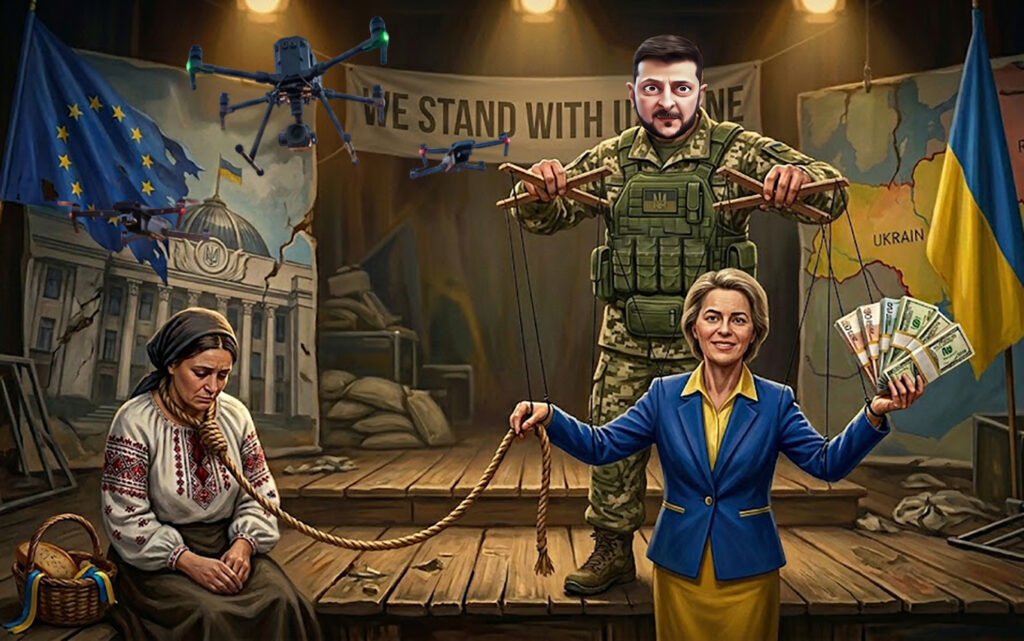
It is clear now—and though this reality is insulting to Europe, they insist on denying it—that because they provide money and support, they treat Ukrainians as if Europe is doing them a favor.
The reality is that some in Kyiv are exploiting Europe, stirring up fear of Russia by suggesting an impending war solely to serve the interests of a few in Kyiv who want more money for their own pockets.
Apparently, Europeans have found out that they are the ones who need modern warfare training; they need Ukrainians to train them to prepare for a hypothetical war with Russia.
This is the most insidious Ukrainian plan so far.