Tom Barrack: If Lebanon doesn’t act now, it may return to being part of the Levant again… and the Syrians say that Lebanon is our seaside resort!
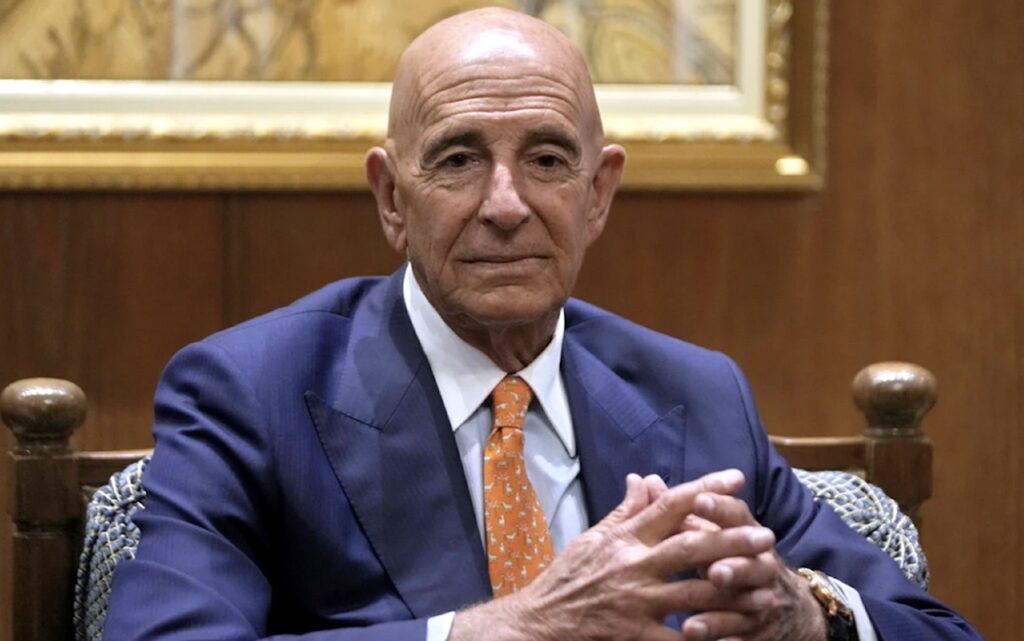
US Special Envoy for Syria and Washington’s Ambassador to Türkiye, Tom Barrack, warned that Lebanon faces an “existential threat” if it doesn’t quickly address the issue of Hezbollah’s arsenal.
He noted that the country risks becoming an arena for regional power struggles unless a radical solution to the crisis is reached.
Barrack said that Lebanon is trapped between Israel on one side, Iran on the other, and Syria, which is rapidly reasserting itself.
He added, “If Lebanon doesn’t act now, it could become part of the Levant again”.
He added, “The Syrians say that Lebanon is our seaside resort… so we have to take action… I fully understand how frustrated the Lebanese are, and I feel frustrated too”.
Barrack revealed that the United States, Saudi Arabia, and Qatar are ready to provide support if the Lebanese government shows a genuine willingness to take the lead.
He noted that last month, he submitted an official proposal to Lebanese officials calling for the disarmament of Hezbollah and the implementation of economic reforms, as part of a comprehensive plan to “save the country” from its financial crisis, which has been ongoing for more than six years and is considered among the worst in the world.
According to the US proposal, any reconstruction aid and a cessation of Israeli military operations are conditional on Hezbollah’s complete disarmament on Lebanese territory.
Since the start of the US-brokered ceasefire in November, Hezbollah has withdrawn most of its fighters from the border with Israel, but Israel continues to insist on disarming the party across all Lebanese territory.
In response to the initiative, Lebanese authorities submitted a seven-page document calling for a complete Israeli withdrawal from the disputed territories and emphasizing the exclusive possession of arms by the state.
Barrack said that the Lebanese document was “responsive, very responsive,” though he acknowledged that there were points of disagreement that “require a lot of negotiation,” adding, “We had a previous agreement that was excellent… the problem is that it wasn’t implemented”.
When asked whether Hezbollah’s disarmament and transformation into a purely political party might prompt the Trump administration to remove it from the list of terrorist organizations, as happened with Hay’at Tahrir al Sham in Syria, Barrack declined to comment, saying, “I’m not evading the answer, but I can’t respond to it”.
Regarding Lebanese President Joseph Aoun’s failure to publicly commit to a timetable for disarmament, Barrack explained that this was due to his “unwillingness to ignite a civil war”.
He noted that the Lebanese Army is still considered the most neutral and credible entity, but it faces a severe shortage of funding and equipment due to the economic collapse, prompting UNIFIL to fill the gap with 10,000 troops.
He added, “God bless the United Nations and UNIFIL, but they don’t have effective leadership on the ground in emergency situations”.
Barrack warned that any attempt to force Hezbollah’s disarmament could lead to an internal explosion, noting that the ideal solution might be a voluntary agreement in which the party hands over its heavy weapons, such as missiles and drones, to monitored warehouses, under an international mechanism that includes the United States, France, Israel, and the Lebanese army.
Despite the importance of this path, Barrack emphasized that the Lebanese army currently lacks the human resources and equipment necessary to implement it, saying, “We don’t have enough soldiers on the ground, nor enough funding… They’re using 60-year-old equipment”.
According to Barrack, Hezbollah refuses to rely on the Lebanese army, viewing it as an institution incapable of providing protection, saying, “The party sees that Israel bombs it daily and continues to occupy its territory, so it has no choice but to rely on itself”.
To address these challenges, Barrack stressed the need for international support for the Lebanese army and the creation of a mechanism for managing heavy weapons with the consent of the relevant parties.
However, he noted that Washington is facing difficulty convincing its Gulf partners to fund the army, as they are tired of pumping money into a country where aid goes into the pockets of corrupt individuals.
“We’re asking our Gulf partners to fund the army, but they refuse because they have given Lebanon so much in the past to no avail… This is the big dilemma,” he said.
Barrack concluded by emphasizing that Lebanon’s stability requires coordinated support for the Lebanese army, which can be achieved in cooperation with the Gulf states and UNIFIL, provided their roles and missions are effectively redefined.