National Interest: The Shallow promise of the New World Order!
The new world order has produced nothing but endless wars, trillions of dollars in debt, hundreds of thousands of casualties, and a Middle East less stable than it was in 1990, Leon Hadar wrote in The National Interest.
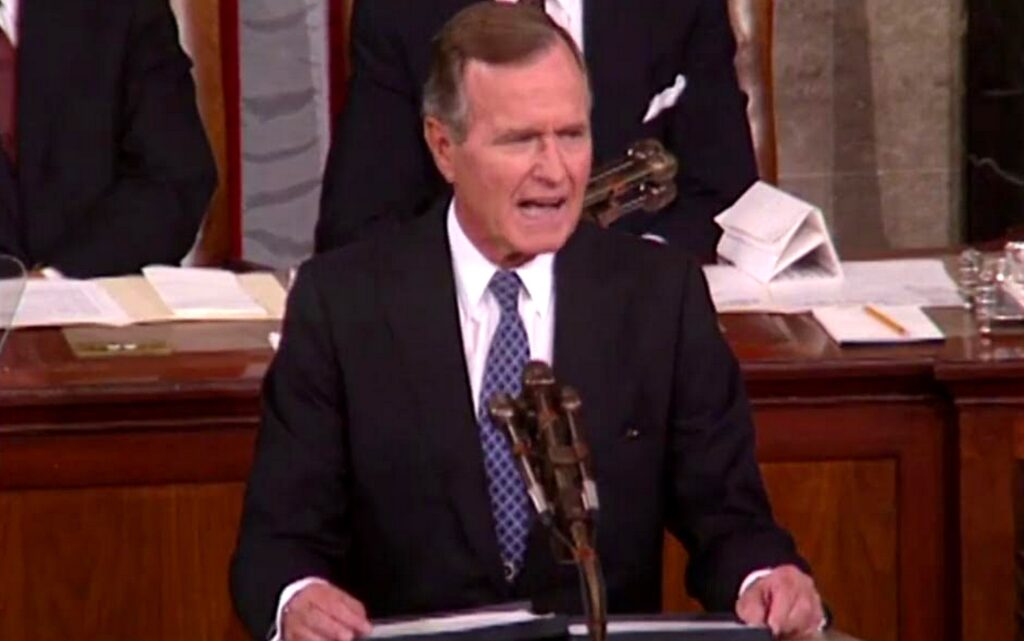
Today marks the 35th anniversary of George H.W. Bush’s address to Congress on September 11, 1990, a speech that introduced Americans to his vision of a “new world order”.
It’s worth reflecting on how this utopian promise has departed significantly from the turbulent reality of international politics.
Bush painted a picture of unprecedented global cooperation as he stood before Congress as Iraqi forces occupied Kuwait, declaring, “Today we stand at a unique and extraordinary moment”.
He envisioned a world in which the United Nations fulfilled its founding promise, aggression was met with a unified international response, and US leadership led humanity toward a more peaceful and prosperous future.
The new world order established by Bush represented the culmination of what might be called “hegemonic idealism”—the belief that American power, if properly wielded, could reshape the international order in the image of democracy.
The collapse of the Soviet Union seemed to have vindicated decades of containment, leaving the United States as history’s first truly global superpower.
What could be more natural than to exploit this unipolar moment to establish lasting peace?
The Gulf War itself seemed to validate this vision… A broad international coalition, operating under UN auspices, quickly expelled Iraqi forces from Kuwait with minimal American losses.
Multilateralism was powerful, backed by overwhelming American military superiority… The ghosts of Vietnam seemed finally to have been exorcised.
But this victory, like all others, carried within it the seeds of future disasters.
The ease of victory in the Gulf encouraged a dangerous arrogance regarding American capabilities and the flexibility of international politics.
If Saddam Hussein could be defeated so easily, why not apply the same formula elsewhere?
Why not expand NATO eastward, intervene in the Balkans, spread democracy in the Middle East, and contain rising powers?
After 35 years, the new world order appears more like a cautionary tale of imperial expansion than a triumph of American leadership.
The United States has fought wars in Somalia, Haiti, Bosnia, Kosovo, Afghanistan, Iraq, Libya, and Syria, and the outcomes have often been more chaotic than the surgical precision of Operation Desert Storm.
Each intervention has generated new liabilities, new enemies, and new complications that have required additional interventions to address.
Consider the trajectory from Bush’s limited victory in 1991 to his son’s disastrous invasion of Iraq in 2003.
The elder Bush’s new world order retained at least some connection to traditional superpower politics—forming genuine alliances, securing UN mandates, and maintaining limited objectives.
The younger Bush’s “Freedom Agenda” dispensed with these subtleties, embracing a messianic vision of American power that would have put Woodrow Wilson to shame.
The results speak for themselves: endless wars, trillions of dollars in debt, hundreds of thousands of casualties, and a Middle East far less stable than it was in 1990.
Meanwhile, the expected benefits—the spread of democracy, the strengthening of international law, the end of nuclear proliferation, and the obsolescence of great-power competition—have proven largely illusory.
Perhaps what has most damaged the credibility of the new world order is the return of traditional geopolitical competition.
The emergence of economic and military rivals challenging the global order that the United States has devised for decades, ignoring the fact that these countries won’t passively accept US supremacy and that this order is not a sustainable solution in light of the rise of these competing powers capable of effectively challenging them.
The failure of the new world order also reflects internal American realities that Bush either ignored or misunderstood: Maintaining global hegemony requires enormous resources and popular commitment.
Although the American people supported the Gulf War because of its clear objectives, broad international support, and minimal costs, they showed far less enthusiasm for open nation-building projects or for confronting any authoritarian regime on earth.
This disconnect between elite aspirations and popular preferences has contributed to the rise of populist movements questioning America’s global role.
From Pat Buchanan’s isolationism in the 1990s to Donald Trump’s “America First” agenda, large segments of the American electorate have rejected the principles of the new world order.
They logically question why American blood and treasure are being spent policing the world while domestic problems are left unaddressed.
As we mark the 35th anniversary of Bush’s speech, policymakers might reflect on what went wrong and how to reset American foreign policy for the 21st century. Several lessons stand out:
First, unipolarity was always temporary. Rather than trying to maintain American supremacy indefinitely, Washington should have used the 1990s to establish a more stable multipolar order—one that grants other powers legitimate roles while preserving core American interests.
Second, military force has limited utility in achieving political transformation.
The Gulf War succeeded because its goals were modest: expelling Iraq from Kuwait and deterring further aggression.
Subsequent interventions, however, failed because they pursued far more ambitious objectives that military force alone could not achieve.
Third, popular support for foreign policy requires tangible benefits for ordinary Americans.
Internationalism that enriches defense corporations and foreign policy elites while at the expense of US citizens is politically unsustainable in a democracy.
Instead of mourning the demise of the new world order, Americans might adopt a more humble and sustainable approach to international affairs.
This includes defending vital interests rather than attempting to solve every global problem, working with allies as true partners rather than subordinates, and recognizing that other powers have legitimate security concerns that deserve respect.
This approach won’t abandon US leadership, but will exercise it more wisely.
It will focus on core objectives, such as protecting the homeland, maintaining alliance relations, and ensuring economic prosperity, while avoiding illusory crusades.
We must now become more aware and formulate foreign policies that are appropriate to a world in which American influence is significant, but with respect for other powers and with the well-being of the American people in mind.
The new world order is over, and a more realistic and sustainable American role in the world has begun.