The US claims responsibility and threatens further attacks after an air raid against Iran
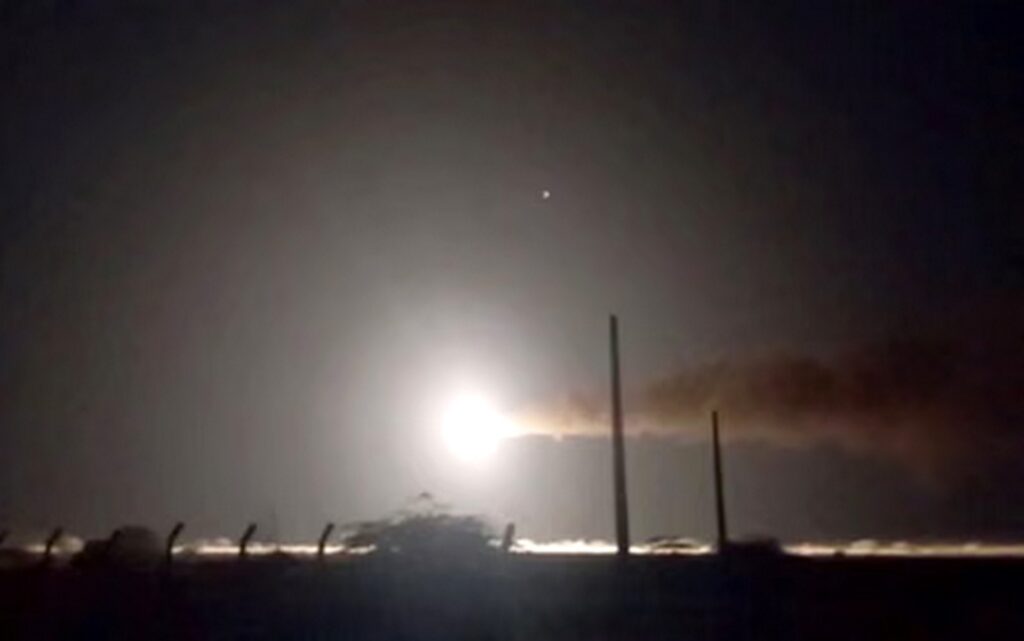
Iranian media reported on Thursday evening hearing successive explosions in the city of Bandar Abbas and Qeshm Island in the south of the country, near the Strait of Hormuz.
Washington acknowledged launching what it described as defensive strikes, and a US official stated that his country carried out military strikes on the two locations.
While an Iranian military spokesman, speaking to the semi-official local news agency Tasnim, accused Washington of violating the ceasefire and threatened retaliation, Israeli officials denied Israel’s connection to the explosions.
These developments began when Tasnim quoted local sources as saying that successive explosions were heard in Qeshm Island and Bandar Abbas, as part of these sounds resulted from operations carried out by the Iranian Revolutionary Guard’s naval force to issue warnings to ships that attempted unauthorized passage through the Strait of Hormuz.
For its part, Iranian state television announced that the explosion on Qeshm Island occurred at the Bahman pier.
An unnamed military official was quoted as saying: “Following the attack by US forces on an Iranian oil tanker, hostile units in the Strait of Hormuz region were subjected to Iranian missile fire… After suffering losses, they were forced to flee”.
For its part, the semi-official Fars News Agency reported an exchange of fire between the Iranian army and hostile elements on Qeshm Island.
Tasnim News Agency returned and reported that the city of Bandar Abbas was attacked by two drones without specifying their identity, and that Iranian air defense systems destroyed them.
It quoted an unnamed spokesman for the Khatam al Anbiya Central Headquarters as saying that the US military violated the ceasefire by targeting an Iranian oil tanker that was heading from Iranian coastal waters towards the Strait of Hormuz, in addition to another ship that was entering the Strait of Hormuz opposite the port of Fujairah in the UAE.
The spokesman added that the United States launched airstrikes on civilian areas on the coasts of the ports of Khmer, Sirik and Qeshm Island, in cooperation with some countries in the region”.
He added that the Iranian armed forces responded immediately by attacking US military vessels east of the Strait of Hormuz and south of the port of Chabahar, claiming to have inflicted serious damage on them.
The spokesman said, “The United States and its allies should know that Iran will respond forcefully and without the slightest hesitation with a crushing response to any aggression”.
The agency also quoted sources it described as well-informed, saying that the Iranian navy targeted three US destroyers near the Strait of Hormuz with missiles and drones, damaging some of them, according to its claim.
The sources stated that the US destroyers withdrew towards the Sea of Oman, while an Iranian military source spoke of the continued targeting of US naval vessels in the region.
Meanwhile, the US Central Command (CENTCOM), in its first official comment from the United States, said that its forces intercepted Iranian attacks that it deemed unjustified, stressing that it responded with defensive strikes.
CENTCOM added in its account on X that Iran launched missiles, drones and boats towards US warships, confirming the safety of all US assets and that no destroyer was directly hit.
CENTCOM said the Iranian attacks occurred as guided-missile destroyers were crossing the Strait of Hormuz into the Strait of Oman.
CENTCOM added that its forces had launched precision strikes against Iranian military installations, command and control sites, and reconnaissance centers.
In the same context, Fox News quoted a US official as saying that the United States had carried out strikes on the Iranian port of Qeshm and the city of Bandar Abbas.
On Wednesday, US President Donald Trump announced a temporary suspension of Project Freedom, which he launched on Monday, aimed at removing ships of neutral countries stranded in the Strait of Hormuz, claiming significant progress has been made toward reaching a comprehensive agreement with Iran.
In early March, Tehran closed the Strait of Hormuz in response to the war waged against it by Israel and the United States, in a move that observers considered an attempt to raise the cost of the confrontation regionally and globally, which led to disruptions in food supplies and a rise in energy costs globally.
The Strait of Hormuz is one of the most vital arteries for energy transport globally, with about 20 million barrels of oil passing through it daily, in addition to about 20% of the world’s liquefied natural gas trade.
The United States and Israel launched a war against Iran on February 28, before Tehran responded with attacks on Israel and against what it called “US sites and interests” in the region.
Washington and Tehran later announced, on April 8, a temporary truce mediated by Pakistan.
Following the failure of the first round of negotiations between the two sides in Pakistan, Trump announced on April 13th a blockade on Iranian ports and on any ship passing through the Strait of Hormuz without permission from Tehran.