Kommersant: A surprising request made by the Syrian government to Moscow that could change the current situation for Israel in southern Syria
The Russian Kommersant newspaper reported, citing informed sources, that the Syrian government has expressed an official desire to resume Russian military police patrols in the south of the country, in an attempt to contain the growing Israeli influence in those areas since late 2024.
According to the Russian newspaper, this move by Damascus comes as part of an effort to undermine Israeli military intervention, particularly after Israel announced the establishment of a “buffer zone” within southern Syrian territory, under the pretext of protecting its northern border and ensuring the security of the Druze community residing there.
A source who attended Syrian Foreign Minister Asaad al Shaibani’s meeting with members of the Syrian community in Moscow in early August told Kommersant newspaper that Damascus views the return of Russian forces to their previous positions as an effective means of preventing Israel from expanding its interference in Syria’s internal affairs.
The source also indicated that Moscow could play a pivotal role in regulating relations between the new Syrian government and Israel.
The Kommersant newspaper notes that the recent political changes in Damascus, including the assumption of the presidency by Ahmed al Sharaa, coincided with Israeli military movements in southern Syria, where the occupation forces have taken control of parts of the area, prompting Russia to temporarily reduce its military presence there.
On July 31, Syrian Foreign Minister Asaad al Shaibani visited Moscow, heading an official delegation.
He was later followed by Defense Minister Murhaf Abu Qasra, who held extensive security meetings with his Russian counterpart, Andrei Belousov.
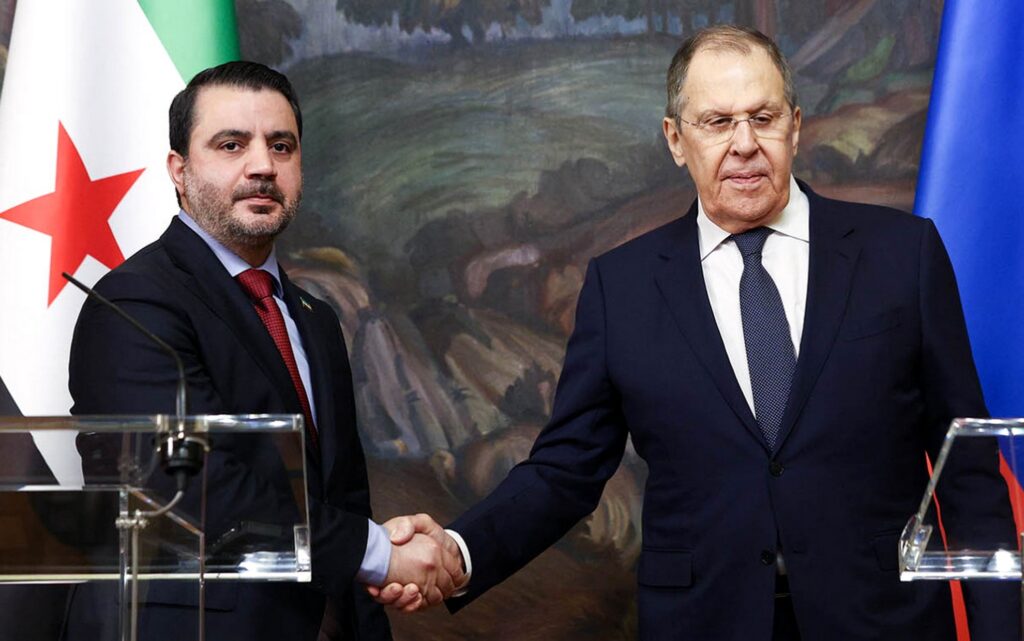
From his part, al Shaibani also met with his Russian counterpart, Sergei Lavrov, before being received by Russian President Vladimir Putin at the Kremlin.
During the meeting, the two sides affirmed a new phase of the strategic partnership between Damascus and Moscow, based on respect for Syrian sovereignty, support for territorial integrity, and rejection of any foreign interference, particularly by Israel.
In related issue, the Russian forces have begun a series of steps over the past few weeks to strengthen their military presence at Qamishli Airport in northeastern Syria.
These steps include rehabilitating and extending the airport’s infrastructure and expanding the locations where Russian soldiers and officers are stationed.
The Russian moves included expanding the accommodation points for its personnel near the airport’s main building, fortifying aircraft and radar positions by erecting earthen berms and expanding the main gate.
The Russian flag was also raised over the airport’s main building, with new fortifications, including the new location of the Russian military radar and a number of helicopters were placed.
In this regard, two Russian military cargo planes operate regular flights between Qamishli Airport and Hmeimim Air Base in the Latakia countryside, usually during the night or dawn hours, to minimize media exposure and reduce the possibility of detection.
Although the number of Russian forces in Qamishli has decreased over the past few years, particularly after the Syrian regime’s control waned, Moscow has repositioned its forces in the area for about a month.
The estimated the number of Russian soldiers currently at the airport is around 200 personnel.
Russia had closed one of the sites previously designated for the accommodation of senior Russian officers, relocating them to a more fortified point in front of the airport entrance.
In addition, military vehicles had been redeployed within the Russian base, away from exposed areas.
Russia still maintains three military helicopters and a continuously operating radar at Qamishli Airport, along with cargo planes transporting equipment and soldiers on an almost daily basis.
In a significant development, Russian forces conducted a joint patrol with the Syria Democratic Forces (SDF) in the eastern countryside of Qamishli about a week ago, as this was the first such patrol in years.
In a related development, Russian Deputy Foreign Minister Sergei Vershinin said in a statement on July 31, that consultations between Moscow and Damascus regarding the future of Russian military bases in Syria are still ongoing.
He added that these bases contribute to stabilizing the situation on the ground and represent an important element in protecting Russian citizens and facilitating the delivery of humanitarian aid to civilians in Syria.