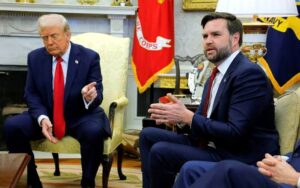
Who is J.D. Vance Trump’s vice-president nominee?

Eight years ago, in the run-up to the 2016 presidential election, J.D. Vance was a fierce critic of Republican candidate Donald Trump.
He publicly called him a fool and said he was reprehensible, moreover in his private sessions, he compared Trump to Adolf Hitler!
However, by the time the former president chose him as his running mate on Monday, Vance, who hails from Ohio, had become one of Trump’s most ardent defenders, standing by him even when other prominent Republicans rejected it.
James David Vance has gone from being a self-described “never in favor of Trump” to a strong supporter.
This makes him a relatively unusual figure in Trump’s inner circle.
Democrats and even some Republicans questioned whether opportunism rather than ideological orientation motivated Vance, who wrote a best-selling memoir titled “The Elegy of Hillbilly” (Hillbilly means a resident of the poor mountainous rural areas of the United States) and is now a US senator from Ohio.
But Trump, who survived an assassination attempt at a campaign rally in Pennsylvania on Saturday, and many of his advisers see Vance’s shift as honest.
They point out that Vance’s political beliefs, which blend isolationism and economic populism, are consistent with Trump’s and put the two men at odds with the old Republican Guard, where foreign policy hawks and free-market missionaries still wield.
Republican Senator John Barrasso of Wyoming, whom Vance described as his mentor, said that Vance changed his views on Trump because he saw the successes Trump had as president.
Vance’s declared opposition to US aid to Ukraine has also been warmed by Trump’s ultraconservative Russia, even as it has upset some of his Senate colleagues.
Conservative commentator Tucker Carlson, a staunch supporter of Vance, said that he understands and agrees with what Trump is running for, unlike the rest of the Republican Party in Washington.
Vance, 39, was born into a poor family in southern Ohio.
His choice could help bolster Trump’s campaign position in Ohio’s Rust Belt region in a race that will be decided by voters in a few crucial states, including neighboring Pennsylvania and Michigan, though his conservative views may alienate moderate voters.
David Niven, an assistant policy professor at the University of Cincinnati who wrote speeches by two Democratic governors, said, “How supportive he is on the Republican presidential ticket (until winning) will be the restoration of being the voice of the American dream,” referring to Vance’s rise from poverty to the U.S. senator and his running vice president.
After serving in the Marines, attending Yale Law School and working as a venture capitalist in San Francisco, Vance rose to the federal level with his 2016 book The Hillbilly.
In this memoir, he explored the social and economic problems facing his hometown and attempted to explain Trump’s popularity among poor white Americans to readers.
Vance has harshly criticized Trump, both publicly and privately, in 2016 and during the early stages of his 2017-2021 term.
He wrote to a colleague on Facebook in 2016, “I oscillate between thinking that Trump is as malicious as Nixon who may not have been that bad, and maybe he could have proven useful, and that he is America’s Hitler!”
In 2022, when his comment comparing Trump to Hitler was first reported, his spokesman did not refute it, but said he no longer represented Vance’s views.
When Vance ran for the Senate in 2022, his support for Trump, which included downplaying the attack on the Capitol by supporters of the former president, on January 6, January, 2021, resulted in Trump’s support in return, which helped put him on top in a competitive primary.
In media interviews, Vance said there was no moment of revelation that changed his view of Trump.
Instead, he gradually realized that his opposition to the former president was mainly caused by style rather than substance.
For example, he agreed with Trump’s claims that free trade has undermined the US middle class by crushing domestic manufacturing and that the country’s leaders are very quick to get involved in foreign wars.
Vance told the New York Times in June, “I allowed myself to focus so much on Trump’s style that I largely ignored the way he was presenting something very different in terms of foreign policy, trade, immigration”.
In the same interview, Vance said he met with Trump in 2021 and that… The two converged during his Senate campaign.
Vance declined to be interviewed by Reuters for the report and his spokesman declined to comment.
Critics of the Ohio senator see his shift in views as a cunning ploy to rise through Republican politics.
Niven, a professor of politics, said, “What you see is some of a really profound opportunism”.