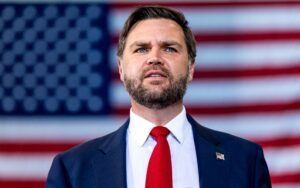
Washington Post: Under Trump… America has become like the totalitarian regimes with is pictures on buildings!
Most of the buildings in the Federal Triangle complex dating back to the Great Depression era are of erratic architecture.
The Federal Trade Commission building, known as the Apex Building, is a right-angled triangle with its sharpest angles rotated.
The Ronald Reagan Building, added in 1998, looks a bit like a short, full cleaver.
The Justice Department building, named after assassinated senator, former secretary of state, attorney general and presidential candidate Robert F. Kennedy, is a quadrilateral with beveled corners.
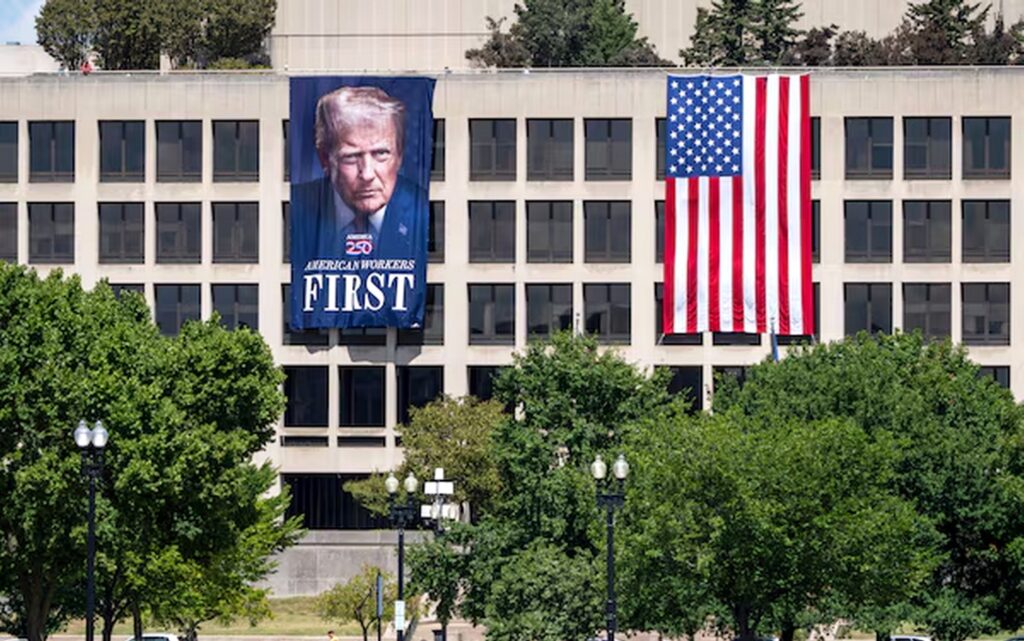
On one of these short, slanted faces of the building’s façade overlooking Pennsylvania Avenue, the Justice Department hung a tall blue-gray banner with a huge portrait of President Donald Trump.
The Justice Department, which has traditionally operated independently of direct political or presidential control, now joins the Departments of Agriculture and Labor as the site of large-scale photographs of the forty-seventh president.
The sign, installed on Thursday, hangs between two ionic columns that define a large balcony-like space above a ceremonial entrance to the building.
The building’s angular tilt makes this narrow façade unusually visible along Pennsylvania Avenue, the nation’s capital’s most important symbolic hub that connects the US Capitol to the White House.
This is the path taken by presidential inauguration processions, grand marches, protests, and displays of state power, including the grand parade of armies in 1865 after the victory in the Civil War.
A filmmaker seeking to portray a dystopian vision of American authoritarian fascism will find almost no better location to organize a discourse or rally led by the “great leader”.
The place looks like an Evita balcony, a raised balcony under an enclosed space with long vertical lines that focus attention heavily on the sign and the president’s face.
The building’s pedigree, the color of the stone, and the abstract classicism of its architecture could be a good alternative to the famous 1989 speech of the Romanian tyrant Nicolae Ceausescu, when he shamelessly lied to his people for the last time before being met with condemnation, ousted and summarily executed a few days later by an improvised court.
The sign, by its position and composition, indicates a culture of observation.
By positioning it to ensure maximum visibility, the Justice Department has orchestrated the image to suggest maximum oversight or control over the city and, more broadly, the people and the country as a whole.
The blue-gray color scheme makes the main appear as a shadow presence, or permanent presence, in contrast to the sunlight associated with the core democratic values of transparency, openness, and enlightenment.
This shadow has progressed at a shocking pace over the past thirteen months.
The president, whose business model is more about the brand than on building or development, has put his image not only on buildings, but also on seasonal permits for the National Park Service, and on coin designs that may soon be issued (although there is a law prohibiting it) from the US Treasury Department.
His name has now been effectively added to the John F. Kennedy Center for the Performing Arts (a memorial to the 35th president) and the US Institute of Peace.
The new sign on the Robert F. Kennedy Justice Department Building enshrines, in its symbolism, what already exists in practice: the president has repurposed the agency into an instrument of personal political vendetta and partisan vendetta.
As with many developments over the past year, as the country slides deeper into a new era of authoritarianism, it all has a dark comic element that evokes a mix of complex emotions.
A year ago, this would have seemed absurd; now, absorbing that absurdity seems like a forced act meant to distract the mind and numb the conscience.
Democracies don’t celebrate their patriotic leaders in such an outright glorified way; As the mind moves from laughter to anger and then to a reluctant acknowledgment of a new reality, the world of shadows, the world of control, surveillance, and uncertainty, becomes more and more entrenched.
The first time I visited a country where images of a tyrannical leader were ubiquitous was in 2004, when I spent a week in the Syrian police state run by Bashar al Assad; He was a tall, shaved man with no obvious chin.
His portrait was often displayed alongside that of his father, Hafez al Assad, who looked like a low-level bureaucrat with a bad hairstyle.
They were ugly men, outwardly and inwardly, thugs and brutals; Their overwhelming presence on the sides of buildings, on the banners on lampposts, and on the walls of every office, no matter how marginal, made their ugliness seem like part of the weather.
You would adapt to it, complain about it (subtly and routinely), and joke about it (tired old jokes that act as dating signs).
If you’re Syrian, you’ll always take a quick look at the shadowy spaces before you give your hollow compliments to the two lions.
Those banners have been removed, as have Ceausescu’s pictures, along with the images of countless tyrants who are remembered or forgotten in the pages of history.
The hanging of these pictures almost sounds like a “Chekhov’s gun” that dramatic and narrative rule that “if you say in the first act that there’s a gun hanging on the wall, in the second or third act it must be fired”.
When you place these kinds of images in democratic spaces, spaces untouched by the shadows of monochromatic absolute power, you are setting the stage for the final chapter, when its inevitably gone.
We’re in the first chapter, and the third chapter will follow.
What is troubling are the untold events of the second chapter.