The US Congress moves to punish Damascus after the Sweida events!

As bloody events escalate in the southern Syrian province of Sweida, informed diplomatic sources revealed that relations between Damascus and Washington are facing a sharp turn, in light of a new move within the US Congress that threatens to reimpose and tighten sanctions on the Syrian government.
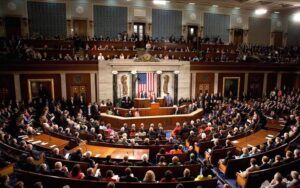
According to what Western sources based in Washington, the US House Financial Services Committee is currently discussing a new bill that would extend the “Caesar Act” sanctions for up to three additional years, imposing stricter conditions on the current Syrian leadership.
The bill, introduced by Republican Representative Mike Lawler and co-sponsored by French Hill and Brian Mast, not only extends the timeframe, but also includes new provisions that could have a profound impact on the Syrian situation.
The prominent among these provisions are:
- Dismantling Captagon production networks and holding those involved accountable
- Ensuring effective protection for religious and ethnic minorities within Syria
The US source explained that the proposed law is based on executive orders previously issued by US President Donald Trump, which allow the US government to target individuals involved in human rights violations or drug trafficking, without the need for collective punishments affecting the general population.
This move comes as US envoy to Syria Thomas Barrack publicly expressed his objection to the continuation of the Caesar Act, arguing that it has caused grave humanitarian and geopolitical damage to the Syrian people.
Barrack believes that this new bill contradicts the current policy of the US administration led by Trump, which is leaning toward gradual openness toward Damascus.
Meanwhile, there are growing voices within Congress calling for a tougher US stance, especially after the alleged massacres that occurred during the Sweida clashes.
The most prominent of these voices is Representative Abraham J. Hamadeh, of Syrian Druze origin, who called on Trump to pressure the Syrian government to ensure the protection of civilians and halt sectarian violence.
In light of these developments, the Syrian community in the United States has begun taking concrete steps, forming a lobbying delegation comprising prominent figures from Syrian-American civil society organizations.
This delegation aims to engage with members of Congress and explain the risks of passing the new law, particularly for the Syrian economy and the future of stability and reform.
The source stated, “The battles on the ground in Sweida are tragic, but the greatest danger today is the political silence in the halls of Congress, which could perpetuate a long-term economic suffocation that hinders any chance of reconstruction or improving the lives of Syrians”.
In a related context, US Secretary of State Marco Rubio expressed his deep concern over what he described as “the ongoing atrocities in southern Syria,” calling on Damascus to immediately halt the violations, hold those responsible accountable, and halt the fighting between Druze factions and Bedouin tribes.
For his part, Tom Barrack reiterated his position that Syria stands at a historic crossroads, stressing that “the opportunity for peace still exists, but it is threatened by brutal acts that undermine state authority and obstruct any reform efforts”.
Observers point out that mounting pressure within Congress, coinciding with the massacres in Sweida, could lead to the end of the “political honeymoon” between the Trump administration and the new Syrian government, especially since the bill scheduled for a vote next Wednesday could return relations to a state of tension and estrangement.
Earlier, US Special Envoy to Syria Thomas Barrack expressed deep concern and deep sympathy over recent developments in the southern Syrian province of Sweida, stressing the need to hold the Syrian government accountable for what he described as “tragic events that cannot be ignored”.
During a press conference held Monday in the Lebanese capital, Beirut, Barrack said that the United States is dealing with the situation in Sweida with “an unprecedented degree of concern, pain, and assistance,” stressing that Washington is closely monitoring the humanitarian and security situation there.
He added, “What Syria has witnessed in recent days has been horrific by all standards, but it could provide an opportunity to advance efforts to unify ranks and address outstanding issues, if invested responsibly”.
Barrack also emphasized the importance of integrating minorities into future government institutions, calling for the development of an inclusive governance model.
He emphasized the need for communication and coordination with neighboring countries, especially Israel, given its importance in ensuring regional stability.
Despite his call for accountability for the Syrian government, Barrack made it clear that the regime in Damascus must also assume its responsibilities towards its citizens and work to achieve internal stability.
He also pointed to the weak coordination and communication among the components of Syrian society, which further complicates the crisis.
Barrack’s remarks coincide with the entry into force of a ceasefire agreement in Sweida province, which was officially announced Sunday evening.
This agreement follows a week of violent clashes between armed Druze factions and militants from Bedouin tribes, resulting in hundreds of deaths and injuries.
Despite the truce, the situation in Sweida remains tense and cautiously calm, amid international calls for a permanent ceasefire and the start of a comprehensive dialogue involving all components of Syrian society.