The Russian army acknowledges the advance of Ukrainian forces in Kursk… Zelenskyy challenges Moscow and Russia is preparing to huge respond
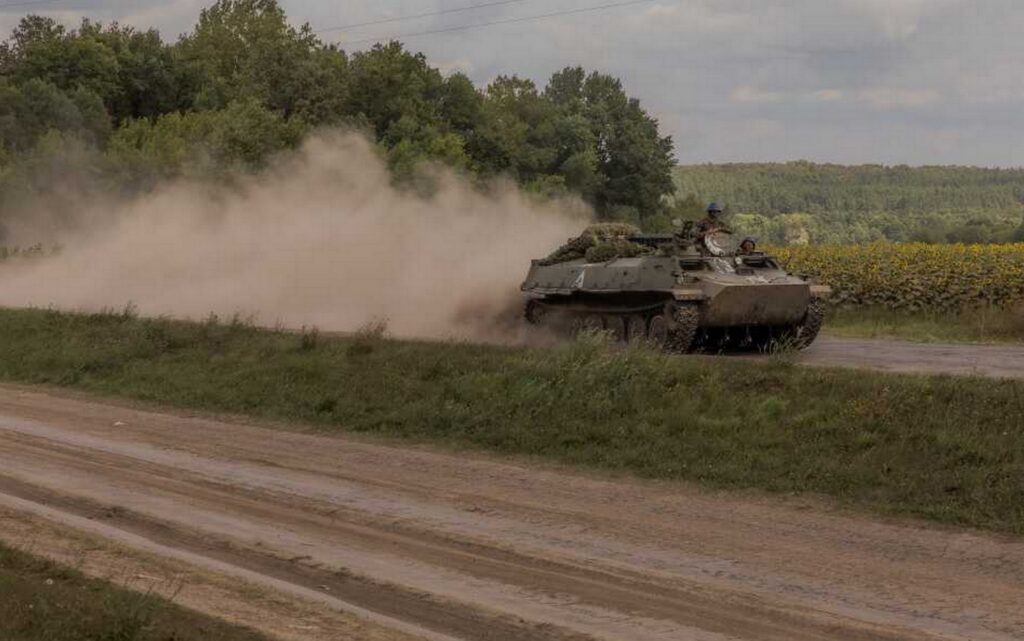
Russia acknowledged Sunday that Ukrainian forces had advanced deep into the Kursk border region, in an attack that a senior Ukrainian official said was aimed at destabilizing Russia and dispersing its armed forces.
The two countries have traded blame for a fire that broke out at the Zaporizhia nuclear power plant in southern Ukraine, which is occupied by Russian forces. But both sides and the International Atomic Energy Agency have indicated that there is no risk of a nuclear radiation leak.
The fire that broke out at the station on Sunday evening has been extinguished, Vladimir Rogov, the Russian-appointed official in the Zaporizhia region, announced on Monday.
After months of retreat on the eastern front, Ukraine launched an unprecedented large-scale operation on Tuesday in the Russian border region of Kursk, allowing its forces to penetrate, according to analysts, to a depth of at least 15 kilometers and take control of several sites.
“We’re on the offensive,” said the Ukrainian security official, who preferred to remain anonymous.
“The goal is to disperse the enemy’s positions, inflict maximum losses, and destabilize the situation in Russia, because they are unable to protect their borders, and to transfer the war to Russian territory”.
For its part, the Russian Defense Ministry announced on Telegram that on Sunday night, Russian forces destroyed 18 Ukrainian drones in three regions in western Russia (Kursk, Belgorod, and Voronezh).
The Russian Defense Ministry had previously announced that it had thwarted attempts by Ukrainian soldiers to use armored vehicles to achieve a penetration deep into Russian territory, while an immediate evacuation order was issued for the Belgorod region due to the Ukrainian incursion and heavy shelling.
However, Russian Defense Ministry indicated that some of these forces are stationed near the villages of Tolbino and Opshi Kolodz, 25 and 30 kilometers from the Russian-Ukrainian border.
The Russian military announced on Wednesday that Ukraine had sent 1,000 soldiers to take part in the incursion that caught the Kremlin by surprise.
“There are more than that,” the Ukrainian official commented, estimating their number at thousands.
After days of relatively low-key comment from Ukrainian authorities, President Volodymyr Zelenskyy addressed the operation for the first time in his daily address on Saturday evening, saying that Kyiv was seeking to take the war to Russia.
Overnight, Zelenskyy blamed Russia for the fire that broke out in a cooling tower at the Zaporizhia station, while Russia said the fire was caused by Ukrainian shelling.
“Russian invaders set fire” to the station, Zelenskyy said in a post on a social media platform, accusing them of trying to blackmail Kyiv.
On Sunday, the International Atomic Energy Agency, which has monitors at the plant, announced that no damage to nuclear safety has been reported.
No increase in radiation levels has been detected, according to Kiev and Moscow.
Russia launched an attack on Ukraine in February 2022, occupying large areas in the east and south of the country and targeting Ukrainian cities with daily artillery and air strikes.
After regaining control of large areas in 2022, Ukrainian momentum weakened significantly and Kiev suffered from a shortage of troops and military supplies.
The attack on Kursk was considered the largest and most successful cross-border operation carried out by Kiev to date, and the largest attack by a foreign army on Russian territory since World War II.
Russia announced on Saturday the evacuation of more than 76,000 people living in the incursion area, while more left on Sunday.
Russian Railways has run emergency trains from Kursk to Moscow, a distance of 450 kilometers, for people who want to flee.
Russian officials said a Ukrainian missile strike on a residential building in the city of Kursk, about 80 kilometers from the fighting, wounded 15 people.
The regional governor, Alexei Smirnov, acknowledged on Sunday that the situation was difficult, explaining that he had held talks with officials in the Ministry of Defense.
For his part, the leader of the Chechen Republic, Ramzan Kadyrov, announced that an army unit comprising Chechen fighters had been deployed in the Kursk region, noting that Chechen soldiers are considered among the most steadfast and experienced in the country.
Across the border in Ukraine’s Sumy region, from where Kiev launched the incursion, AFP reporters on Sunday saw dozens of armored vehicles bearing the white triangle that appears to be the mark identifying Ukrainian military equipment used in the operation.
The Sumy region has also been subjected to retaliatory shelling.
Authorities there are planning to evacuate at least 20,000 civilians from the border area opposite the Kursk region.
Analysts suggested that Kiev launched the attack in an attempt to relieve pressure on its forces in other parts of the front line.
However, the Ukrainian official said the impact on the fighting in eastern Ukraine had been limited so far.
“In principle, the situation hasn’t changed… Their pressure in the east continues, they aren’t withdrawing their forces from this region,” he said, although “the pace of Russian attacks in the east has slowed down somewhat”.
Russia has declared a state of emergency in the Kursk region and an “anti-terrorist operation” in the region and two other border areas.
The Ukrainian official indicated that sooner or later, Russia will repel Ukrainian forces in the Kursk region, stressing that Ukraine is preparing for a Russian retaliatory attack through large-scale missile attacks, including on the decision-making center in Ukraine.