The Economist: A poll reveals Syrians’ opinions of Ahmed al Sharaa government
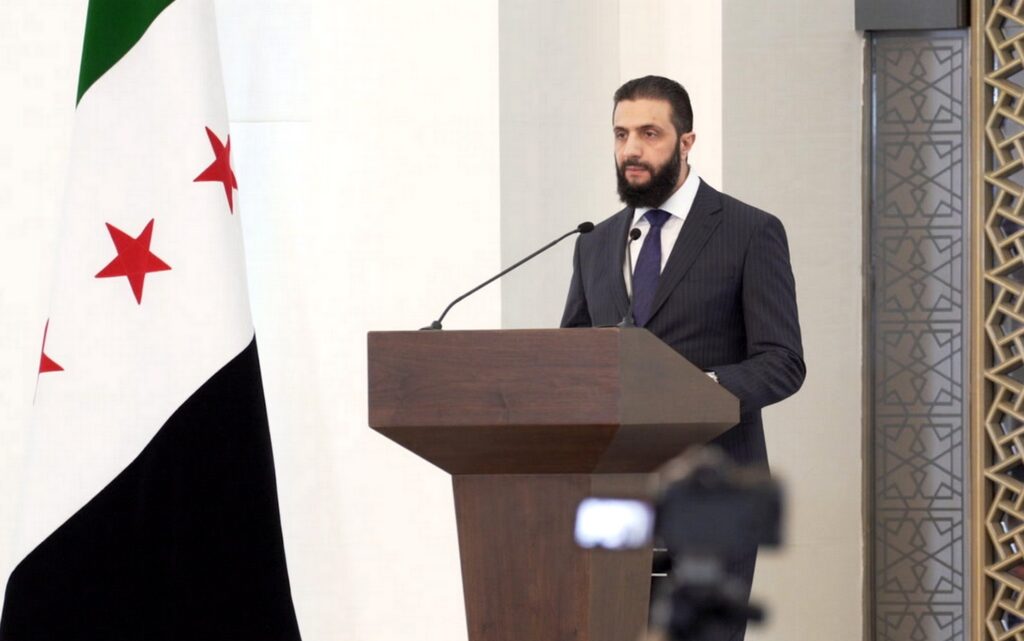
The Economist magazine, in an article titled “Surprisingly, Syrians remain optimistic… Our survey reveals both great optimism and significant sectarian divisions,” said that the coming months will determine whether the Syrian transitional President Ahmed al Sharaa’s government is truly pluralistic.
Despite the general optimism, one the other hand, non-Sunni and non-Arab minorities are concerned about his jihadist past and his tendency to monopolize power.
Last month, hundreds, perhaps many more, were killed in sectarian violence in the coastal region, and currently both Druze and the Kurds don’t recognize the new government.
However, the results of a poll conducted for the Economist magazine last March indicate that widespread optimism remains in Syria regarding Ahmed al Sharaa and his ability to rebuild the country.
The survey included 1,500 people from all governorates and sects, and showed that 81% of those surveyed agreed with Sharia law governing the country.
According to the poll result, 22% of whom who participants believe that al Sharaa’s jihadist past makes him unqualified to lead the country, while a large number of participants feel that the new regime is safer, freer, and less sectarian than the Assad’s regime.
Around 70% of participants feel optimistic about the general situation in the country, with Idlib Governorate (the former feudal state of Sharia, according to the Economist magazine) the most optimistic (99%), while Damascus and Tartous were the least optimistic (49% optimistic and 23% pessimistic).
The conditions for conducting the survey weren’t ideal, as the surveyors had to work in public places, and survey methods such as random contacts couldn’t be used to obtain a representative sample of Syrians.
Instead, they contacted people directly to obtain the opinions of men and women in each of the governorates.
In the coastal areas, they faced angry Sunni fighters, but the major urban areas, Damascus in particular, where skepticism and pessimism appear to be at their highest levels, were not adequately represented in the survey.
Survey participants strongly criticize Ahmed al Sharaa, particularly in the economic aspect, with 60% believing that economic conditions haven’t improved or have worsened under his tenure.
Most participants oppose the policy of integrating foreign fighters into the new army, and 60% believe they should be deported.
The survey reveals a deep divide between Sunnis and other minorities, with only 6% of Sunni respondents are pessimistic, compared to 40% among Alawites.
Meanwhile, Kurds, Druze, and Christians now feel poorer, less free, and less secure than Sunnis, with 90% of Sunni respondents favored the full or partial re-implementation of Sharia law, while only 7% favored a fully secular system, and 80% of Druze and Christians and 73% of Kurds participating in the survey prefer a secular system in the country.
The survey shows that support for the implementation of Sharia law is lower among women than men, with 29% of female respondents supporting it (40% of men), while 75% of respondents support women’s equal rights with men.
Finally, regarding Israel and the recent events, the survey showed that Syrians don’t want to fight, as according to the survey, with 66% prefer diplomatic means to deal with Israel, while only 10% prefer the military option.