Netanyahu warns Lebanon: It will witness destruction similar to what happened in Gaza
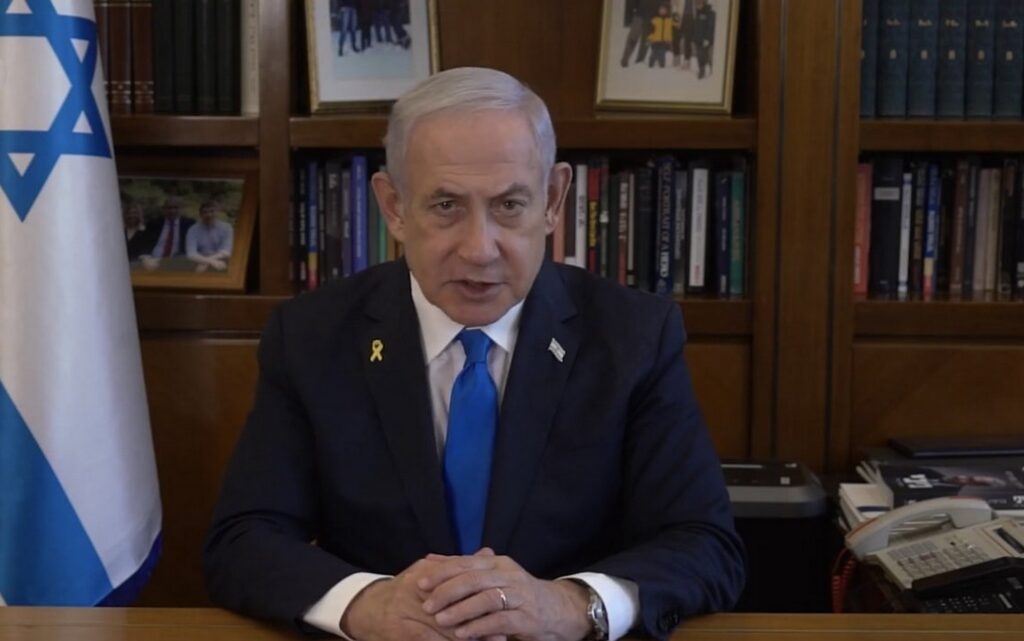
Israeli Prime Minister Benjamin Netanyahu warned the people of Lebanon on Tuesday that they would face “destruction and suffering” similar to that faced by Palestinians in the Gaza Strip if they didn’t “liberate” their country from Hezbollah, as Israel expanded its ground offensive against the group in southern Lebanon.
This comes a day after Netanyahu vowed to continue the fight until victory over Hezbollah and Hamas, backed by Iran, on the first anniversary of the Palestinian movement’s unprecedented attack on southern Israel on October 7, 2023, which sparked a war in Gaza that spread to Lebanon, raising fears of a large-scale regional conflict.
“I say to you, the people of Lebanon, free your country from Hezbollah so that this war can stop,” Netanyahu said in an English-language address to the Lebanese people.
“You’ve a chance to save Lebanon before it falls into the abyss of a long-term war that will lead to destruction and suffering similar to what we are witnessing in Gaza,” he added.
Netanyahu said that the Israeli forces eliminated thousands of terrorists, including Hassan Nasrallah, Nasrallah’s successor, and his successor’s successor, without mentioning any names.
Earlier, Israeli Defense Minister Yoav Galant said that Hezbollah had now become an exhausted and destroyed organization after the intensive Israeli strikes that targeted it.
Despite the blows suffered by Hamas and Hezbollah, the two organizations continue to launch rockets at Israel, which in turn intensifies its strikes in Lebanon and the Palestinian sector, especially in the north and center.
The Israeli military said Tuesday it had launched airstrikes targeting Hezbollah in areas of southwestern Lebanon.
On Monday, the 146th Division began limited and focused operations against Hezbollah targets and infrastructure in southwestern Lebanon, it said in a statement.
This division is the fourth that Israel has deployed since launching its ground offensive on September 30 in southern Lebanon, from which the Israeli army withdrew in 2000 after a 22-year occupation.
In the coastal city of Sidon, 40 kilometers south of Beirut, boats didn’t go out to sea at dawn on Tuesday to bring in fish, which is the source of livelihood for hundreds of families, after the Israeli army warned residents to stay away from the maritime area until further notice.
Israel continued to launch raids on southern and eastern Lebanon, as well as on the southern suburbs of Beirut, the three strongholds of Hezbollah.
Hezbollah announced on Tuesday that its fighters had confronted an Israeli force that had infiltrated behind a UNIFIL position inside a border town in southern Lebanon.
For his part, Hezbollah’s Deputy Secretary-General Naim Qassem confirmed Hezbollah’s ability to fight despite the intensive strikes launched by Israel over the past two weeks, and the assassination of a large number of its leaders, most notably its Secretary-General Hassan Nasrallah on September 27.
“I would like to reassure you that our capabilities are fine,” he said in a televised speech, noting that Hezbollah’s leadership is strictly organized despite the painful Israeli strikes”.
He explained, “I repeat what I said last time: the leadership, control, and management of the party and the resistance are organized precisely… We’ve overcome the painful blows,” adding that Hezbollah will complete the election of the Secretary-General according to the organizational mechanisms and we will announce that upon completion, despite the difficult circumstances.
After weakening Hamas, Israel shifted the weight of its operations to the northern front, and intensified its raids on Lebanon starting on September 23, targeting Hezbollah.
On September 30, it announced the start of “limited” ground operations against Hezbollah in southern Lebanon.
Israel seeks to remove Hezbollah fighters from the border areas and stop the firing of rockets towards its north to allow about 60,000 Israelis who fled the party’s rockets to return to their homes.
The spiral of cross-border violence that began a year ago between Israel and Hezbollah escalated into open war on September 23.
The Israeli army began bombing Hezbollah strongholds in southern and eastern Lebanon and the southern suburbs.
Since October 2023, more than 2,000 people have been killed in Lebanon, including more than 1,110 since September 23, with more than a million people have been displaced, according to the authorities.
Netanyahu called a number of ministers to hold security consultations later on Tuesday evening, to discuss an expected military operation against Iran.
According to Yedioth Ahronoth, Defense Minister Yoav Galant, who wasn’t invited to a security consultation held on Monday, was among those invited.
The official Israeli Broadcasting Authority wondered whether the security consultation tonight was related to an expected attack on Iran.
Israel Hayom newspaper said, “Prime Minister Netanyahu is holding a security discussion tonight at the Kirya (the headquarters of the Ministry of Defense in Tel Aviv) with the participation of senior security officials and a number of ministers”.
Israel Hayom pointed out that the security discussion will examine the Israeli response to Iran.
Netanyahu has been holding intensive consultations for several days regarding a strike he said he intends to launch against Iran, after the latter’s missile attack on Israel last Tuesday.
Last Tuesday, Israel announced that Iran had fired about 200 missiles at it, in an attack that Tehran said was revenge for the assassinations of Ismail Haniyeh, Hassan Nasrallah, and Revolutionary Guards commander Abbas Nilforoushan.
On Wednesday, the Israeli army admitted that the missile strike caused damage to its air bases.
Israel assassinated Hezbollah Secretary-General Hassan Nasrallah and others, including Nilforoushan, in an airstrike on Beirut’s southern suburbs on September 27.
Meanwhile, the head of the political bureau of Hamas, Ismail Haniyeh, was assassinated in a bombing of his residence during a visit to Tehran at the end of last July.
As for Gaza, the most areas at the strip were reduced to rubble and at least 41,965 Palestinians, most of them civilians, were killed.
The war in the Gaza Strip and Lebanon is accompanied by an escalation between Israel and Iran, with Israel confirming that it’s preparing to respond to an Iranian missile attack that targeted it on October 1.
Iranian Foreign Minister Abbas Araghchi warned on Tuesday, against the backdrop of fears of possible Israeli strikes targeting nuclear or oil sites in Iran, that any attack on Iranian infrastructure facilities will be met with a strong response.
Tehran said the October 1 attack was in response to the assassination of Hamas political bureau chief Ismail Haniyeh in Tehran on July 31 in an operation attributed to Israel, and of Hezbollah Secretary-General Hassan Nasrallah in an Israeli raid on September 27 that also killed an Iranian Revolutionary Guard official.