More than a million demonstrators took to the streets of Tel Aviv demanding a ceasefire in Gaza and the return of the hostages
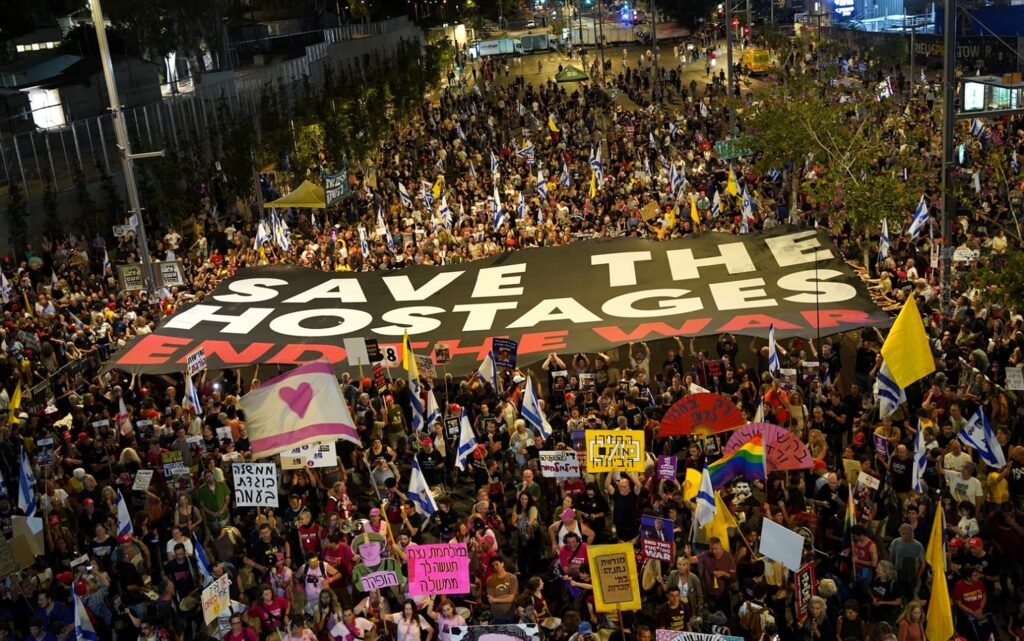
More than a million people took part in protests and events across Israel on Sunday, as part of a general strike called by the families of hostages and soldiers killed in the Gaza Strip to pressure the government to conclude a prisoner exchange deal with Hamas.
The Israeli hostages’ Families Authority stated in a statement that more than one million people participated in demonstrations, protests, and events held across Israel.
The statement came at the conclusion of a general strike that shut down vital facilities and major companies in protest against what the families described as “the authorities’ disregard for the suffering of the hostages and their families”.
The hostages’ families emphasized that the end of the activities at the ” Kidnapped Square” headquarters in Tel Aviv doesn’t mean the cessation of the movement against the government.
They stressed that she would continue to call for participation in any further events or demonstrations until the prisoners held by Hamas in the Gaza Strip were returned.
During the protests, demonstrators held up signs reading, “We’ll not let the government sacrifice the kidnapped,” according to them.
On August 10, the families of prisoners and Israeli soldiers killed in action announced at a press conference in Tel Aviv their intention to launch a comprehensive strike and bring life to a standstill on the 17th.
Channel 12 reported that large crowds participated in the central gathering for the return of prisoners in central Tel Aviv, noting that tens of thousands demonstrated to demand a prisoner exchange deal that would lead to the release of prisoners, even if it comes at the expense of a ceasefire in the Gaza Strip.
Major unions in Israel, including the Bar Association, the Doctors Association, and the Businessmen’s Forum, also participated in the general strike, along with various universities, including Ben-Gurion University in the Negev (south), the Open University in Tel Aviv, and the Hebrew University in West Jerusalem.
Hundreds of private companies, municipalities, and organizations across the country joined the strike, according to the commission.
The Israeli Haaretz newspaper reported that dozens of Israeli artists, celebrities, and athletes have announced their support for and participation in the strike.
Some local authorities, such as the Ramat Hanegev and Jezreel Valley councils, also joined the general strike, while the Ben Gurion Airport Workers Union allowed workers to join individually, warning of crowding and delays to the airport.
A wide range of major companies have joined the strike, including Microsoft, Meta, Wix, and Tnuva, according to Hebrew media.
In Tel Aviv, events began in the morning with marches and protests at the city’s entrances, followed by a march of doctors in white coats toward Kidnapped Persons Square, where the central march was held in the evening.
Several major roads and intersections, including Ra’anana, Shilat, Nachshon and Nahalal, were completely closed to traffic.
In some areas, protesters set fires on roads, causing significant traffic disruption.
Sporadic demonstrations were also held in Jerusalem, Haifa, and Beersheba, in addition to vehicle marches on main roads.
In the final hour of the general strike, demonstrators blocked many major roads and intersections across Israel to traffic, setting fire to tires on the roads in some places.
As part of the protests, violent clashes erupted between thousands of demonstrators and Israeli police outside the headquarters of Netanyahu’s Likud party in Tel Aviv.
The Israeli Maariv newspaper reported that a march of thousands of demonstrators set out from Hatufim (Hostages) Square toward the party headquarters, known as Ze’ev Fortress, despite police warnings not to approach the area.
The Calcalist newspaper reported that police attempted to prevent demonstrators from reaching the building, which led to violent clashes.
According to Channel 12, demonstrators set tires on fire on King George Street near the party headquarters, while police arrested four people.
Israeli President Isaac Herzog participated in the protests in Tel Aviv’s Kidnapped Square to express his solidarity with their families.
In a brief speech to the crowd, he said: “We’ll not forget the kidnapped and will do our utmost to bring them back”.
He called on the international community to pressure Hamas to release the kidnapped soldiers immediately.
Israeli opposition leader Yair Lapid also participated in the strike, posting a video on X of himself participating in a demonstration in Tel Aviv.
“We’re shutting down the state today because the government cannot sacrifice our prisoners in Gaza… They are citizens, and the government must return them to their families,” Lapid said in the video.
He added, “They won’t stop us, they won’t exhaust us, and they won’t make us despair,” concluding, “We’ll continue the struggle until the prisoners return to their homes… There will be a deal, the war will stop, and everyone who has a home will return to it”.
Yedioth Ahronoth newspaper reported that police “arrested 38 protesters across the country while participating in the general strike that began this morning”.
The newspaper explained that police “suppressed demonstrators in Jerusalem and Tel Aviv using water cannons after they attempted to block several streets, tunnels, and bridges”.
Police were quoted as saying that the protesters “blocked main roads, set tires on fire, and disrupted traffic”.
Israeli Prime Minister Benjamin Netanyahu attacked the strikes and demonstrations organized by the families of prisoners held in Gaza.
The official broadcasting authority quoted Netanyahu as saying at the start of the weekly cabinet meeting: “Those who are calling today to end the war without eliminating Hamas are not only strengthening its positions and preventing a deal to return our prisoners, but are also ensuring that the horrors of October 7 (2023) will return, and that we will find ourselves in an endless war”.
As extremist National Security Minister Itamar Ben-Gvir said in a post on X, the strike strengthens Hamas and distances the return of the prisoners.
Finance Minister Bezalel Smotrich said, “The people of Israel wake up this morning to a vicious and dangerous campaign orchestrated on behalf of Hamas, burying prisoners in tunnels”.
He explained in a post on X that the strike campaign “is trying to push the state to surrender to its enemies and endanger its security and future”.
Regarding the impact of the strike and demonstrations on Israel’s domestic scene, Channel 12 reported a significant decline in restaurant reservations and a moderate decline in credit card purchases, down 5.5% compared to last Sunday.
Channel 12 confirmed that many restaurants closed their doors on Sunday due to the strike day in Tel Aviv.
Meanwhile, the economic newspaper Calcalist reported that hundreds of thousands of Israelis took to the streets across the country to demand the return of the prisoners, raising the slogan: “Enough chaos”.
Calcalist noted that a series of intersections and roads across the country were closed throughout the day, impacting the Israeli economy.
Many transportation lines across the country, most notably trains, were also disrupted, causing heavy traffic jams.
The opposition and prisoners’ families accuse Netanyahu of sabotaging the prisoner exchange deal with Hamas for political reasons related to his refusal to dissolve his government coalition and his insistence on remaining in power.
Hamas has repeatedly declared its willingness to release Israeli prisoners “in one batch” in exchange for an end to the war of extermination, the withdrawal of the Israeli army from Gaza, and the release of Palestinian prisoners.