An unknown jihadist group claimed responsibility for the suicide attack on the church in Damascus
A little-known jihadist group claimed responsibility Tuesday for the suicide attack on St. Elias Church in Damascus, while authorities said the group was affiliated with the Islamic State group and that the perpetrator wasn’t Syrian.
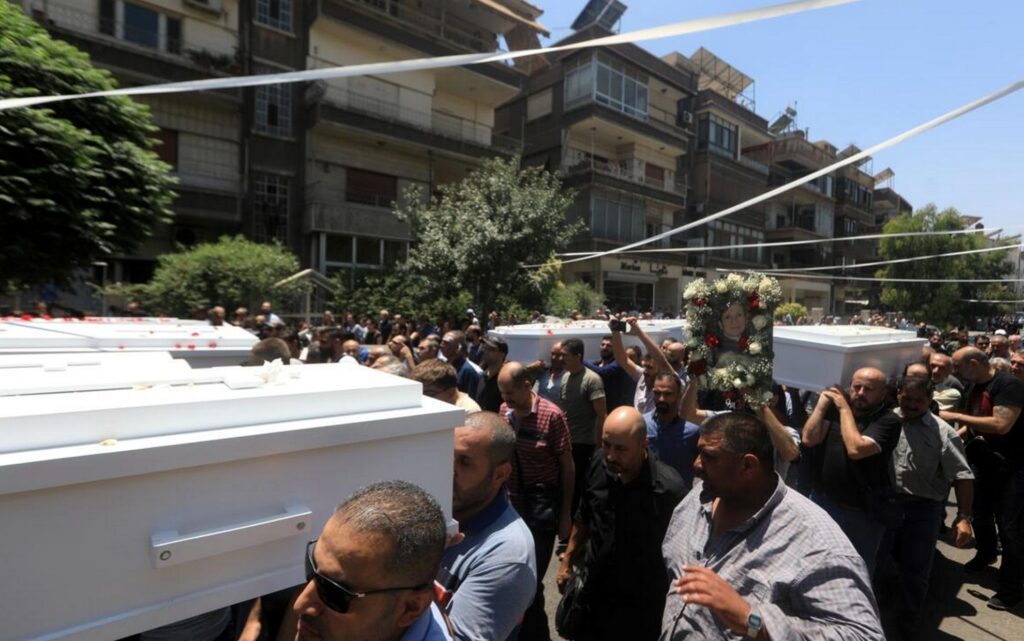
Funerals were held on Tuesday for several victims of the unprecedented attack on Sunday on the church in the Dwel’a neighborhood, which left 25 people dead and dozens injured.
The attack renewed concerns among minorities, whom the international community had repeatedly urged the new government to protect and include in the transitional phase.
In a statement on Telegram, Saraya Ansar al Sunna reported, “The martyred brother Muhammad Zain al Abidin Abu Othman… blew up Mar Elias Church”.
The statement said the operation came after provocation by Damascus Christians against the call and the people of the faith.
The group is led by a former leader of Hay’at Tahrir al Sham, the faction headed by Ahmed al Sharaa that spearheaded the offensive that ousted Assad.
Its leadership also includes a former member of the al Qaeda-linked Guardians of Religion organization, which announced its dissolution earlier this year.
During the funeral ceremony for the victims at the Church of the Holy Cross in Christian neighborhood in Damascus, Greek Orthodox Patriarch John X of Antioch and All the East described the attack as an “unacceptable massacre”.
Addressing the Syrian transitional president, he said, “Yesterday, you spoke by phone with the Patriarchal Vicar to convey your condolences… This isn’t enough for us”.
He added, “The government’s first duty is to ensure the safety of all citizens without exception or discrimination”.
He added, “We extended our hands to you to build a new Syria, and unfortunately, we are still waiting to see a hand extended to us”.
He explained that what happened was the first massacre in Syria since 1860, referring to the massacres of Christians that Damascus witnessed during Ottoman rule, adding, “We don’t accept that this should happen during the revolution and during your honorable era”.
To the sound of ululations and tears, nine white coffins made their way into the church, amid tight security measures, searches of the area, and closures of the roads leading to it.
The former Assad regime had long presented itself as a protector of minorities.
During the years of conflict since 2011, several churches were damaged or their surroundings were attacked, but none were directly targeted by suicide attacks.
In March, a clash broke out in front of St. Elias Church after residents objected to the parking of a missionary vehicle that was broadcasting Islamic songs over its loudspeaker, forcing its passengers to leave.
Minority concerns were exacerbated by sectarian violence in March that killed 1,700 people on the Syrian coast, the vast majority of them Alawites, followed by clashes with Druze militants near Damascus that left dozens of dead.