During his speech at the victory day parade… the Russian president praises the bravery of Russian soldiers in Ukraine
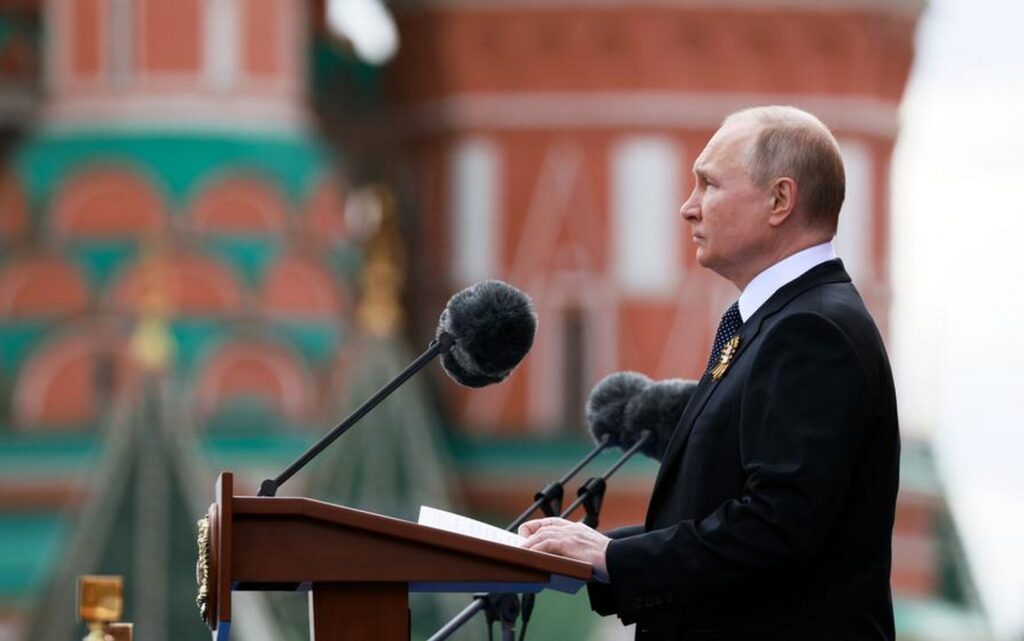
President Vladimir Putin on Friday praised the valor of Russian soldiers fighting in Ukraine, before tens of thousands of people gathered in Red Square and some 20 foreign leaders in Moscow for the 80th anniversary celebrations of the victory over Nazi Germany.
Putin took advantage of this occasion, one of Russia’s most important national celebrations, to draw historical comparisons between World War II and the massive attack on Ukraine that he ordered in February 2022.
“The entire country, society and people, supports the participants in the Russian special operation” in Ukraine, he said, using the term common in Russia to refer to the war in Ukraine.
“We’re proud of their bravery, determination, and strong morale, which have always brought us victory,” he said, stressing that his country “has been and will remain a strong bulwark against Nazism, Russophobia, and anti-Semitism”.
Among the attendees were war veterans and about 20 heads of state, including Chinese President Xi Jinping and Brazilian President Luiz Inacio Lula da Silva, as well as countries traditionally allied with Russia, such as Kazakhstan, Belarus, Vietnam, Armenia, Cuba, and Venezuela.
Despite Western countries’ policy of isolating Russia, Slovak Prime Minister Robert Fico, defying Brussels, Serbian President Aleksandar Vucic, and Bosnian Serb President Milorad Dodik, who is wanted by Bosnian justice, also participated in the celebrations.
In front of them, approximately 11,000 soldiers, including 1,500 who participated in the war in Ukraine, performed a massive military parade on Red Square with the participation of soldiers from 13 countries.
The Russian president saluted North Korean soldiers who supported Russia in its war on Ukraine.
State television footage showed Putin telling several North Korean officers in uniform, “I offer you and your troops my best wishes”.
This year’s parade featured weapons, including modern T-90 tanks, Iskander missiles, and S-400 air defense systems.
For the first time, Orlan, Lancet, and Geran drones, which Russia uses almost daily to bomb Ukraine, participated in the parade.
Military equipment was not displayed in this manner during the first two years of the war in Ukraine, when Russian forces were in a more difficult position on the front.
This year, the Russian president ordered his troops to cease fire in Ukraine from May 8 to 10 to mark these celebrations, which, as every year, are crowned by a large military parade in front of the Kremlin walls.
However, Ukraine, which has been facing a large-scale Russian invasion since 2022, accused the Russian army on Thursday of attacks along the front line, noting that the truce had been violated hundreds of times.
In contrast, Russian forces affirmed that they strictly respect the truce, stressing that they would only respond to Ukrainian violations.
On the other hand, Ukrainian President Volodymyr Zelensky criticized the military parade in Red Square, describing it as a “display of lies” and considering any foreign participation in it “support for the aggressor state of Russia”.
European Union foreign policy chief Kaja Kallas announced that Kyiv and its supporting countries would approve the establishment of a special court to investigate Russian “crimes of aggression” during a meeting on Friday in Lviv (western Ukraine).
Kallas said on Thursday, “Crimes won’t go unpunished”.
Russian authorities have emphasized that this year’s celebrations are unprecedented in their scale, as May 9 is a key milestone in the national narrative in Russia and other former Soviet republics.
Over the past three years, Putin has frequently cited the victory over Nazi Germany to justify his attack on Ukraine, emphasizing that Russia wants to eradicate Nazism from the neighboring country, nearly 20% of whose territory is occupied by the Russian military.
World War II, which claimed more than 27 million lives in the Soviet Union and required enormous sacrifices from its population, left a trauma whose repercussions are still felt in society and fueled a sense of nationalism exploited by the Russian president.