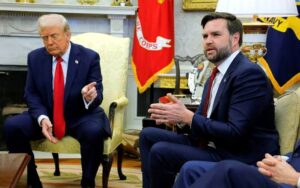
What are the priorities of Donald Trump’s foreign policy if he wins?

With US President Joe Biden withdrawing from the presidential race, the presidential election in the United States has entered a new phase.
Many observers predict that Vice President Kamala Harris won’t be able to confront Donald Trump, who has gained more support after his failed assassination attempt.
The Republican Party held its national convention, approved Donald Trump’s nomination, and approved his presidential platform on which he would govern in his possible second term.
Through this program and Trump’s statements, it’s possible to discern the features of his foreign policy, especially towards the Middle East and Iran.
The Republican Party pledged to make America stronger by strengthening national defense.
The party believes that Joe Biden’s foreign policy has made the United States less secure.
Therefore, Republicans plan to restore peace through force, rebuild the US military and its alliances, confront China, defeat terrorism, and build a defensive missile shield.
Republicans are mainly focused on China, seeing it as the most important threat, and seeking strategic independence from it.
They pledge to abolish China’s status as the most preferred country, phase out imports of basic commodities, and prevent China from buying US real estate and industries.
Trump aims to impose high tariffs on Chinese industries to encourage Chinese investment to do business in the United States.
The Republican document doesn’t mention Russia or the Ukrainian war by name, but Trump has repeatedly vowed to end the Ukrainian war and restore peace.
The document refers to the pursuit of peace in Europe and the prevention of a third world war.
It also emphasizes strengthening alliances and ensuring that allies fulfill their financial obligations to mutual defense.
The Republican Party document commits to the pursuit of peace in the Middle East and stands by Israel, and emphasizes the rebuilding of the network of alliances to ensure a future of peace and stability.
However, the document didn’t say anything about dealing with Iran, its nuclear program or its influence in the region.
As a result, the features of Trump’s second term if he reaches the White House look similar to his foreign policies in his first term, focusing on economic wars rather than military, especially towards the Chinese threat, trying to reach an understanding with Russia to end the Ukrainian war, and demanding that Europeans pay their dues to NATO.
However, it seems that Trump won’t pursue the same policies as before in the Middle East, due in part to the policy of maximum pressure hasn’t succeeded in bringing Iran to the negotiating table.
Strategic changes in the region after the events of October 7, and the losses suffered by Israel and genocide in Gaza, making investment in normalization processes futile.