Trump announces tariffs on countries around the world

Two months ago, US President Donald Trump began implementing his economic vision of imposing tariffs on a number of countries, starting with Canada, Mexico, and China.
The flood then swept across the European Union and other countries, totaling more than 200 countries, islands, and territories, in what Trump described as “US Liberation Day”.
At a press conference on Wednesday titled “Making America Rich Again” at the White House, Trump announced tariffs on most countries around the world.
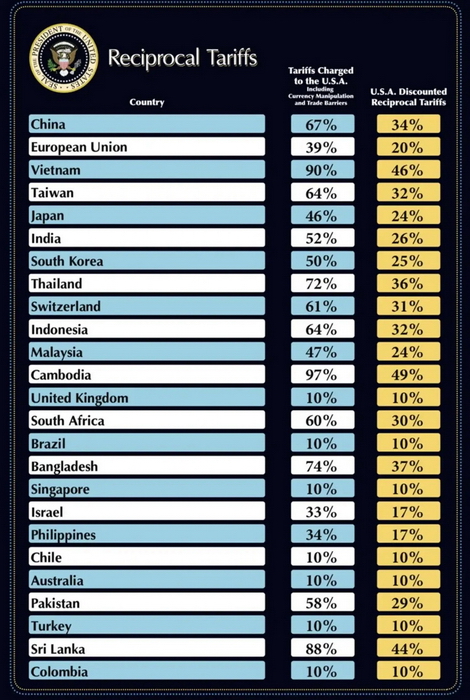
Tariffs varied for other countries with significant economic ties to the United States, including Cambodia, which had the largest share of tariffs at 49%, and Vietnam at 46%, exceeding China, whose goods had tariffs of 34%.
The US President also announced a 25% tariff on cars manufactured outside the United States, effective midnight local time.
The recent US decisions come as part of a response to what Trump has described as an unfair trade imbalance, referring to the volume of imports and exports in trade with the United States, as well as the principle of reciprocity, which refers to the fact that countries subject to tariffs also impose similar taxes on imported US goods.
Trump expressed optimism that the new tariffs would lead to an American industrial “renaissance” and halt the country’s commercial exploitation, which analysts see as a precursor to a full-blown global trade war.
The Wednesday’s announcement of the new tariffs covered 184 countries, islands, and territories, not including the 27 EU member states, meaning most countries worldwide were subject to taxes of at least 10%.
Initially, since early February, Washington announced border customs duties within the North American continent, imposing tariffs on Canada in the north and Mexico in the south.
The tariffs included the People’s Republic of China, a fierce competitor of the United States, which Trump had included in his threats before his second inauguration, saying at the time that tariffs on Canada, Mexico, and China would be his priority from his first day in the Oval Office.
Trump then put the EU in the spotlight, saying the EU was treating Washington very harshly, citing a $350 billion US trade deficit with the EU, and subsequently imposing 20% tariffs on them.
The United States and the European Union have the largest trading relationship in the world, with trade volume between them amounting to €1.6 trillion ($1.7 trillion) in goods and services in 2023, representing nearly 30% of global trade.
The United States has also imposed taxes on many Asian countries, such as Japan, Vietnam, Malaysia, Indonesia, India, Pakistan, Thailand, and Taiwan, and Israel and Türkiye accounted for 17% and 10% respectively, with other taxes varying from Brazil, South Africa, Britain, South Korea, and Switzerland.
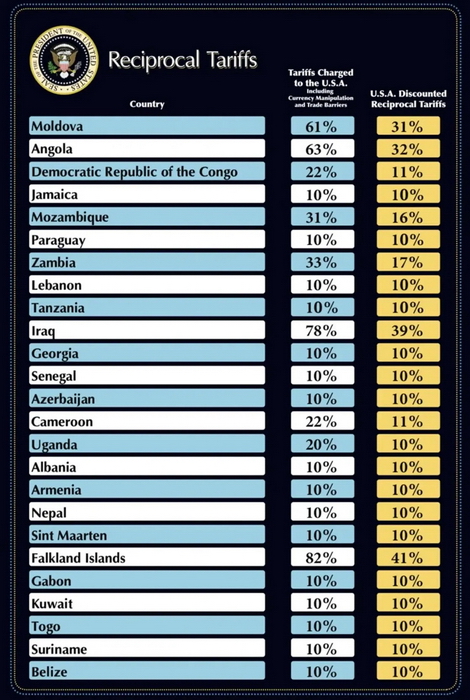
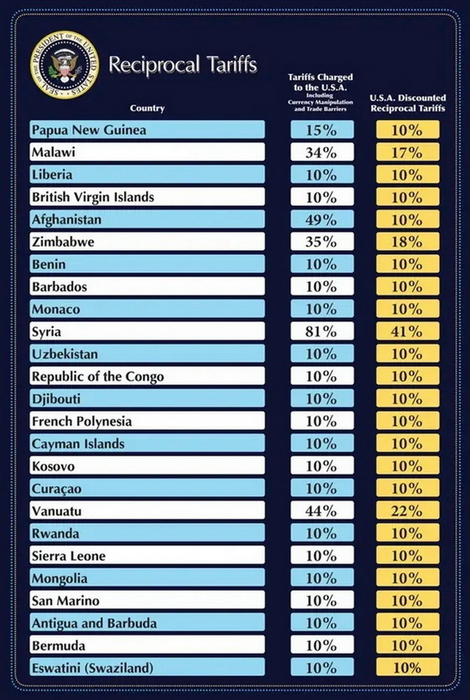
The long list included Arab countries, most of which were subject to a 10% share of customs duties, including Egypt, Sudan, Lebanon, Yemen, Saudi Arabia, the UAE, Kuwait, Qatar, Bahrain, Morocco, Mauritania, Oman, and the Comoros.
Syria’s share was 41%, Iraq’s 39%, Jordan’s 20%, Tunisia’s 28%, Algeria’s 30%, and Libya’s 31%.



Which economic sectors are most affected?
It appears that broad economic sectors will be affected by US decisions, from the aluminum industry to the automobile industry to the petroleum industry to the agriculture industry and even the wine industry.
Automotive and Vehicles Sector: Trump announced a 25% tariff on imported cars and light trucks, effective midnight on April 2, including previous tariffs on finished vehicle imports.
Imports of major automotive parts (engines and engine parts, transmissions, powertrain parts, and electrical components) are expected to be subject to tariffs on a date to be specified in a federal notice no later than May 3, 2025.
Steel and aluminum: On March 12, Trump raised tariffs on all steel and aluminum imports to 25%, expanding the duties to include hundreds of finished products, from nuts and bolts to bulldozer blades and soda cans.
The United States is the world’s largest importer of aluminum and the second-largest importer of steel, with more than half of that coming from Canada, Mexico, and Brazil.
Energy and Resources: Canadian uranium mining company Cameco stated that uranium prices for US companies could rise by 10% if tariffs are implemented, placing a heavy burden on a country that relies heavily on imports of this raw material.
Retail gasoline prices in the United States are expected to rise, as the latest tariffs could raise the cost of energy imports, according to traders and analysts.
The Russian Central Bank said on Wednesday that US tariff increases could lead to a slowdown in the global economy, and oil prices could be lower than expected for several years due to lower global demand.
Agriculture and livestock: Mexican farmers and agricultural workers have expressed concern that the 25% tariff on Mexico will severely impact the livestock industry, particularly small producers and their businesses, which they have spent years building.
Wood: On March 1, Trump ordered a new trade investigation that would result in additional tariffs on imported lumber, exceeding the current tariff on Canadian softwood lumber and 25% tariffs on all Canadian and Mexican goods.
Electronic chips: Trump also said that tariffs on semiconductor chips would start at “25% or higher” and increase significantly over the course of the year, but he did not specify when these tariffs would take effect.
Computer industry: Computer manufacturers, such as Dell, face the risk of potentially higher prices as a result of tariffs imposed on China.
Dell stated in February that it was reviewing the tariff orders, adding that the announcements had not yet affected its prices.
However, the research firm International Data Corporation lowered its forecast for traditional PCs for 2025 and beyond in February due to risks related to the tariffs.
pharmaceutical: Trump’s decision to increase tariffs on goods imported from China, including finished medicines and raw materials, has raised expectations that pharmaceuticals will be added to the list, marking a radical change in the decades-long policy of exempting pharmaceutical products from tariffs.
The UK pharmaceutical industry has expressed concern about the US tariffs.
Meanwhile, and according to Reuters, pharmaceutical companies are pressing Trump to implement gradual tariffs on imported pharmaceutical products, hoping to mitigate the impact of the tariffs and allow time for manufacturing to change.
Retail and e-commerce: Many other US retailers are preparing for a potential hit from tariffs, especially on their main supplier, China.
With the tariffs on Vietnam taking effect, sportswear and apparel manufacturers, from Nike to On Holding, are expected to be affected, as the United States imports about half of its products from Vietnam.
It’s worth noting that there’s a so-called “de minimis” measure, which allows goods valued at less than $800 to enter the United States duty-free and with minimal inspections.
If the new US decision includes this measure, it will negatively impact online retailers, which offer discounted prices.
E-commerce companies such as Shein, BDD Holdings-owned Teemo, and Alibaba’s AliExpress rely on the simple tax exemption to keep prices low.
Alcohol: On March 13, Trump threatened to impose 200 percent tariffs on imports of wine, cognac, and other alcoholic beverages from Europe, in retaliation for the European Union’s plan to impose tariffs on American whiskey and other products next month.
The United States is the largest export market for Scotch whisky, and Annabel Thomas, CEO of Scotland’s Nc’nean Distillery, said that high tariffs could deter the company from investing in the US.
Travel: Tourists and businesses have reduced their spending amid growing economic uncertainty, forcing airlines to lower their forecasts for the first quarter of 2025.
Some airlines have also begun reducing flights to avoid lower fares and protect profit margins.
How does the crisis escalate?
Traders work at the New York Stock Exchange, amid escalating trade war waged by US President Donald Trump and inflation indicators that worry investors.
Following the implementation of tariffs imposed by US President Donald Trump on China, the Chinese Ministry of Finance announced that it will impose a 15% tariff on imports of coal and liquefied natural gas from the United States, and a 10% tariff on crude oil, as well as agricultural equipment and some automobiles, starting February 10.
On March 4, China retaliated against the new US tariffs, announcing increases of 10 to 15% in import duties covering a range of US agricultural and food products.
The European Commission has outlined two phases of its response to the US tariffs on steel and aluminum, including reinstating measures introduced in 2018 when Trump first imposed tariffs on metal imports, which were later suspended under Joe Biden.
These countermeasures, including a 50% tariff on US bourbon whiskey, were scheduled to take effect on Tuesday, but the Commission later postponed them until mid-April to allow more time to consider the US goods they would impose.
The Commission also prepared another list of US import, including meat, dairy products, wine, and clothing, worth €21 billion, which it planned to reduce to €18 billion for a second tranche of tariffs.
The European Union has not yet announced what steps it will take in response to the car tariffs or the upcoming reciprocal tariffs.
It’s worth noting that at the end of 2023, the so-called Anti-Coercion Instrument (ACI) entered into force as an EU measure against other countries that exert economic pressure on member states to change their policies.
In addition to imposing tariffs on goods, this tool could restrict the protection of intellectual property rights, limit financial services companies’ access to EU markets, and limit these companies’ ability to market chemicals, agricultural products, and food products in the EU.
The EU may also restrict companies’ access to tenders and take measures that affect trade in or investment in services.
The Canadian Prime Minister’s Office said Tuesday that Prime Minister Mark Carney spoke with Mexican President Claudia Sheinbaum about Canada’s plan to “combat unjustified trade actions” by the United States.
On the other hand, in South Africa, Trade Minister Parks Tau said Tuesday that South Africa will seek a meeting with US authorities regarding the auto tariffs, noting that the duties are a concern given the country’s preferential trade treatment with the United States.
Experts expect South Africa, whose exports of cars and spare parts to the United States are estimated at more than $2 billion, to be severely impacted by the 25% tariff on car imports announced by US President Donald Trump, in addition to a 30% tariff on the country’s overall imports.
In recent weeks, Vietnam has announced a series of measures, including increased US imports, to reduce its trade surplus with Washington, which exceeded $123 billion last year.
However, this didn’t prevent it from ranking second on the list of countries with the highest tariff rates, with a 46% tariff rate.
The United States also imposed 17% tariffs on Israel, despite a statement the day before this decision by the Israeli Finance Minister on Tuesday, confirming that he had launched a process to immediately eliminate tariffs on US imports.