Tough negotiations in Beijing between Germany and China on EU tariff hikes and Russia
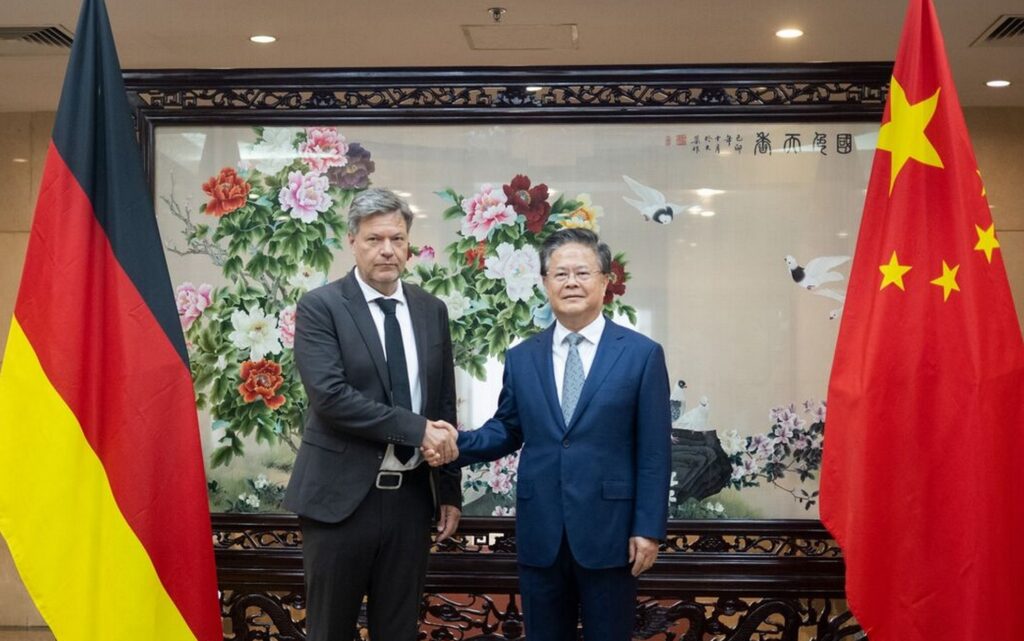
German Vice Chancellor Robert Habeck said Saturday in China that the door is open to discuss additional tariffs imposed by the European Union on Chinese electric vehicles, without failing to reassure Beijing, which has vowed it will resolutely defend its companies.
Habeck, who is also Germany’s economy and climate minister, is on a visit to China that appears to be the last chance to avoid a trade war between the continent and the world’s second superpower.
The political situation further complicates Habeck’s task.
On Saturday, the German minister criticized China’s economic support for Russia over the invasion of Ukraine, saying it hurts relations between Beijing and Brussels.
China, Germany’s important economic partner, reiterated its condemnation of the additional tariffs on electric vehicles, which will take effect next month, saying they were purely protectionist.
Robert Habeck told Zheng Shanjie, director of China’s economic planning agency, on Saturday, that these aren’t punitive tariffs, and it’s not a matter of punishment.
In the absence of a compromise by the Fourth of July, the European Commission will impose a 28% increase in tariffs on imports of Chinese electric cars, accusing Beijing of violating competition rules by massively subsidizing the sector.
These surcharges will become final from November.
Robert Habeck told a news conference in Shanghai, “As for Europe, I can say that the field is open and that the discussion has been called several times… Now, it must be accepted”.
EU spokesman Olof Gill confirmed from Brussels that EU Commissioner for Trade Valdis Dombrovskis and Chinese Trade Minister Wang Wentao had a frank and constructive call on Saturday about the investigation to combat EU subsidies for electric cars produced in China.
“The two sides will continue to communicate at all levels in the coming weeks,” EU spokesman Olof Gill said.
Earlier on Saturday, the Chinese side struck a firm tone.
Chinese Commerce Minister Wang Wentao said, according to Chinese state television channel English, “If the EU expresses a sincere position, China is willing to start negotiations as soon as possible… But if the EU insists on this path, we will take all necessary measures to defend our interests… This will include filing a complaint with the WTO dispute settlement mechanism… We will firmly defend the legitimate rights and interests of Chinese companies”.
Beijing announced on Monday that it had launched an anti-dumping investigation into imports of pork and pork products from the European Union.
German and European manufacturers are struggling with cheaper competition from Chinese electric cars, whose imports to Germany have increased tenfold in just three years between 2020 and 2023.
China says the success of its electric vehicle sector is due to innovation and efficient supply chains, not government subsidies.
“Protectionism in the EU won’t protect manufacturers competitiveness and will only slow down the global fight against climate change and promote the green transition,” Zheng Shanjie, director of China’s economic planning agency, told Germany’s vice chancellor.
“We expect Germany to take a leadership role within the EU and take the right actions,” Zheng Shanjie was quoted by the official Xinhua news agency as saying, which means the removal of the additional tariffs.
Such conclusions seem unlikely, with Robert Habeck again criticizing Beijing on Saturday for increasing its trade with Moscow.
“Russia’s aggressive war and Chinese support for the Russian government are harming trade and economic relations between Europe and China,” he told Chinese officials.
China vowed not to supply weapons to Russia and called for respect for the territorial integrity of all countries, including Ukraine, but didn’t condemn Russia’s invasion of Ukraine.
Habeck confirmed on Saturday that Russia uses many “dual-use” goods (civilian and military) after passing through “third countries,” referring to China.
The German vice chancellor stressed that “we therefore cannot accept” that the Russian invasion is supported by these products, calling on Beijing to stop its exports to Russia.
German automakers fear a major trade dispute with Beijing if China takes retaliatory measures, which would undermine German companies’ activity in this vital market.
China accounts for up to 36% of the sales volume of Mercedes, Volkswagen and BMW.
China remained Germany’s main trading partner in 2023 for the eighth consecutive year, but has fallen behind the United States since the start of the year.