The US House of Representatives extended the Caesar Act in Syria
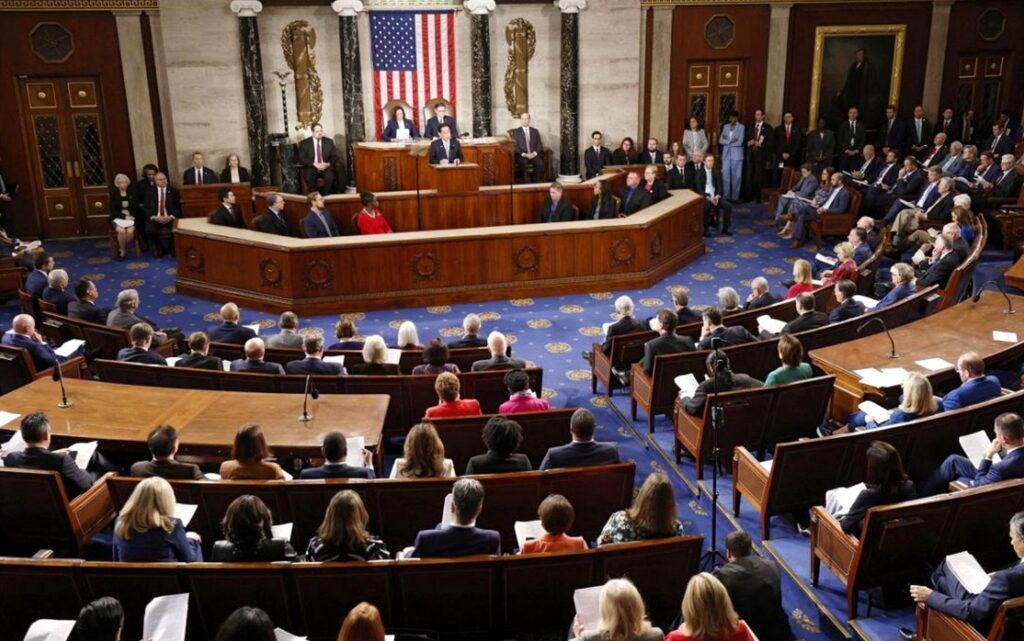
A draft resolution aimed at repealing the Caesar Act, which imposes sanctions on Syria, has failed in the US House of Representatives after being proposed as part of the Pentagon’s 2026 budget.
During congressional discussions on the National Defense Authorization Act, Senate Armed Services Committee Chairman Roger Wicker, a Republican, proposed repealing Caesar, supported by leading Democrat Jack Reed.
However, the effort failed to gain sufficient support, despite Republican Representative Joe Wilson and the Syrian-American Alliance for Peace and Prosperity stressed the need to lift sanctions imposed on Syria, arguing that their continuation exacerbates the suffering of civilians.
Wilson said via X, “Congress must support US President Donald Trump and move forward with the full repeal of the Caesar Act,” praising the efforts of US Special Envoy to Syria Tom Barrack to enhance the prospects for peace in Syria and Lebanon.
Earlier, Abdul Hafeez Sharaf, a member of the Syrian-American Alliance, indicated that the law was effectively suspended, but was still awaiting a final decision from the House of Representatives.
In late June, US President Donald Trump issued an executive order ending the general sanctions program on Syria, while maintaining individual sanctions on former President Bashar al Assad and a number of senior officials.
For his part, US Secretary of State Marco Rubio confirmed that the administration is considering the option of completely suspending the Caesar Act as part of a comprehensive review of US policy toward Syria.
The Syrian-American Alliance, through X, renewed its commitment to continuing its efforts to lift sanctions and open the door to a new phase of peace and economic recovery in Syria.
The Caesar Act was first voted on in January 2019 under the name “Syria Civilian Protection Act,” which imposed broad sanctions against the former Syrian government and its allies, such as Russia and Iran.
The legislation came into effect in June 2020, imposing severe economic sanctions targeting vital sectors such as energy, infrastructure, and reconstruction projects, as well as senior officials, including Assad and his wife, Asma.
Washington says the goal of these sanctions is to push Damascus to accept a political solution in accordance with UN Resolution 2254 and prevent any reconstruction investments before a political settlement is reached.
While the US administration views the sanctions as a means of pressure to advance the political process, opponents of the Caesar Act argue that it has exacerbated the economic and humanitarian crisis in Syria, directly impacting the lives of millions of civilians.
The failure to repeal the Caesar Act is seen as an indication of Congress’s complete lack of confidence in the current transitional government led by Ahmed al Sharaa, especially as Washington awaits clearer steps on counterterrorism, cooperation against ISIS, and engagement in regional normalization processes, including with Israel.