The United States on the verge of a civil war
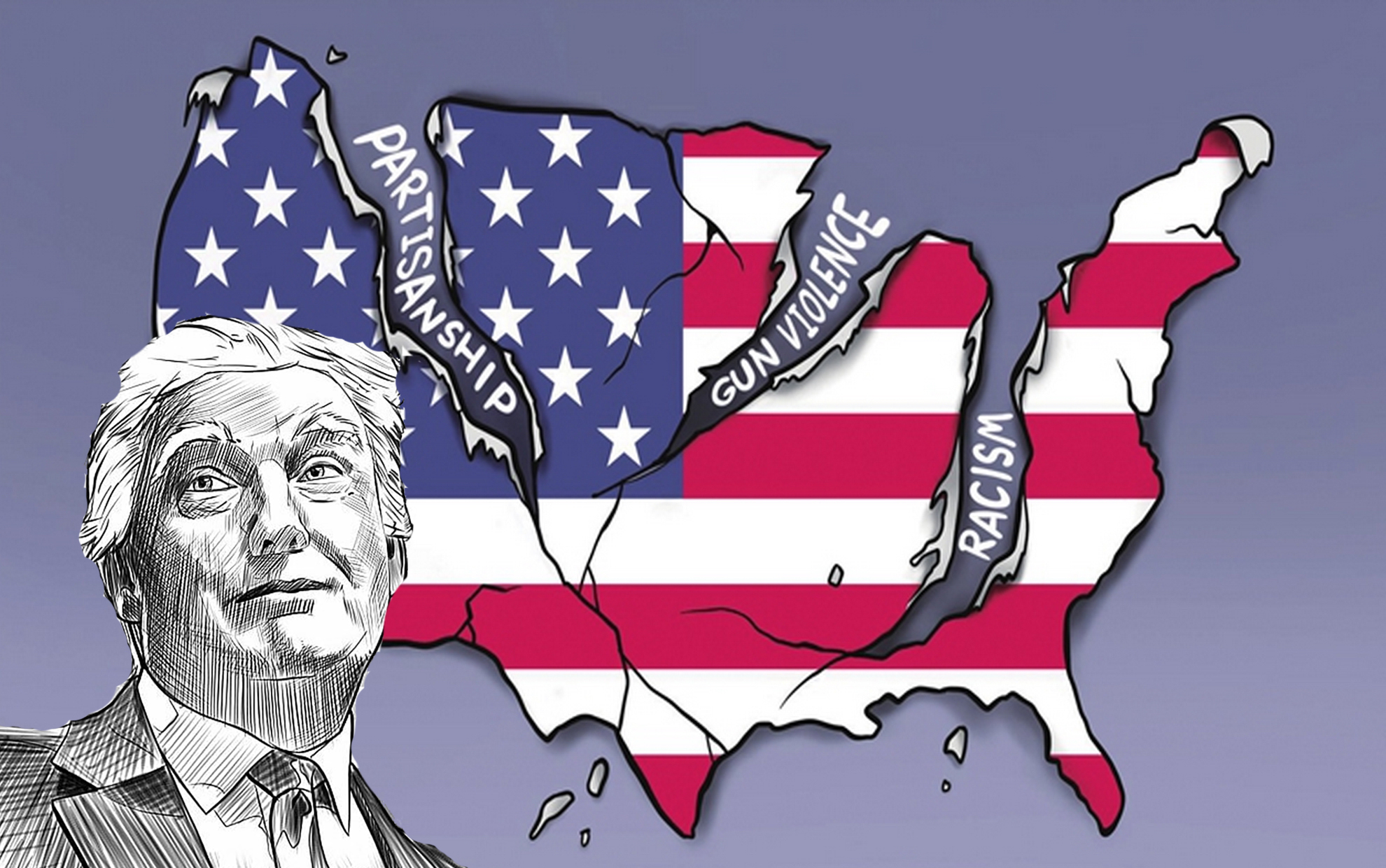
The time is not like any moment in the past, as Americans today look to the future with fear and anxiety about the specter of civil war, and they see this danger hovering over their country because of the political crisis that the United States is currently witnessing.
Its roots go back to the stage of the victory of current President Joe Biden in the last presidential elections, after his defeated rival, former President Donald Trump, refused to recognize the results, mobilizing his supporters and inciting them to storm the Capitol building on January 6, 2021, to finally culminate with the raid launched by the office of The FBI investigated Trump’s residence in Mar-a-Lago, Florida, in search of secret documents and documents that Trump had deliberately hidden.
Especially since those in the US, from the Republican Party and with it the extremist right-wing groups, are preparing the conditions and reasons for it, preparing the fertile ground for it, and blowing into the fire in order to ignite it, especially since they consider it the only salvation from the Biden administration, his government and their deep state.
But what are the signs of the Civil War in America?
A wide range of voices, including those of some Republican and Democratic politicians, academics who study civil conflict, as well as extremists on the other side are all now promoting the idea that civil war is near or necessary.
Most importantly, all of them refer to a number of evidence, facts and data that support their vision of not ruling out a civil war in America, and they can be summarized in 3 facts:
- A firestorm of threats included FBI agents, judges, elected officials, school board members (for being at odds with the Republican view of student upbringing), as well as election supervisors.
- The establishment of closed paramilitary camps in which armed extremists would train to confront their government.
- The results of opinion polls that show that the presence of Americans expect a violent conflict, and that a real civil war may knock their doors at any moment, especially with the approach of the midterm legislative elections.
When looking at the quality of the academic voices that delved into the issue of the American Civil War and its owners, we find in their introduction Stephen Markey, author of “The Next Civil War: Letters from the American Future,” who presented an approach, in which he said that the extremists’ threats had become more clear and specific, and that their discourse had been leaked To a very large segment of Americans and influenced them.
This is evidenced by the actions of the Texas government and the Republican Party in it, which challenged the federal authority, after thousands of Republican activists, after their meeting in Houston (the largest city in Texas) last June, during the party convention in the state, approved a resolution rejecting the election result. 2020 presidential election, and Biden is declared “acting president”, as well as they are seeking a voter referendum on secession from the United States.
What is remarkable is that Markey, the Canadian-born novelist, who was ringing the alarm bell of what is coming on America, recently accelerated the pace of his warnings, and became more urgent, after he saw small groups of armed men training to fight government agents, and commented on this matter, saying, “This kind of The chaos I’m describing is like internet rage: you can make it staged or it can be very dangerous, and it can be weekend fun, or actual military setup.
Markey shares the view with other analysts, who said the current noise is a strong indication that a hot civil war – likely to see bombings, assassinations and attacks on federal institutions and officials – may be imminent.
In an intersection with Markey’s ideas, conservative writer Kurt Schlechter predicted civil war, concluding in his new book, We Will Return: The Fall and Rise of America, that “the blue states face a challenge, and it is good to keep the cities, but if you also do not hold all the rural lands between Cities, as well as roads to places where you get your food and fuel, you have a real problem”.
Another well-known American figure, who does not rule out the American Civil War, is Robert Reich, Secretary of Labor under President Bill Clinton, who had pointed out that “the second American Civil War is actually happening,” and added, during his talk to the Guardian, “But it is not a war”.
It is a kind of benign separation similar to unhappy married couples who do not want to go through the trauma of formal divorce”.
Interestingly, Reich is not likely to see a violent partition of the country, but something “akin to Brexit – a reciprocal, intermittent decision to go separate ways on most things, while maintaining contact on some sensitive issues such as national defense, monetary policy, and civil rights, and politics.
What about opinions that rule out civil war?
Against this category of apprehension about the possibility of civil war, there are other groups that deny this option, such as the Anti-Defamation League and other American watch groups, who do not see the kind of specific planning by private militias and online gatherings of extremists with the same clarity that existed before the 6th of January of last year rebellion, before the white supremacy rally in Charlottesville in 2017.
This view is also shared by Oren Segal, vice president of the Center for Countering Extremism, who explained to NPR, “We’ve been through this for a long time, and I don’t see people coming together in a cohesive organization like the one we saw on January 6th”.
Analysts of both categories, both who say we are heading toward civil war, and those who hold that the threat landscape is largely limited to single people, small, disorganized groups whose dangerous and dispersed actions do not constitute civil war, agree and do not rule out the possibility of an organized violent attack against government, local or state authorities (albeit to a limited extent), and taking up arms against their federal counterparts.
In addition to this sharp division over whether a series of individual attacks and small groups can lead to a war-like conflict that destabilizes the country, the greater danger that looms, and haunts both sides in the civil war debate, is that the most worrisome trend is Widespread loss of confidence, hope and sense of belonging in a severely affected society.
What inspired the enthusiasts of the Civil War?
Indeed, William Pierce, a physics professor turned neo-Nazi theorist, is seen as the source of the ideas of murder, liquidation, and the elimination of the US government, for American right-wing extremists.
A quarter of a century ago, after the bombing of the federal building in Oklahoma City, excerpts from the book were found in the car of the bomber Timothy McVeigh, who had taken Pierce’s Turner Diaries and plotted to launch a civil war, when he killed 168 people and wounded hundreds more, mostly children.
The catastrophe for current American leaders is that Pierce was so proud of the popularity of his book among white supremacists and other extremists that his goal, and that of those he hoped would read his book, was to overthrow the government.
That’s why Pierce said, “People don’t use the book as a blueprint, but as an inspiration”.
He asserted, “I don’t have time to write just for fun… But to explain things to people… I would like to see North America only a white continent”.
To make matters worse for Americans, Pierce has a destructive vision of the American system, as he clarified that “if we don’t destroy the system before it destroys us – if we don’t cut this cancer out of our living flesh – then our whole race will die”.
Pierce, who died in 2002, had predicted in his book that white supremacists would plot to blow up the FBI headquarters and ignite a wider war on the government.
He also expected the recurrence of individual acts of violence, saying that “terrorism has no meaning unless it is sustainable… and one day there will be real and organized terrorism that will take place according to a plan aimed at overthrowing the government”.
What about Trump and the Republican Party’s enthusiasm for the Civil War?
For decades, Pierce’s Turner Diary has been a text used by violent extremists, appearing frequently online in the conversations of participants in the January 6 attack and supporters of President Trump.
Not only that, hostile rhetoric has also become part of the daily campaigns of some Republicans.
Laura Loomer, the Republican candidate in Florida’s 11th House district, who narrowly lost in last week’s primary, wrote on Telegram August 8 that “it’s time to take the gloves off… If you’re a loving American”.
For freedom, you have to remove the words decent and civility from your vocabulary”.
Similarly, conservative YouTuber and podcaster Stephen Crowder tweeted on the day the FBI raid in Mar-a-Lago took place, saying that “tomorrow is war”.
“It is time to fight for every square inch,” he added, then repeated his words the next day, stressing that it was time to fight fire with fire.
The pro-Trump critics’ website also wrote incitement phrases such as “This… You know… The war”.
In addition, people on pro-Trump social media have talked about buying ammunition and looking to confront federal agents.
“Civil war! Pick up the guns, people,” one of the angry tweeted.
Such talk was a mainstay of the Trump years.
Last summer, Representative Madison Cawthorne, a North Carolina Republican who denied the results of the presidential election, alleged that the US election systems were “rigged,” stressing that it “will lead to one place, bloodshed”.
Even Trump himself, who had spoken out against teaching critical race theory at a rally in South Carolina this spring, noted that America’s fate “ultimately depends on the willingness of its citizens to give up their lives to defend their country, and they ought to do so”.
In a similar vein, earlier this year on ABC’s “The View”, one of Trump’s most prominent critics, Representative Adam Kinzinger of Illinois, asserted that civil war could break out.
And we’re talking about that so we can realize that and fight hard against it”.
Although Pierce’s book continues to inspire individual actors and small groups, his broader war has never come close to fruition yet.
Today, “Civil War” is a powerful cry, some Americans have reflected in their behavior, by wearing it on T-shirts, and others are practicing it openly with offensive weapons, as does the pastor’s son, Heung Jin Moon, who sponsors training courses at his compound in Texas and Pennsylvania for a war Another ‘patriotic’ on the ‘deep state’ and his speech.
And what do opinion polls say about the prospects of civil war?
Many Americans believe that a real and violent civil war is coming.
In a poll conducted this spring by the University of California’s Violence Prevention Research Program in Davis, most respondents said they expect civil war in the next few years.
In addition, another poll conducted by the Survey on American Life, a nonpartisan project of the conservative American Enterprise Institute, found that over a third of Americans agree that “the traditional American way of life is disappearing so quickly that we may have to use force to save it.
An alarming new poll published by YouGov, a leading market research company, reveals that four out of 10 Americans believe that civil war is a possibility in the next decade.
YouGov notes that among those who say they voted for Trump in 2020, more than 50% also expect political violence to increase in the coming years.
Moreover, another YouGov poll, which was conducted for The Economist, indicates that about 14% of the respondents said that civil war is “very likely within 10 years”.
While 29% said it was “somewhat likely”.
But, among Trump voters, those numbers were 19% and 34%, respectively, or 53% in total.
Among Biden’s voters, the total was just over a third.
In conclusion, Americans feel that divisions among the nation justify or precede violent conflict.