The EU is heading to offer 5 billion Euros to support first Taiwanese chip factory in Germany
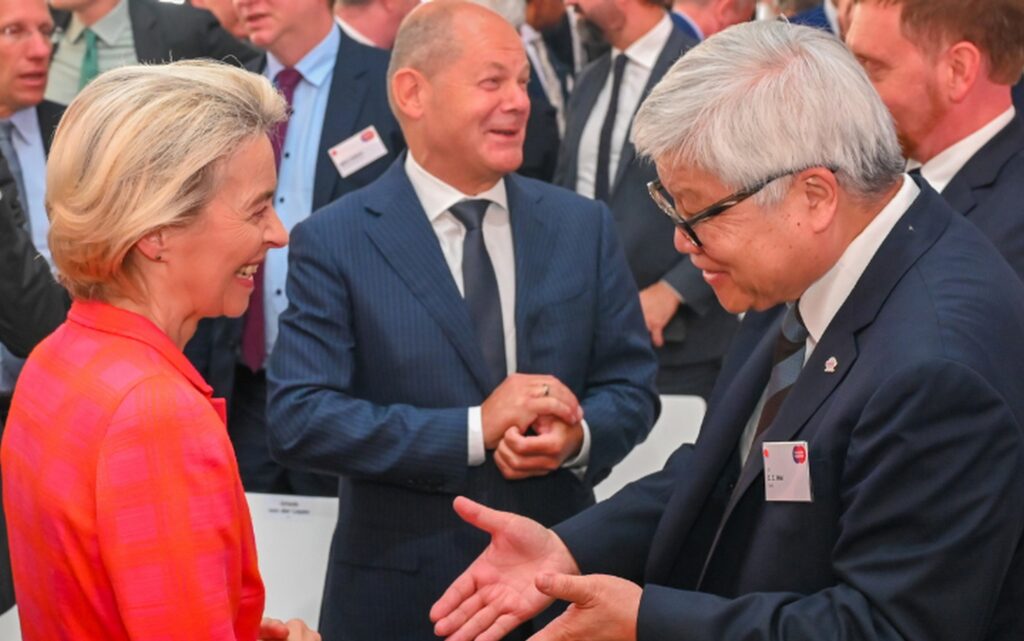
The European Commission on Tuesday approved 5 billion Euros (about $5.57 billion) in aid to the German government to support Taiwanese chipmaker TSMC’s first chip factory in Europe in Dresden.
The factory is called European Semiconductor Manufacturing Company (ESMC), a joint venture between the Taiwanese chip giant, Dutch company NXP, and German companies Bosch and Infineon, according to the thenextweb, website.
TSMC owns 70% of the plant, while European chipmakers each own a 10% stake.
The aid is part of the EU’s Microchip Act, which aims to increase the bloc’s share of global chip production to 20% by 2030.
It’s also the largest grant so far under the act, providing about half of the estimated 10 billion Euro investment to set up the plant.
The reasons for the financial support seem clear: TSMC’s key position in the global semiconductor supply chain, and the upcoming plant meets the law’s requirements for a first-of-its-kind facility for large-scale technology development that currently doesn’t exist in EU countries.
ESMC is set to deliver high-performance wafers, based on 300mm silicon wafers with node sizes covering 28/22nm and 16/12nm.
They will use FinFET technology which improves performance and power efficiency.
The plant is expected to reach full operational capacity by 2029, and will produce 480,000 silicon wafers annually.
It will provide semiconductors for industrial and automotive applications.
As part of the deal, ESMC will operate as an open factory, meaning any customer other than the four shareholders will be able to order specific chips.
The EU Competition Commissioner, Margrethe Vestager, said in a statement that the factory will ensure widespread access to energy-efficient chips, including by small businesses and start-ups, while limiting any potential distortion of competition.
Attracting chip giants to the bloc, through financial incentives and favorable regulation, is a key part of the EU’s strategy to boost domestic production.
Alongside TSMC, Intel has committed to building a 30 billion Euro mega-factory for highly advanced chips in Germany.
If the project goes ahead — which isn’t guaranteed due to financial problems — the factory will deliver chips for applications such as artificial intelligence and high-performance computing.
However, in the face of fierce global competition and an increasingly unstable geopolitical landscape, it’s unclear whether the EU will actually achieve its goals.