Tebboune’s visit to Italy: Important agreements with Rome
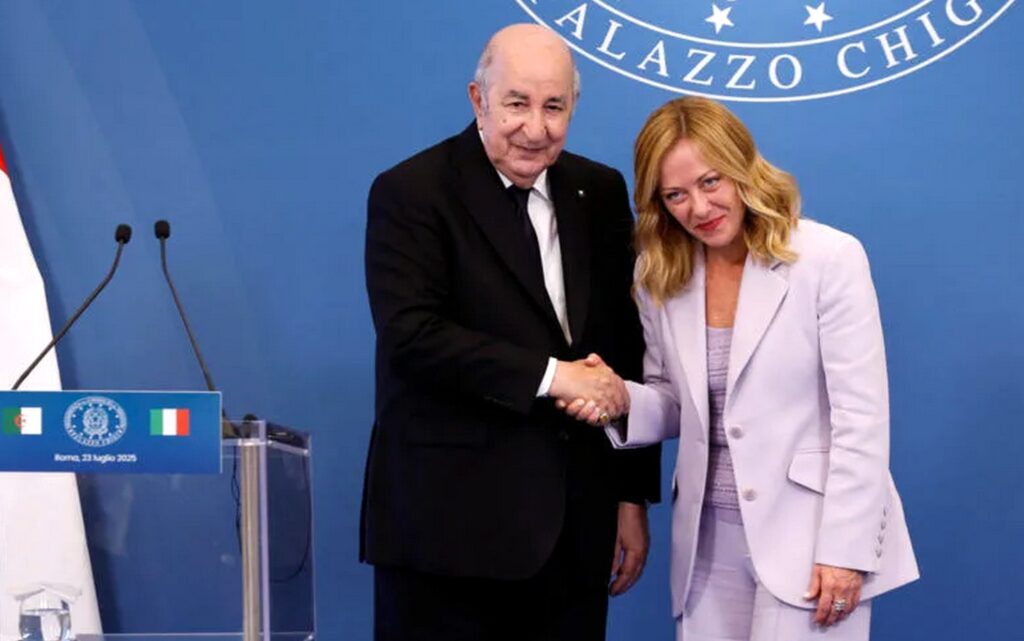
Algerian President Abdelmadjid Tebboune’s visit a few days ago to Italy, his country’s strategic ally and leading global economic partner, sparked concern in French circles, particularly among the far-right.
During his second visit to Italy since assuming power in late 2019, the fifth high-level government summit was held between Tebboune, Italian Prime Minister Giorgia Meloni, and members of the two countries’ governments.
Italian President Sergio Mattarella also received his Algerian counterpart, who in turn visited the Vatican and met with Pope Leo XIV.
The visit culminated in Algeria and Italy signing more than 40 agreements and memoranda of cooperation, 14 of which were institutional, while the rest were between public and private companies from both countries.
The signed agreements cover the energy, defense, security, mining, automotive, pharmaceutical, technology, digitalization, higher education, agriculture, fisheries, aquaculture, culture, and other sectors.
During the visit, the two countries held a high-level business forum attended by more than 500 heads of public and private companies, experts, and businessmen from both countries.
Official data from the Agency for the Promotion and Internationalization of Italian Businesses Abroad (affiliated with the Ministry of Foreign Affairs) indicate that trade with Algeria amounted to approximately 15 billion Euros in 2024.
Of the total bilateral trade, Algeria exported approximately 12 billion euros to Rome in 2024, most of which was natural gas, oil, petroleum derivatives, and raw materials.
In return, the Arab country imported industrial machinery and equipment in several sectors, in addition to agricultural equipment and medicines from Italy, worth approximately 3 billion Euros.
During the first four months of 2025, figures from the same agency indicate that trade between the two countries reached 4.49 billion Euros, a 6.7% increase compared to the same period last year.
Italy is Algeria’s leading economic partner in the world, with Rome representing the primary destination for Algeria’s gas and oil exports.
It has also been the European country’s leading gas supplier since 2022, following the Russia-Ukraine war, covering more than a third of its annual needs.
While Rome has strengthened its partnership with Algeria in several sectors over the years, such as automotive, through the Fiat plant in the western province of Oran, and a major project by the Italian PFG Group in the Sahara agricultural sector to produce durum wheat and dry legumes.
Algeria and Italy are considering expanding the investment of the BF Bonifichi Ferraresi Group in the production of durum wheat, legumes, and pasta in the Timimoun province in southwestern Algeria to include milk, red meat, and animal feed.
A total investment of 420 million Euro has been allocated for the first project, 49% of which is financed by the Italian Group which is Italy’s largest agricultural group, while the remainder is borne by the National Investment Fund, a sovereign wealth fund and the financial arm of the Algerian government.
In the French media, clear signs of discontent emerged following Tebboune’s visit to Rome, and the issue became a topic of widespread debate on local news channels.
During these discussions, French diplomacy was sharply criticized, described as incapable of protecting the country’s interests in the Maghreb region, after what was considered a resounding success for Algerian diplomacy in strengthening its partnership with Italy.
The far-right French channel CNEWS broadcast footage from the visit, showing Tebboune walking alongside Meloni amid full formal ceremonies.
French journalist Louis de Raguenel commented on these photos, saying, “It’s extremely humiliating to be French… It’s hard to bear”.
He considered that Meloni sent a clear message of disregard for Paris’ position and of strengthening Italy’s relations with Algeria as a sovereign state.
He pointed out that Tebboune’s visit to Rome was “a state visit with all its symbolism and protocol,” adding that “if Meloni did so, it’s because she feels empowered by the Italian people, and she’s not afraid of France at all”.
He continued, “Meloni defended her country’s supreme interests, while Paris was preoccupied with ‘moral fanaticism,” referring to French President Emmanuel Macron’s pro-Moroccan stance on the Western Sahara issue.
In the same context, Bernard Cohen-Haddad, president of the Marcel Etienne think tank, expressed his shock at the level of Algerian-Italian partnership, saying that Macron bears responsibility for what happened due to his decision regarding the Sahara region.
According to Bernard Cohen-Haddad, “What happened after Tebboune’s visit is a slap in the face to French diplomacy… It’s uncomfortable to be French today and see this slap in the face”.
He warned that Italy could become Algeria’s gateway to the European Union, given its diplomatic acumen in handling the Sahara issue, compared to Paris and Madrid.
He considered France’s losses in Algeria to be unnecessary, and that they resulted from miscalculated political calculations, for which Paris paid the price, while Rome was able to quietly accumulate gains without provoking Algeria.
The visit also came days after the European Commission announced it would resort to arbitration regarding the partnership agreement with Algeria, a move reportedly spearheaded by France.
However, President Tebboune’s appearance in Rome, where he signed cooperation agreements with Italy in the fields of energy, industry, and agriculture, was interpreted by observers in France as a fresh blow to Paris’s attempts to draw the European Union into a unified stance against Algeria.
Since President Tebboune came to power in 2019, the French economic presence has gradually diminished, with several companies leaving the country, such as RATEPI Paris, which operated the Algiers metro, and SIGS, which oversees the water and sewage network in the capital and the neighboring coastal province of Tipaza.
Algeria has also significantly reduced its imports from France of several products, including grains, particularly wheat, dairy cattle, slaughter and fattening calves, cheese products, and others.
The diplomatic crisis between the two countries, triggered by President Macron’s recognition of the autonomy proposal put forward by Morocco years ago as a solution to the conflict in the Western Sahara region, has also escalated.
Relations further deteriorated following the arrest of Algerian writer and French citizen Boualem Sansal last November, who was subsequently sentenced to five years in prison, in addition to immigration-related charges.
Since last year, Algeria has withdrawn its ambassador from Paris and reduced its representation to a chargé d’affaires.
In return, France recalled its ambassador from Algeria and also reduced its representation to a chargé d’affaires.
Jamal Qassoum, an Algerian political analyst, social science researcher, and activist based in France, believes that the disquiet expressed by French authorities and political and media circles can be explained by several factors, including “residual colonial tendencies”.
According to Qassoum, there is another factor relates to the issue of “the feeling of insult and humiliation expressed by French political circles,” and this matter is linked, he believes, to what Paris was betting on to isolate Algeria.
He stated that this feeling is linked to the fact that Paris was betting on isolating Algeria diplomatically, not only by France, but especially through the European Union.
He considered that Tebboune’s visit to Rome was evidence of the lack of solidarity on the part of a major European country like Italy, which undermines the isolation efforts.
Qassoum pointed out that France has no influence over Algeria, whether politically, diplomatically, or economically.
Majid Touhami, an activist in the Algerian community in France and head of a private construction company, believes that the stakes in Algeria’s relationship with Italy reflect a fundamental difference in visions between Paris and Rome.
He explained that Italy, along with Algeria, has chosen the path of realism and shared interests, while France continues to suffer from strategic hesitation and isolation stemming from an old outlook that is no longer valid in a changing world.
He considered that Algerian gas is no longer just an energy resource, but rather a sovereign tool through which Algeria expresses its choices in international relations.
According to the spokesperson, Sonatrach today represents more than just a supplier of Algerian gas to Italy.
Rather, it’s a strategic partner that strengthens Rome’s energy independence, embodied by close institutional cooperation with the Italian company Eni, free from any ideological or colonial considerations.
In contrast, Touhami believes that the state of anxiety in France is not due to Algerian or Italian moves, but rather reflects a strategic vacuum in Paris.
He pointed out that France’s delay in developing its liquefied natural gas infrastructure and its lack of a clear vision for the Maghreb countries have left Paris a bystander to major transformations taking place on its borders.
He stressed that Algeria today doesn’t build its relations on pleasantries or emotional promises, but rather on realistic foundations and mutual interests.
In this regard, he said, “The alliance with Italy is the result of a shared vision on energy, security, and the economy, and is not directed against any party… Algeria simply operates as a sovereign state, managing its affairs according to its own priorities, not those of others”.