The Guardian: Trump and Netanyahu from war partnership to mutual recriminations!
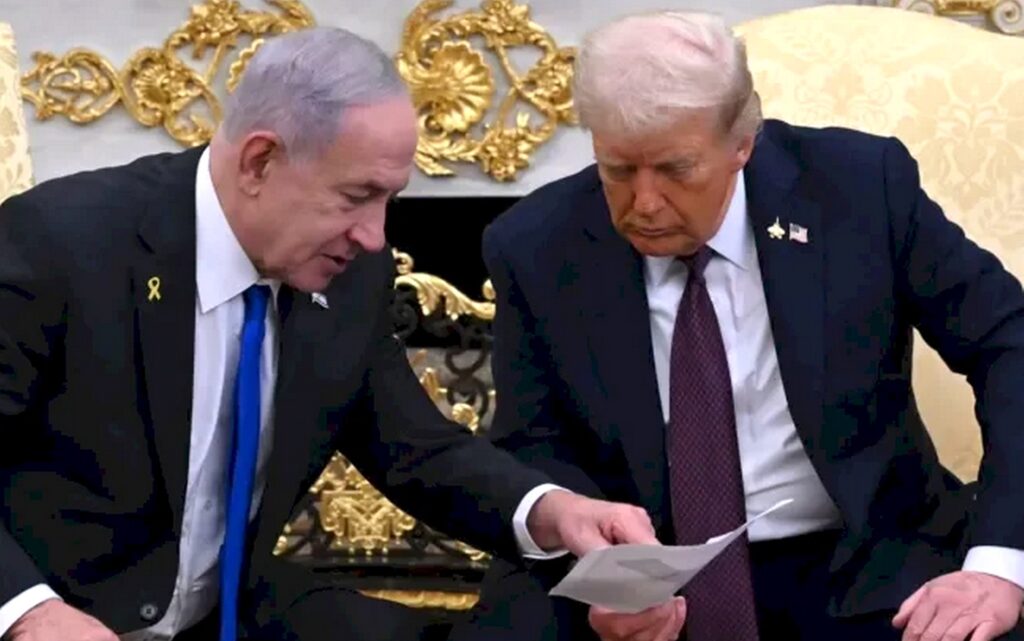
The Guardian newspaper said that a growing rift is emerging in the relationship between Israeli Prime Minister Benjamin Netanyahu and US President Donald Trump over the stalled war against Iran, and noted that public statements attempting to show full coordination between the two sides actually mask a deepening state of mistrust and political disagreement.
In a report from Jerusalem, the British newspaper’s correspondent Julian Borger said that Netanyahu is excessively insistent on boasting about the strength of his relationship with President Trump, but Israeli observers believe that this insistence raises more doubts about what is really going on behind the scenes, especially after leaks that spoke of Israel being excluded from some American consultations related to the war and indirect negotiations with Iran mediated by Pakistan.
According to the American-Israeli political analyst Dalia Sheindlin, Netanyahu’s frequent talk about the strength of the relationship with Trump is more worrying than reassuring, adding that the war is going very badly compared to the original objectives.
The article argues that the relationship between the two men has been based for years on a deep political and ideological intersection, as both have followed populist methods that have strengthened their internal influence at the expense of traditional institutions.
Netanyahu spent many years trying to convince US presidents to attack Iran, and played a pivotal role in pushing Trump to withdraw from the 2015 Iran nuclear deal concluded under Barack Obama.
The collapse of the nuclear agreement in 2018 led to the acceleration of the Iranian nuclear program and the accumulation of a large stockpile of highly enriched uranium, which paved the way for the current crisis.
According to former Israeli diplomat Alon Pinkas, Netanyahu convinced Trump that the Iranian regime was fragile and close to collapse, citing the previous US operation against Venezuelan President Nicolas Maduro as a model for quick and low-cost regime change.
Pinkas said that Netanyahu assured Trump that the Iranian economy was collapsing, that the people were on the verge of revolt, and that the Revolutionary Guard was losing control.
Mossad chief David Barnea even contributed to solidifying this image, presenting Iran as a “ripe fruit ready to fall”.
But these estimates, according to the article, proved to be completely wrong; the Iranian regime didn’t collapse, and the people didn’t rise up against the authorities, while Tehran was able to respond forcefully by targeting US bases and Gulf states, and disrupting navigation in the Strait of Hormuz, which caused a global economic crisis.
By the end of March, Trump was increasingly disillusioned with Netanyahu after the war became a political and strategic liability.
The US administration gradually ceased involving Israel in certain communications related to the negotiations with Iran, prompting Israeli officials to rely on their own intelligence agencies to ascertain the situation.
Trump also began to publicly criticize Netanyahu, especially after Israel targeted Iran’s South Pars gas field, and later declared via social media that Israel was forbidden from continuing to bomb Lebanon, in an unprecedented rebuke of the Israeli prime minister.
Trump is seeking to close the book on the war before his anticipated visit to Beijing and meeting with President Xi Jinping.
However, the war’s repercussions have politically intertwined the fates of the two men.
Netanyahu faces elections that could end his political career, while Trump fears the war’s impact on his domestic standing and the upcoming US elections.
Both, Trump and Netanyahu have each inflicted serious damage on the other, indicating that the war that brought them together could turn into a burden that threatens their political future together.