Palestinian banks are full of Israeli shekels!
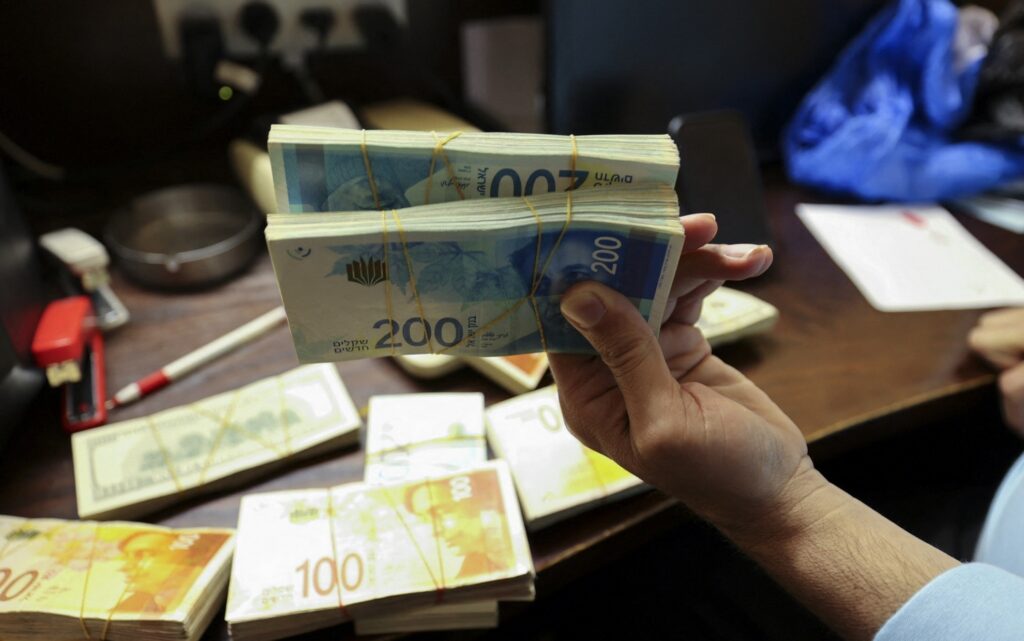
The Palestine Monetary Authority, the institution acting as the central bank, has issued renewed warnings about the repercussions of Israel’s continued refusal to receive the shekels accumulated in banks operating in the Palestinian markets.
The story is old and recent, with dates back several years, but it has worsened since the outbreak of the Israeli war on the Gaza Strip last October, while the Monetary Authority hasn’t issued any clarifications regarding the reasons for Israel’s delay in receiving the accumulated shekels.
Technically, the accumulation of the shekel means the existence of a monetary mass of the Israeli currency that exceeds the capacity of the Palestinian markets and the banks operating there to absorb it.
Here, the Bank of Israel is required to absorb the accumulated shekel, as it is the entity issuing the currency.
According to data from the Palestinian Monetary Authority, the amounts accumulated annually in the Palestinian banking sector exceed 18 billion shekels, while in the past few years they exceeded the 22-billion-shekel barrier.
Even on the eve of the Israeli war on Gaza, the Palestinian Monetary Authority and Israeli banks were coordinating to transfer the surplus cash, with a quarterly average of approximately 4 billion shekels.
The Israeli currency is considered the main payment and wages instrument in the Palestinian market, and it’s the approved currency alongside the US dollar and the Jordanian dinar, according to the Paris Economic Protocol signed in 1994.
The crisis of the accumulation of shekels in banks arises due to several factors, most notably trade payments between the Palestinian and Israeli sides, which causes the currency to move between the two parties.
Also, despite the decline in the number of Palestinian workers in Israel since the outbreak of the war on Gaza, the wages of these workers are paid in shekels, as this currency is transferred from Israel to the Palestinian territories.
Another factor is the purchases of Palestinians from the West Bank markets, as a result of which part of the Israeli monetary mass is transferred to the West Bank.
This last point has been further reinforced in the past few years with Israel limiting cash transactions to 11 shekels for individuals, and any purchases above this figure must be made through payment instruments other than cash.
Here, a segment of Palestinians inside Israel, and to a lesser extent Israelis, in the West Bank found a channel to meet purchases above these amounts, and pay in cash, to bypass Israeli restrictions.
Another factor which is related according to Palestinian banking sources, is related to the transfer of shekel money across the border between the West Bank and Israel, and its exchange in local markets.
As the shekel hoarding crisis escalates, banks are increasingly unable to accept deposits from their customers in Israeli currency.
The reason for this refusal by the banks is that they determine the size of the monetary mass in each currency they have, at a time when the shekel mass has exceeded the levels stipulated by the internal regulations of each bank.
The vaults of some banks are now filled with shekels, while others have been forced to put the cash in garbage bags because the vaults are full.
Here, with the accumulation of the Israeli currency, what is called the “idle shekel” is created, which banks cannot invest by lending it, and thus the money supply remains idle with them.
In this case, banks will face an insurance cost, because every shekel, dollar or dinar that enters the bank is insured, to avoid any developments that may cause this currency to lose.
The banks will also bear the cost of storing this cash as long as it’s not invested in other channels, and they will also be faced with the cost of transporting it from one place to another, whether between branches, or when the overcrowding crisis is resolved and the Israeli banks agree to receive it, and thus it is shipped and the shipping process is insured as well.
All these financial costs are recorded as expenses for the banks, and ultimately affect their financial results, and most importantly, the value of the shekel in comparison to these costs will actually be less than the Israeli shekel.
Since money or bank deposits are the fuel of banking, the existence of idle, uninvested currency is a burden on them and increases the operational costs of those banks.
There are 13 local and foreign banks operating in the Palestinian market, including 7 local banks and 6 foreign banks, including 5 Jordanian banks and one Egyptian bank.