MEMO: Brazil in the Global South and a multipolar world: the role of Arab-Brazilians
Unlike most of the articles I write for this portal, this time it is not a political analysis of a singular fact, but a hypothetical theoretical text.
Theory is understood as a set of concepts coherently articulated with each other, which elaborates concrete questions beyond mere rhetoric.
In other words, theory is to act in reality.
In this case, the theoretical debate presented here questions us, descendants of Arabs and participants in Brazilian citizenship.
We need to debate: what role can we play in the destiny of the country?
I reinforce the guiding idea. I do not question the role as “fragmented individualities”, but as a collectivity in accelerated reconfiguration.
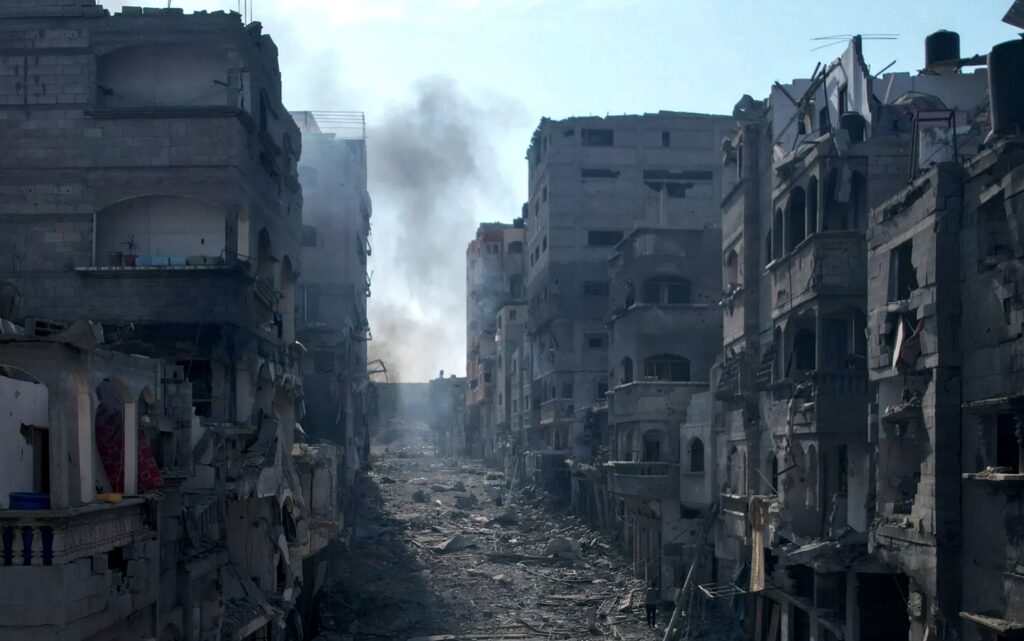
We are facing a genocide that is clearly being committed by the Israeli state and directly financed by the United States.
In comparison, it is like watching the gas chambers during the Shoah of World War II and seeing this crime against humanity being supported by the greatest Western power of the period.
Any similarity is no coincidence. Given this evidence, we must repeat the question: there are more than 16 million Brazilians of Arab descent; what should we do?
Considering that more than 92% of this population are Levantines, we have origins in Bilad al Sham, so the attacks on territories against Lebanon, Syria and Palestine unite us — or should unite us.
A possible comparison is to imagine that in the 1980s, we already had a consolidated Afro-Brazilian middle class in Brazil.
And, in the formation of consciousness of this part of the citizenry, the indignation against the apartheid practiced in South Africa polarized the debates and the sense of belonging of these tens of millions of people.
This is what is happening right now.
From first- or second-generation families, still with relatives in the land of origin, to generations already fully “assimilated” into the West — having the “luck” of being socially white —, the war against the Palestinian people polarizes our consciences.
We can say that this is a time of effervescence and indignation.
The first reaction is anti-Zionist propaganda.
Tens of thousands of Brimos and Brimas are trying to break the censorship and blockade of Zionist hegemony, reproduced by the media conglomerates in Brazil as if they were a propaganda machine of the State Department.
Committees supporting the Palestinian cause are springing up all over the country; the image of the largest Arab entities is being reinforced, which organize live broadcasts on the internet practically every day; and portals like this one lead the audience on the anti-imperialist internet.
That said, it looks like we’re okay, right?
Not yet.
Indignation organizes us: The majority of the population supports Palestine
In Brazil in 2024, one in five adults already follows some evangelical, neo-Pentecostal or neo-Calvinist denomination.
Unfortunately, the great leaders — the “colonels of faith” — are supporters of Zionism, defenders of the State of Israel and its supposedly divine right to massacre the indigenous peoples of occupied Palestine.
At the same time, a good portion of these believers are discontented, leading to the approximate number of 11 million “unchurched”, that is, people who broke with their religious leaders precisely because of their turn to the extreme right and their encouragement of colonial apartheid.
In addition to the evangelical base and its dissenters, Brazilian public opinion is far removed from the brainwashing promoted by the enemy lobby, the media oligopoly and the presence of operators within financial capital and related areas.
Thus, we have over 70% support from the Brazilian population, which expresses some form of support for Palestine and wants an end to foreign domination in our territories of origin.
Even so, it is not enough; It is impossible to understand ourselves as a collective in diaspora if the bond is organized only as support for a still distant struggle.
Nor are our collectives limited to political minorities idealized as secular, pan-Arabist, and linked to the most progressive ideas.
The reality is more complex, and the dynamic centers of the diaspora are more closely linked to the expansion of Islam in the country, both Shiite and Sunni, especially in São Paulo and Foz do Iguaçu.
In addition to the dynamic center, we have millions of isolated citizens who are regaining their consciousness and sense of belonging, realizing day after day the horrors of the West in its colonialist pretensions.
Beyond indignation: What country project accommodates our demands?
If there is anything that can unite us, besides supporting the struggle for the liberation of Palestine — from the river to the sea — and the sovereignty of Lebanon and Syria, it is to be part of a project for a country that can oppose US imperialism.
Any basic study of the geopolitics of the hegemonic North states that: “Brazil is already too big in inertia to become even bigger in movement”.
Another observation is: “Where Brazil goes, South America and perhaps all of Latin America will go”.
If it depends on Washington and the majority of the ruling class in this country, we will never stop being a mix of financial casino, plantation farm and open-pit mining.
In other words, our “manifest destiny” would be to serve as a primary export platform to serve the world market.
The most we can hope for — according to this logic of domination — is to be part of the Asian trade flow, under Chinese leadership, and to try to seize some opportunities in the world commodities market in the face of the new bipolarity.
In other words, we will not be able to have, as a country, an industrial recovery, nor the preservation of biomes, nor the use of resources to develop the pharmaceutical industry and scientific patents.
Brazil would be (is) a giant with feet of clay, where the colonialist mentality permeates the controllers of rentierism, financing of agribusiness and interest groups lobbying within the federal government. Unfortunately, the high command of the Armed Forces has shown itself to be little or not at all trustworthy when it comes to defending democracy and popular sovereignty.
The recent (mis)government of Jair Bolsonaro — a strategic ally of Zionism and of Netanyahu himself — has proven that the mix of surrender, corporate interest and subservience to Washington and Tel Aviv is gigantic.
It is impossible to support any presence, projection of power or “peaceful” coexistence with the Zionist enemy and its imperialist financier in Brazil.
In the International System, our country must be a pillar of multipolarity and open relations of cooperation and complementarity with the so-called Global South.
Specifically, economic development through the BRICS is a viable path and obviously, subject to sabotage and destabilization by Zionists and the United States.
The logical reasoning expressed here is far from being realized.
Brazil does not have a ruling class or ruling elites with a vocation for world power.
Strengthening a position that is not subordinate to Washington automatically generates conflict within the state apparatus and the lobbies of colonial interests.
Any action in the opposite direction attracts the attention of enemy espionage and its spokespeople operating in the country.
Therefore, we, Brazilians of Arab origin and supporters of the anti-colonial struggle, cannot be part of a subordinate project for the country.
It may even seem like a cliché or a pamphlet, but it is that simple.
Supporting the liberation of Palestine from Brazil is fighting for a sovereign country that is necessarily inserted in South-South relations, a bastion of multipolarity.
The original article here.