Israel’s ambassador in UN: The capabilities of the Egyptian army is on the rise… Why all these tanks and submarines?
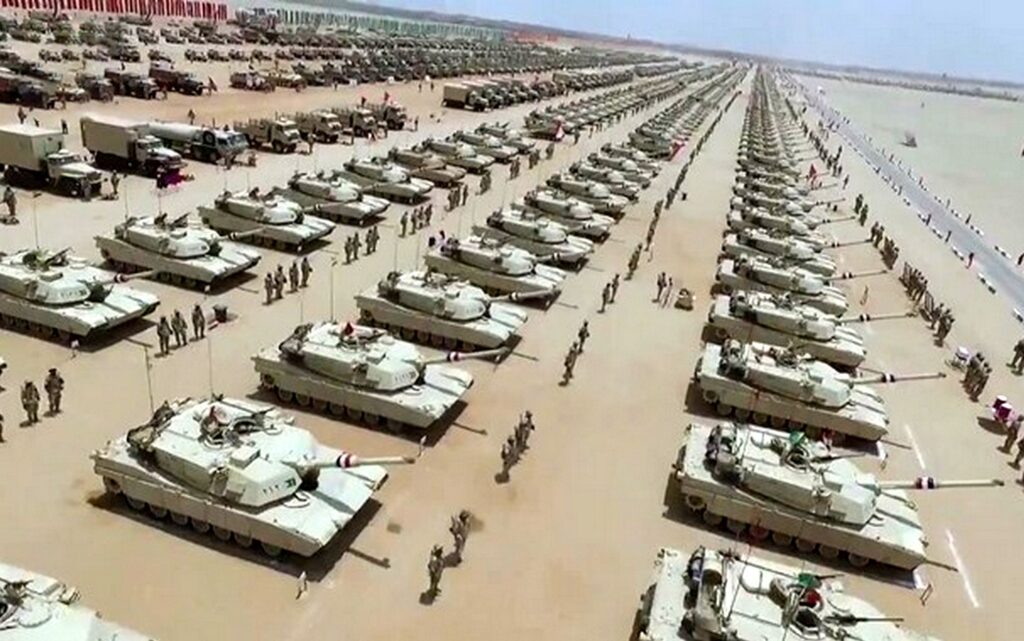
Israel’s ambassador to the United Nations, Danny Danon, warned of the growing military arsenal of the Egyptian army, in a rare statement at the official level in Tel Aviv.
Danon wondered why Cairo spends hundreds of millions of dollars annually on modern military equipment, even though it does not “face any threats on its borders,” he said, adding, “Why do they need all these submarines and tanks?”
Speaking on local Israeli radio, Danon linked his concerns about Egypt to the October 7 Hamas attack on Israel, saying, “After the events of October 7, we must sound the alarm… We’ve learned our lesson, and we must monitor Egypt closely and prepare for all scenarios”.
Israel’s ambassador to the United Nations also pointed to Washington’s role in supplying Egypt with weapons, urging it to reconsider the matter.
“We’ve to ask the United States why Egypt needs all this equipment?” he said.
This is the first time that a high-ranking Israeli official has publicly raised questions about Egyptian military expansion.
Egypt has diverse defense partnerships that have allowed it to purchase advanced weapons from the United States, European countries, Russia and China at the same time.
Cairo also manufactures several types of equipment and ammunition locally.
Egypt and Israel have been linked by a peace treaty since 1979, when it was the first Arab country to sign a peace agreement with Israel.
Bilateral relations between the two sides then went through periods of calm and tension, following four military confrontations in 1948, 1956, 1967 and 1973.
The US-sponsored peace between Cairo and Tel Aviv has long been described as a “cold peace,” as most of its manifestations were confined to the official level between the two countries.
Egypt, along with Qatar and the United States, participated in mediating between Israel and Hamas, which resulted in a ceasefire agreement in the Gaza Strip, the first phase of which went into effect on January 19, after about 15 months of war.
The Israeli war on Gaza led to tension in Egyptian-Israeli relations, as Cairo condemned Tel Aviv’s targeting of Palestinian civilians in the Strip, and protested the entry of Israeli forces into the “Philadelphi Corridor” area, considering it a violation of the peace agreement between the two countries.
It also warned of the Israeli war machine’s efforts to push the residents of the Strip towards the Egyptian border.
While Hamas was announcing on Tuesday evening its approval of the Egyptian proposal for a ceasefire agreement in the Gaza Strip, Israeli tanks were making their way to eastern Rafah.
The US President, Donald Trump, who returned to the White House, renewed Cairo’s fears of the scenario of displacing the residents of Gaza, after he publicly called for their transfer to Egypt and Jordan, statements to which the Egyptian President, Abdel Fattah el Sisi, and the King of Jordan, Abdullah II, responded with categorical rejection.
However, that did not prevent Trump from challenging the two countries, repeating more than once that they would receive the residents of Gaza.
During a meeting with Egyptian military commanders last November, el Sisi said, “The successive events and turbulent conditions witnessed by the region confirm that our choice for a just and sustainable peace requires us to continue building the capabilities of comprehensive forces to preserve and protect the homeland, while continuing the efforts of comprehensive development of the state”.
Last October, Egyptian Foreign Minister Badr Abdel Aati said that the Egyptian armed forces were fully prepared to defend the Egyptian borders.
The Egyptian Foreign Minister pointed out in statements, that Israel’s peace is contingent on fulfilling the legitimate rights of the Palestinian people”.
He added, “There is no compromise regarding the Egyptian borders, and we are constantly monitoring the readiness of our armed forces… No one will dare to tamper with Egyptian sovereignty, because they know the severity of the Egyptian response, which will be extremely harsh in the event of any threat to national security”.
The Egyptian Foreign Minister considered that pretending to be arrogant and forceful hasn’t and won’t achieve security and stability for Israel.
He added that “Egypt is fully aware of the attempts to spread chaos in the region, and realizes that the peace process can only be achieved with the force that protects it”.
From his part, Israel’s prime minister, Benjamin Netanyahu considered that what he called relieving pressure on Hamas by leaving the Philadelphi corridor doesn’t enable his government to return all the detainees in the Strip.
Last September, Netanyahu renewed his allegations that the Philadelphi Corridor on the border with Egypt was used to smuggle weapons to Hamas, as a justification for the Israeli army to remain there.