Financial Times: Lack of French support thwarts Germany’s moves on frozen assets
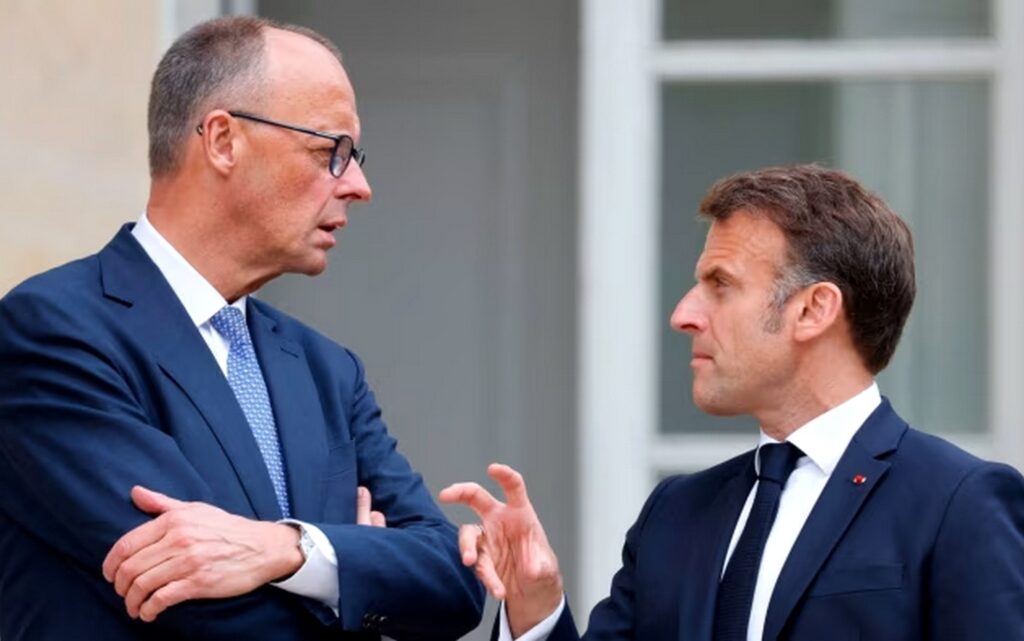
German Chancellor Friedrich Merz has found himself without a decisive ally in his latest bid to persuade EU leaders to use some 210 billion Euros of frozen Russian sovereign assets in support of Ukraine, after it became clear that French President Emmanuel Macron wouldn’t stand by him.
The German chancellor was pushing hard ahead of the Brussels summit last Thursday to adopt his country’s proposal, before it became clear to him that there was no support for Macron, Berlin’s most prominent traditional ally within the bloc.
In the weeks leading up to the summit, the French president did not publicly oppose the German initiative, but his team expressed legal reservations in closed meetings, warning that debt-ridden France would find it difficult to provide a national guarantee if it had to return these assets to Moscow at short notice.
The newspaper reported that the joining of other countries, including Italy, to Belgium’s opposition position from the beginning, where most Russian assets are being held, prompted Macron to align himself with the rejectionist camp, which dropped the proposal.
A senior European diplomat with direct knowledge of the European summit discussions said: “Macron betrayed Merz and he knew that this would pay a price, but he was so weak that he was left with no choice but to join Italian Prime Minister Giorgia Meloni”.
This tension reflects a new dynamic between Europe’s two biggest powers: Germany is leading the initiative and France is “dragging its feet”.
Since Merz came to power in May, a more assertive tone has prevailed in Berlin, which has translated into opening the door to spending of up to 1 trillion Euro on defense and infrastructure over the next decade, while Paris appears constrained by high public debt and political turmoil in the second half of Macron’s last term.
The imbalance has dashed hopes of reviving the Franco-German engine, which was once behind some of the biggest political leaps in EU history.
Georgina Wright, a senior fellow at the Marshall Fund, a Paris-based think tank, said: “In Brussels, there is a real sense that Berlin is the biggest player, and that France’s influence is limited”.
Merz sought to turn the page on three years of German hesitancy under his predecessor Olaf Scholz, who was often forced to abstain in Brussels due to divisions within his ruling coalition, a pattern that became known as the “German vote”.
After Merz’s Christian Democrats won the February election, he made recalibrating relations with France a key priority.
This has included pledging to strengthen Europe’s defenses in the face of a US administration seen as unreliable, abandoning Germany’s opposition to nuclear energy and reducing regulatory restrictions within the European Union.
But the German chancellor later found himself confronted by the French president, who was described by the British newspaper as a “lame duck” politically and severely restricted in his ability to abide by any decisions with financial implications.
Mojtaba Rahman, head of Europe affairs at the Eurasia Group, said: “What is happening is a complete reflection of the roles between Macron and Merz… For the past four or five years, there has been a conviction in the Elysee Palace that Germany’s weakness has undermined Europe’s ability to act”.
“Today, there is a German chancellor who understands geopolitics and wants to get more involved and do more for Europe, but Paris is unable to deliver its share of the deal”.
The European summit also saw another point of tension in the trade deal between the European Union and the Mercosur bloc of Latin American countries.
After more than 25 years of negotiations, Merz has been pushing for months to sign the deal by the end of December, hinting at a vote in which France could find itself in the minority.
But Macron, a pro-EU centrist, has again found an unlikely ally in Meloni, Italy’s right-wing leader, who has successfully postponed the deal for a few weeks, denying Merz a new political victory.
Daniela Schwarzer, a researcher at the Bertelsmann Foundation in Berlin, said: “There is a real realization on both sides that the relationship needs to be more effective, and that it didn’t work under Scholz… However, France is under much more pressure, and this brings to the surface fundamental differences between the two powers, especially on trade”.
Despite the manifestations of division between Merz and Macron, the summit witnessed an important breakthrough, as the European Union agreed to give Ukraine a loan of 90 billion Euros, guaranteed by the bloc’s budget.
“Macron played a pivotal role in reaching the agreement,” an official at the Elysee Palace said, “France’s goal has always been to provide a clear financial vision for Ukraine over the next two years… We were open to the proposed funding arrangements, and we worked to find a solution that would achieve this goal”.
Meloni also pledged to support the Mercosur agreement next month, paving the way for its signing regardless of France’s objections.
Joseph de Wyck, a researcher at the Foreign Policy Research Institute, said: “In the Mercosur dossier, France may have won two or three weeks, but it lost the battle. In both issues, there is no joint leadership, and Merz is leading the push”.
The Franco-German partnership will face further pressure in the coming weeks as a decision is made on whether to proceed with a 100 billion Euro joint venture to develop a new fighter, with France’s Dassault and Airbus, whose defense division is based in Germany, refusing to resolve the dispute over the allocation of roles and work quotas.
Berlin has been considering alternative partnership options in the fighter jet field, amid growing frustration with Dassault and suspicions that Paris is primarily seeking funding.
The consensus between France and Germany has rarely been greater than it is today, in the face of high US tariffs and President Donald Trump’s threats to withdraw US troops from Europe.
The two sides also agree on support for Ukraine and the need for the continent to play a more active role in peace talks through the “Alliance of the Willing,” which also includes Britain.
Merz has embraced concepts that Paris has long defended, such as European strategic autonomy, a preference for “European procurement” in defense procurement, and greater protection of the single market from unfair competition.
Recently, Berlin supported trade measures against Chinese steel imports, a clear departure from Germany’s previous position.
Georgina Wright said: “There is a growing sense in Brussels that France is prioritising national interests over European interests… The old saying that ‘France is words without action’ is coming to the fore”.
Domestically, Merz is facing growing impatience and mistrust, as he returns from Brussels with diplomatic failures.
German officials confirmed that the EU loan to Ukraine will be financed from unused items in the EU budget, without imposing any burdens on the national finances.
Merz expressed satisfaction with the results last week, saying they were better than his original proposal, and asserting that Russian assets were still able to cover the loan.
“We’re offering a down payment, but its guaranteed with Russian assets,” he said.
However, criticism has poured in from the far-right Alternative for Germany (AfD) party, with its leader Alice Wiedel saying that “the German taxpayer will bear the bill again”.
Güntram Wolff, a senior researcher at the Bruegel Institute, said it wasn’t good to go back to the country without the Mercosur agreement or the Russian asset plan.
He added, “The question before Macron now is whether it’s wise to blame Merz for political losses in two big files”.