Ecuadorian voters reject the return of US military bases to the country
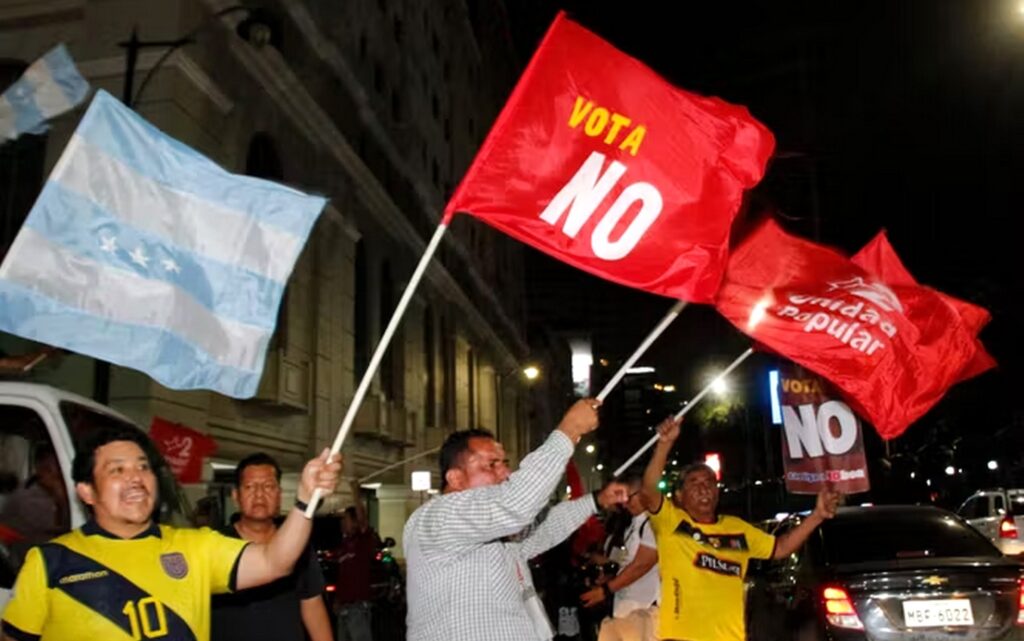
Ecuadorian voters categorically rejected the return of US military bases to the country in a referendum on Sunday, the results of which dealt a severe political blow to President Daniel Noboa, Washington’s close ally and friend of Donald Trump.
After about three-quarters of the votes were counted, partial results showed that about 60% of Ecuadorians said “NO” to lifting the long-standing ban on foreign bases.
The refusal cuts off the way for the US military to return to an air base in the Ecuadorian port city of Manta, which was once a Washington’s counter-narcotics operations center.
Before this heavy defeat, Noboa had hoped to support the United States in its Latin American policies in exchange for its support in fighting gangs that proliferate in his country, the main export corridor for drugs produced in Peru and neighboring Colombia.
Some 14 million voters were eligible to participate in the mandatory referendum, with four questions to say yes or no about the country’s foreign rules, draft a new constitution, end government funding for political parties and reduce the number of members of parliament.
The preliminary count of votes showed that the rest of the proposals also failed by a wide margin.
“We respect the will of the Ecuadorian people,” Noboa said after the results showed that a large majority of voters rejected his proposals.
The referendum was held amid heightened tension in Latin America and a US military deployment in the Caribbean and Pacific, where Washington has been carrying out strikes it says are targeting drug traffickers.
The result was a shock because most opinion polls predicted that all four proposals would pass for Noboa, who remains hugely popular after recently winning a second term.
Ahead of the vote, Noboa announced in a post on X the arrest of Bebo Chavarria, the leader of Ecuador’s main drug trafficking ring.
Interior Minister John Remberg later clarified on the same platform that the arrest took place in Spain.
Ecuador is experiencing an unprecedented phase of insecurity, with a homicide rate of 39 per 100,000 inhabitants, according to the Insight Crime Institute, the highest among Latin American countries.
Experts expect the rate to reach 52 this year, a rate never recorded before, and equivalent to double the rate recorded in the countries of the region.
Since Donald Trump’s return to the White House, Ecuador has become one of Washington’s closest allies, with support for the US military deployment in the Caribbean, where at least 80 people the US says are drug traffickers.
The Ecuadorian president hasn’t disclosed much about the content of the new constitution, but experts have said that it will actually have very little impact on improving the security situation in the country.