DW: Trump’s return to the White House… a nightmare for Berlin
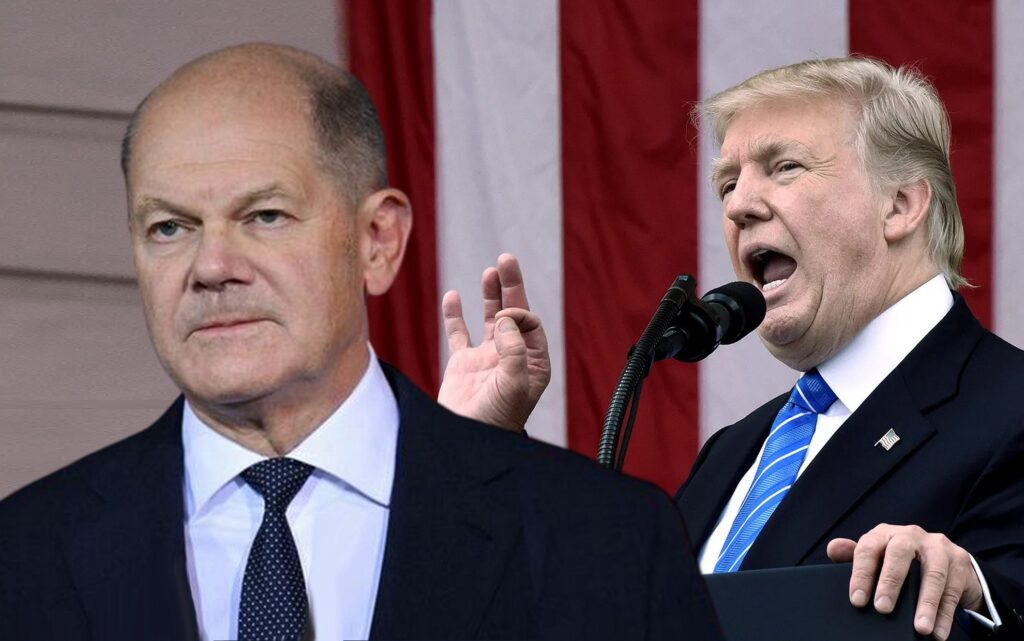
The German government woke up on Wednesday to a real nightmare of Donald Trump’s victory in the presidential election, after having long clung to hopes that Kamala Harris would continue the tradition after Joe Biden, a prominent supporter of transatlantic relations and a champion of multilateralism.
But Trump suddenly won the race quickly and clearly.
Now the German government is ill-prepared, especially given its current crisis that has been ongoing for weeks over disagreements over the economic direction, the disintegration of the ruling coalition after the dismissal of Finance Minister Christian Lindner and Chancellor Olaf Scholz’s announcement of a confidence vote in mid-January, which could lead to early elections by March.
In this context, Henning Hoff of the German Society for Foreign Relations criticizes.
“It was a mistake to rely entirely on the Democrats,” he said, adding, “the special relationship that German Chancellor Scholz maintained with US President Biden was perhaps somewhat biased… Now it’s time for Germany to pay the price for having had no contact at all with the Trump camp”.
Memories of Donald Trump’s first presidency from 2017 to 2021 are still very much alive in Berlin.
During that period, Trump questioned NATO and threatened to withdraw US troops from Germany.
His criticism of Germany and other NATO countries was that they benefited from US military protection without contributing enough to their own defense.
What is important now for the German government is to make up for these shortcomings”.
Hoff said, “There needs to be a much stronger signal that the Europeans, and especially the Germans, are actually prepared to take on a greater defense burden… If we continue to equivocate and argue that we have our own wealth [for the Bundeswehr] and therefore the defense budget itself should rise very little, no one in Washington will like that, neither now nor under Trump”.
The expected change from Joe Biden to Donald Trump will have no other international impact as clearly as the war in Ukraine.
This is also the crucial question that the Scholz government must ask: What will happen to the support for Ukraine?
After all, the United States is by far the most important arms supplier and financier of Ukraine, followed by Germany.
While President Joe Biden and Chancellor Olaf Scholz have promised to support Ukraine as long as necessary, Donald Trump wants the war to end quickly.
He says so anyway… That would likely mean Ukraine having to give up large parts of its territory that Russia took.
But “we don’t know” what US policy toward Ukraine will look like under Trump, security expert Nico Lange told DW ahead of the US election, “We can’t say that Trump will sell out Ukraine when he wins… The thing about Donald Trump is that you can’t really predict what he will do”.
If Trump were to try to reach an agreement with Russian President Vladimir Putin, away from Ukrainian officials and their supporters, in order to end the war at Ukraine’s expense, Henning Hoff believes, this could be a temptation for Berlin: The German government could use this as an excuse.
“We would like to do more, but look at the Americans… That’s the danger I see,” Hoff said.
Germany is one of the United States’ most important trading partners.
As such, Washington’s economic policy has a direct impact on Germany.
During his election campaign, Trump announced his intention to impose a 60% tariff on US imports from China and a 20% tariff on imports from the rest of the world if he wins.
This would significantly raise the prices of German products in the United States.
The German automobile and pharmaceutical industries would be particularly hard hit.
“This would be a huge millstone around the neck of German export industries,” Hoff warned.
That’s why many German industrial companies are worried.
In a survey conducted by the Ifo Institute about two weeks before the US election, 44% of companies surveyed said they feared negative consequences if Trump won the presidency.
Only 5% hoped for positive effects, while 51% expected no difference.
A previous Ifo study predicted that German exports to the United States would fall by around 15%, just from Trump’s tariffs.
The tariff barriers could also have indirect consequences for Germany, fears Andreas Bauer of the Ifo Institute, “We can of course assume that Chinese trading partners will respond, and that is probably what makes us most worried about entering an escalation spiral that could lead to a global trade war”,
However, the situation hasn’t been any easier for the German export sector even under the current Biden-Harris government.
During the election campaign, Trump and Harris focused on strengthening domestic industry and on their desire to bring manufacturing jobs back to the country, as Siegfried Russwurm, head of the Federation of German Industries, said during the election campaign.
Andreas Bauer confirms this by saying that Biden has maintained all the tariffs imposed on Chinese imports by Trump during his first presidency, and even lifted some of them, “The big difference between Trump and Harris is how they view allies… Trump’s rhetoric is clear: what matters is the USA versus the rest, while Harris is well aware that the USA needs allies”.