DW: Tanks instead of cars… How is armament changing the German job market?
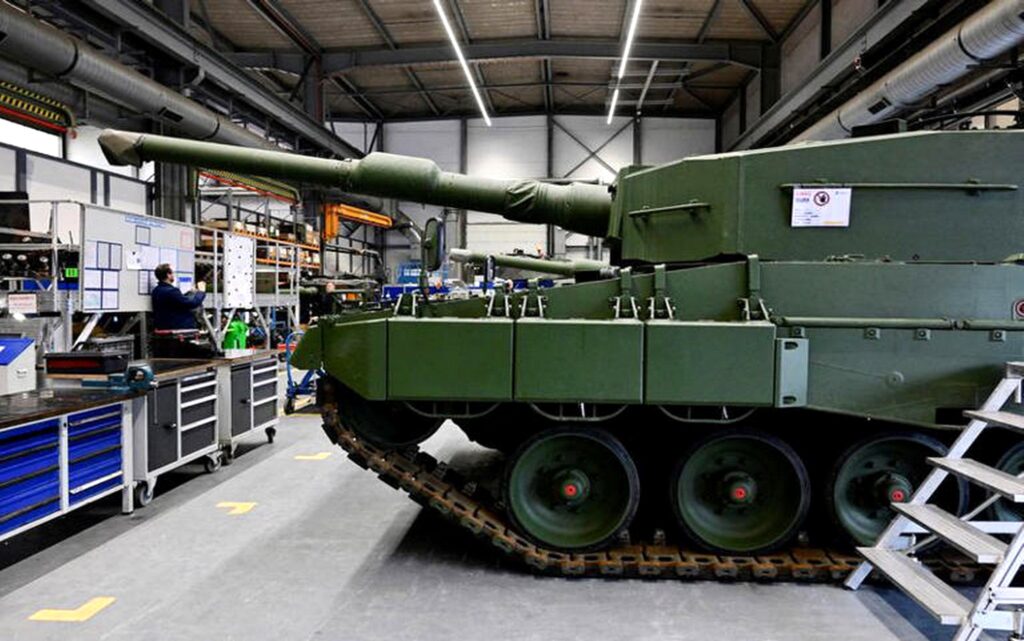
Cards are being reshuffled in German industry, while leading German companies like Volkswagen are losing jobs, tank and cruise missile manufacturers are desperately looking for new employees.
A recent study by the consulting firm EY and Dekabank estimates that NATO member states in Europe will, based on current trends, invest approximately €72 billion annually in the arms sector over the coming years, creating or maintaining approximately 680,000 jobs in Europe.
Another study conducted by the consulting firm Kearney reached similar results, however, the exact number of specialists required depends on the extent to which European NATO countries enhance their military capabilities.
If these countries were to allocate two percent of their GDP to defense spending in the future, in accordance with NATO regulations, there would be a shortage of approximately 160,000 specialists by 2030.
If this percentage increases to 2.5%, the number of vacant positions could reach 460,000, and if it rises to 3%, the deficit could rise to 760,000.
The greatest shortage is in specialists in the fields of artificial intelligence and big data analytics.
To give context: Armaments companies like Rheinmetall and others currently employ around 60,000 people in Germany, and when including suppliers, the number reaches nearly 150,000, according to Klaus-Heiner Ruhl, an arms expert at the Institute for the German Economy (IW), a think tank close to employers.
Manufacturers of artillery, radar technology, and armored vehicles are not only looking for new workers but are also seeking new production sites in anticipation of the expected increased demand.
What better option than capitalizing on struggling sectors?
“We’re taking advantage of the difficulties facing the automotive industry,” Oliver Durra, CEO of Hensault, told Reuters in an interview.
The Bavarian company produces high-performance radars used, for example, in air defense in Ukraine.
One of Hensault’s systems is even capable of detecting stealth bombers such as the American F-35.
Durra confirms that talks are already underway with auto parts suppliers Continental and Bosch about the possibility of absorbing their employees.
In the eastern German city of Görlitz, on the border with Poland, the KNDS arms group took over a factory belonging to the Alstom train company, where trains were being manufactured; The factory was scheduled to close by 2026.
KNDS aims to employ approximately half of its 700-strong workforce.
The company plans to produce parts and components for the Leopard 2, Puma, and Boxer tanks at this former factory, with manufacturing expected to begin in 2025.
Competitor Rheinmetall also relies on hiring people from other fields: for example, a technician who previously manufactured components for the oil industry now produces tank gun barrels at a Rheinmetall factory in northern Germany, even a former beautician now works painting artillery shells.
It’s not easy to transition from the civilian sector to the arms industry, explains Eva Brückner in an interview with DW.
“You can only transition to certain jobs and tasks,” says the recruitment consultant, who specializes in the security and defense sector.
For example, a technical worker working on a production line at Volkswagen or another company can find work at some armament’s companies.
Similarly, a development engineer can, after a certain period of training, work in this field, according to Brückner, CEO of the recruitment firm Heinrich & Kohl in Munich.
But in other jobs, such as sales or purchasing, the transition is almost impossible.
“You can’t simply transfer a purchasing officer from the automotive industry, where they expect suppliers to meet their orders immediately, to the armaments sector, which operates in a completely different way,” Bruckner explains.
For his part, Hans-Christoph Atsboden, Director General of the German Security and Defense Industries Association, points to a particular feature of armaments companies: many jobs require passing strict security checks, and these checks take a long time.
He emphasizes, “The time required to approve these permits is currently insufficient to facilitate a rapid transfer of employees”.
The country list also plays an important role in this context. Germany imposes high requirements on applicants from countries posing significant security risks.
The list, issued by the German Ministry of the Interior, includes countries such as Afghanistan, China, Vietnam, Iraq, Iran, Syria, Russia, and the former Soviet republics.
Its sufficient for a person to have resided for a long period in one of these countries, for his employment in the arms sector to become extremely difficult.
Germany and Europe won’t be able to quickly find enough specialists, opening the door for the United States, says Eva Brückner.
“Because Trump announced plans to cut funding for research institutes and universities, an opportunity has opened up for Europe,” she explains.
Until now, America’s prestigious universities and huge research budgets have attracted the brightest minds from around the world, but with funding cuts, Europe has an opportunity to say, “We’re now the innovation engine, and we will attract these experts”.
Brückner adds that she has already received requests from the United States, where some experts have not had their green cards extended, or no longer feel valued in their American jobs.
She continues, “Many of them are wondering whether they want to continue with the new political and geopolitical approach of the United States”.
She sees this as a golden opportunity that must be seized, because Europe can attract truly brilliant minds.
She believes the defense sector must take a new approach to hiring.
Having more women in leadership positions, which are often dominated by former officers, would be a positive thing.
She explains, “We need discreet people who work in the shadows and don’t seek the spotlight, because dealing with security issues requires it”.
Digital transformation is also changing hiring standards, as today, those in high demand are IT and AI specialists, particularly those specializing in linking modern weapons systems and using big data to analyze the military landscape.
However, he stresses that such experts are very rare, saying, “The defense sector has traditionally relied on analog systems, and now lacks digital minds”.
Regarding wages, Eva Brückner confirms that companies will have to offer higher salaries to attract the required talent, “I am sure that companies will have to raise salaries again”.