CNN admits that the video of its correspondent revealing the moment a prisoner was found in Bashar al Assad’s cells was fake and misleading
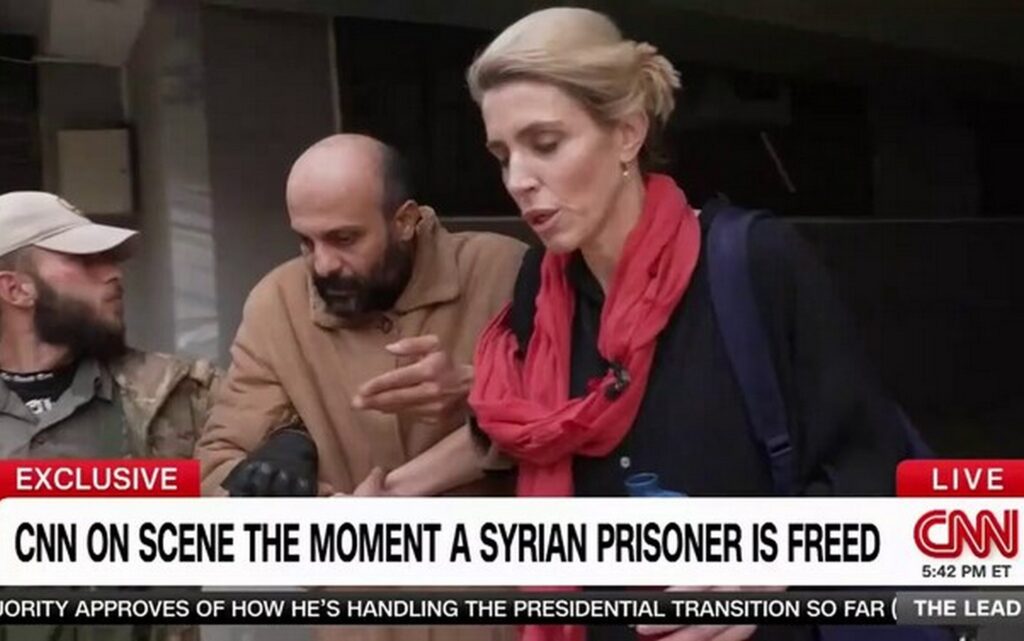
CNN reported that local residents in Syria revealed that the man who was filmed by CNN during his release from a prison in Damascus by Syrian factions is a former intelligence officer in the ousted Syrian regime, and not an ordinary citizen who was imprisoned as he claimed at the time of his release.
CNN initially found the man while following a lead to missing American journalist Austin Tice.
In a video report, the network’s international correspondent Clarissa Ward and her team, accompanied by a guard from the Syrian factions, came across a cell in a prison in Damascus that was locked from the outside.
The guard shot the lock with his pistol to open it, and the man was found alone inside the cell, under a blanket, according to the network.
When he came out into the open air, the man appeared confused, and when the fighter from the Syrian factions who released him asked him for his name, the man identified himself as Adel Gharbal from the city of Homs in central Syria.
He claimed that he had been held in a cell for three months, adding that it was the third prison he had been held in.
The man also said he did not know about the fall of Bashar al Assad’s regime.
He was held in a prison run by the Syrian Air Force Intelligence Service until the collapse of the Assad regime.
A photo obtained by CNN on Monday revealed the true identity of the man, whose name is Salama Mohammed Salama, a lieutenant in the Assad regime’s Air Force Intelligence Directorate.
A resident of the al Bayada neighborhood in Homs provided CNN with a photo said to be of the same man performing his military service, apparently in a government office.
Facial recognition software showed a more than 99 percent match with the man CNN met in a Damascus prison cell.
The image shows the man sitting at a desk and appears to be wearing a military uniform. CNN is not publishing the image to protect the source’s anonymity.
As CNN continues to search for information about the released prisoner after the original report, several Homs residents say the man is Salama, also known as “Abu Hamza”.
They told CNN he ran Air Force Intelligence checkpoints in the city, and accused him of having a reputation for extortion and harassment.
It’s not yet clear how or why Salama ended up in a Damascus prison, and CNN was unable to contact him again.
Meanwhile, CNN and the correspondent were widely condemned by Syrians on social media after the video was published, because it was clearly fake and misleading, whether in terms of the way it was produced, the place where it happened, or the appearance and behavior of the alleged detainee, at a time when Syria is full of stories of real detainees and the disasters that Assad’s regime has inflicted on the Syrians.