What’s behind Germany’s fail to secure UN Security Council seat?
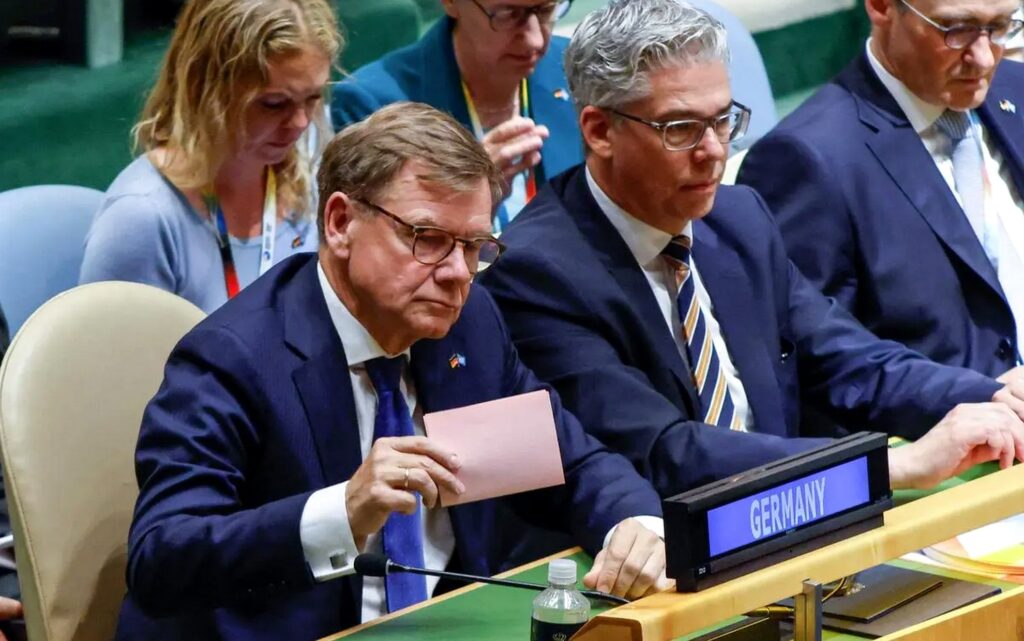
Germany has suffered a significant diplomatic setback after failing to win a non-permanent seat on the United Nations Security Council for the 2027–2028 term.
The outcome marks the first time in recent history that Germany has been unsuccessful in a Security Council election, raising questions about the country’s international influence and the changing dynamics within the United Nations General Assembly.
The election took place on June 3, 2026, during a secret ballot vote conducted by the 193-member UN General Assembly.
Germany competed against Austria and Portugal for two seats allocated to the Western European and Others Group (WEOG).
When the votes were counted, Portugal secured 134 votes and Austria received 131 votes, both surpassing the required two-thirds majority needed for election.
Germany, however, obtained only 104 votes and finished in third place, well below the threshold required to win a seat.
Because Security Council elections are conducted by secret ballot, it’s impossible to determine which countries voted for Germany and which voted against it.
The United Nations doesn’t publish the voting records of individual member states in these elections, meaning that only the final vote totals are known.
Nevertheless, diplomats and political analysts have attempted to explain the result by examining broader geopolitical trends and diplomatic relationships.
One factor frequently cited is Germany’s strong support for Ukraine since the outbreak of the war with Russia.
Berlin has provided extensive military, economic, and political assistance to Kyiv and has been among the leading European advocates of sanctions against Moscow.
While this policy has strengthened Germany’s standing among Western allies, some observers believe it may have reduced support among countries that maintain close relations with Russia or seek to remain neutral in the conflict.
Germany’s position regarding Israel and the conflict in Gaza has also been highlighted as a possible factor.
Berlin has long been one of Israel’s strongest international supporters, a stance that has drawn criticism from some countries in Africa, Asia, and Latin America.
Several analysts argue that Germany’s policies in the Middle East may have affected its ability to attract support from parts of the Global South, whose influence within the General Assembly has continued to grow.
Another explanation concerns the effectiveness of the competing campaigns, as Austria and Portugal reportedly began their diplomatic efforts years before the election, engaging in extensive outreach and building support across multiple regional groups.
Their long-term campaigning may have given them an advantage over Germany, which entered a highly competitive contest where every vote proved important.
Some observers have also pointed to reductions in German development assistance and foreign aid budgets in recent years.
Although Germany remains one of the world’s largest donors, cuts to certain aid programs may have weakened its influence among developing countries, many of which view development cooperation as an important factor when deciding how to vote in international organizations.
Following the election, German Foreign Minister Johann Wadephul suggested that Russia had worked behind the scenes to mobilize opposition to Germany’s candidacy in response to Berlin’s support for Ukraine.
While such claims have attracted attention, no official evidence has been publicly presented to confirm the extent of any Russian involvement in the voting process.
The defeat is particularly notable because Germany has traditionally enjoyed considerable success in international diplomacy and is one of the largest financial contributors to the United Nations system.
Since German reunification, the country had consistently secured election whenever it sought a non-permanent Security Council seat.
The loss therefore came as a surprise to many diplomats and international observers, however, and despite the setback, German officials emphasized that the result wouldn’t alter the country’s commitment to multilateral cooperation or its support for the United Nations.
Berlin reaffirmed its intention to remain actively engaged in international peace, security, and development initiatives and stated that it would continue working closely with partners around the world.
The countries elected to serve on the United Nations Security Council for the 2027–2028 term were Austria, Portugal, Kyrgyzstan, Trinidad and Tobago, and Zimbabwe.
Germany’s failure to join them reflects the increasingly competitive nature of Security Council elections and illustrates the growing importance of diplomatic outreach beyond traditional alliances.
For many analysts, the vote serves as a reminder that influence within the United Nations depends not only on economic strength and political weight but also on maintaining broad international support across a diverse and evolving global community.