South Korea’s Gray War Against Russia
By: Contribution for Syrializm
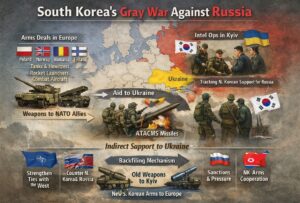
South Korea’s indirect war against Russia is being waged through the supply of weapons to what can be called the NATO-aligned European boarder countries.
In this context, the role of South Korean intelligence is particularly prominent, as it was the first to announce and reveal North Korean cooperation with Russia, and the first to provide intelligence reports detailing North Korea’s supply of artillery shells and various types of ammunition to Russia.
South Korean intelligence was also the first to report on the deployment of North Korean troops to fight alongside Russia.
Furthermore, the interrogation of North Korean soldiers captured by Ukrainian forces took place in Kyiv and was conducted by South Korean intelligence officers, who are now permanently stationed there under diplomatic cover.
Their role involves coordinating the transfer of weapons from European purchasing countries to Ukraine, as well as monitoring and tracking all military activities suspected of involving North Korean forces on various fronts against Russia.
In recent years, South Korea has secured several major arms deals with European countries, solidifying its role as a key arms supplier outside of Asia.
The most significant of these deals was with Poland, South Korea’s largest European partner.
This partnership included a massive multi-year agreement spanning from 2022 to 2029, the largest of its kind in the history of South Korean arms exports to Europe.
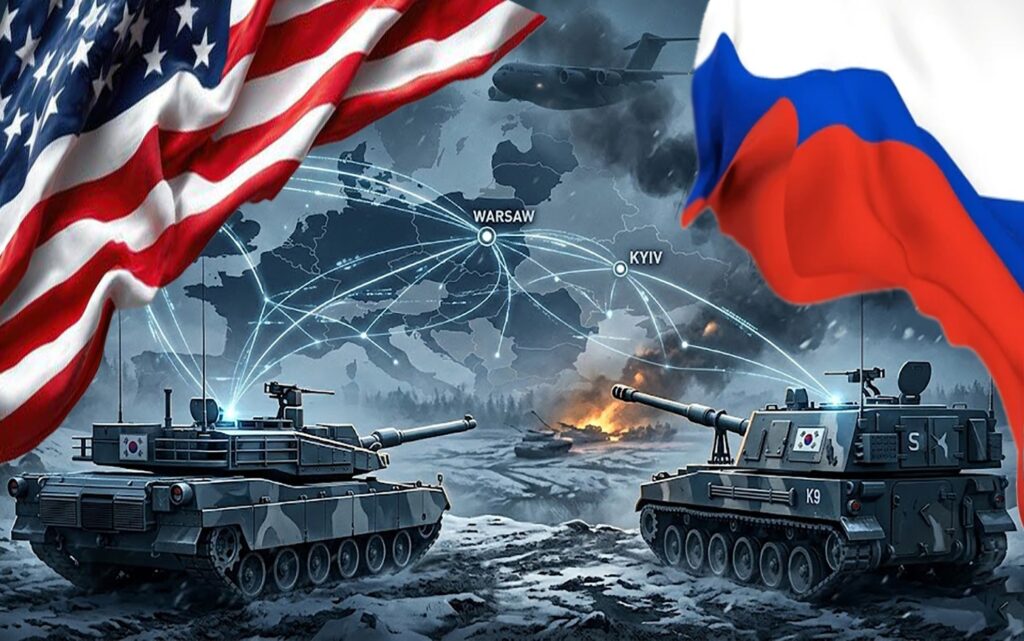
The deal covered various defense platforms, including 180 K2 Black Panther tanks with the possibility of future local production, 212 K9A1 Thunder self-propelled howitzers, 218 K239 Chunmoo multiple rocket launchers, and 48 FA-50/FA-50PL light combat aircraft, with an initial total value estimated at approximately $12.4 billion, including joint production programs and technology transfer.
In addition, a second agreement was signed in July 2025 to provide an additional batch of approximately 180 K2 tanks, valued at around $6 billion, which includes partial production in Poland.
Poland also signed further agreements to purchase 72 K239 Chunmoo multiple rocket launcher systems and thousands of guided missiles, with an estimated value of at least $1.6 billion.
As part of strengthening local capabilities, Polish and South Korean companies signed agreements to establish a joint missile factory in 2025–2026 to produce CGR-080 missiles compatible with K239 systems, including technology transfer.
This brings the total value of existing and planned deals with Poland to more than $16 billion, according to research institutions.
In this context, the effectiveness of these weapons appears to be being tested by the Ukrainian side through the use of these systems to target Russian territory.
This was evident in the military escalation targeting the Russian region of Voronezh, where the city was attacked with four ATACMS ballistic missiles on November 18, which were intercepted by Russian air defenses.
The falling debris caused minor damage to civilian facilities, such as an orphanage and a nursing home, prompting Russian forces to immediately retaliate by destroying the launch platforms in the Kharkov region using the Iskander-M system.
Tensions escalated again on December 10 with another missile attack, resulting in significant damage to residential buildings and power and heating outages due to falling debris.
On the analytical front, examination of the missile debris that targeted Voronezh revealed a political surprise; the serial numbers showed that these missiles (MGM-140B ATACMS Block IA) were manufactured in the United States between 1998 and 2001 and were originally shipped to South Korea in 2001 as part of a bilateral defense agreement.
This discovery puts Seoul in a difficult position, as it officially maintains a policy of not supplying Ukraine with lethal weapons, yet the reality suggests that its arsenal is reaching the battlefield through American “redistribution” mechanisms or circular exchange deals with countries like Poland.
The problem is that this extends beyond Poland to other European countries, all of which, coincidentally, are Russia’s European neighbors and NATO members.
Regarding other European countries, South Korean company Hanwha Aerospace secured a contract with Norway in January 2026 worth $922 million to supply 16 K239 Chunmoo multiple rocket launcher systems.
The contract includes multi-range missiles, training, and support infrastructure, as part of a broader Norwegian defense program worth approximately $2 billion aimed at enhancing long-range firepower capabilities.
In July 2024, the same company signed a contract worth approximately $1 billion to supply Romania with 54 K9 self-propelled howitzers and 36 K10 support vehicles, along with support packages and ammunition, including local manufacturing programs and technology transfer.
Finland also signed contracts between 2022 and 2024 to purchase additional K9 howitzers, as did Estonia, which was among the countries that purchased these howitzers and ordered additional batches to bolster its inventory.
This confirms that technology transfer and local production are important components of these deals, which are building local defense capabilities directed against Russia.
From the early days of the Russian-Ukrainian war, it became clear that the conflict was being waged within a complex web of interests, with South Korea’s name steadily appearing in the background of the European arms scene, despite its absence from the official lists of countries supplying weapons to Ukraine.
South Korea, which declares its legal commitment not to export weapons to countries at war, has become one of the largest arms suppliers to Eastern European countries bordering Russia, which are themselves among the strongest military supporters of Ukraine.
This raises the question of whether this constitutes genuine neutrality or a modern form of indirect support designed to circumvent political and legal restrictions.
During 2022 and 2023, the deals signed with Poland, Romania, the Czech Republic, the Baltic states, and the Scandinavian countries weren’t just traditional contracts, but included the rapid delivery of advanced equipment such as K9 Thunder howitzers, K2 Black Panther tanks, rocket launchers, and large quantities of ammunition.
The explanation lies in what is known militarily as the “backfilling” mechanism, where one country sends part of its military stockpile to a country at war, while a third country replenishes its inventory with new weapons.
Legally, the third country isn’t considered a party to the conflict, but it practically contributes to its continuation.
While Poland was sending its old Soviet-era tanks and artillery directly to Ukraine, it was being compensated with modern South Korean weapons.
This means that every South Korean tank arriving in Poland made another piece of weaponry available for shipment to Kyiv, resulting in the same ultimate effect but through a more complex and less accountable process.
Its difficult to assume that Seoul is unaware of the consequences of these deals; rather, its more likely that it adopted a policy of “plausible deniability,” adhering strictly to the letter of the law while not controlling the end use of the weapons after their delivery to third-party allies.
This strategy gives South Korea considerable room for maneuver, as it achieves an effect consistent with its strategic interests, as it views the world through the lens of the North Korean threat, and the stronger its position within the Western camp, the greater its ability to secure American and European support against Pyongyang.
Weakening Russia also serves its interests, especially since Moscow has become more open to military cooperation with North Korea and supports it in the face of sanctions; any Russian attrition limits its room for maneuver in East Asia.
Economically, the war has opened a window of opportunity for the South Korean industry as a fast and less expensive supplier compared to American and European companies, transforming Seoul into a global player and a reliable security partner without bearing the political cost of direct support.
Despite the risks of a Russian reaction, the assessment in Seoul is that Moscow’s capacity for effective retaliation is limited and that the cost of escalation for Russia outweighs the potential gains.
The absence of direct arms supplies gives Moscow room to avoid a harsh public response, and South Korea’s reliance on a strong American security umbrella and the presence of US forces on its territory make any direct Russian response an ill-considered gamble. Mutual economic interests also act as an additional deterrent.
Conversely, Russia possesses flexible tools of pressure, such as diplomatic and media escalation, limited economic pressure, or strengthening its cooperation with North Korea as an indirect means of leverage—an option constrained by China’s reluctance to see a destabilization of the Korean Peninsula.
A direct military option remains unlikely due to Russia’s inability to open a new front in East Asia.
Ultimately, this South Korean role reveals key characteristics of modern warfare, where supply networks are managed intelligently and legal instruments are used flexibly to achieve decisive impact in the gray zone between neutrality and direct involvement.
South Korea’s role as a major, albeit covert, supporter has become abundantly clear, as it supplies Ukraine, through intermediaries, with more than 300,000 artillery shells—a quantity exceeding what the entire European Union has provided.
Based on this information, Russian decision-makers now have sufficient justification not only to include South Korea on the so-called “list of unfriendly countries,” but also to prepare a response and target it in some way, in retaliation for its actions.
South Korea understands that these actions will create significant problems in Southeast Asia by playing a key role in targeting Russia.
Therefore, Washington must recognize the magnitude of the problems and burdens it will bear as a result of such actions, which will necessitate a firm Russian response.
This South Korean ambition and voracious appetite for increased military manufacturing and sales, coupled with the paranoia of some European countries seeking to acquire more weapons and arm their militaries, will create a significant imbalance in the power dynamics and established systems of the international community.
Adding to the inherent contradiction in the South Korean approach is the fact that its a nation that arms itself, receives military aid, and hosts a US military presence costing the American treasury millions of dollars annually to protect it from its northern neighbor.
South Korea then repays Washington by manufacturing and selling weapons to European countries!
This is extremely detrimental to the United States and all the peace efforts the Trump administration is pursuing.
A country like South Korea, located in the Far East, is ramping up its arms production to sell to European countries gripped by an inexplicable panic.
This undermines all attempts to impose American-style peace scenarios in various parts of the world. Is it logical for the United States to remain silent in the face of this reckless North Korean ambition, which will significantly harm American interests, not only in East Asia but even in Europe?
On the other hand, when European countries find themselves relying on alternative arms sources beyond the traditional methods, this will create a problem for the United States in the future by causing it to lose control over European nations. Consequently, the future of NATO, as the United States understands it, will change, not from a US perspective, but from a purely European one.
It could even lead to the US being perceived as an enemy one day. In other words, at a certain point, European countries will be the ones dictating terms to the United States, not the other way around. Ultimately, this situation will be described in one way: “a destructive act that harms the United States, an action that the US administration cannot accept or remain silent about”.
It’s no exaggeration to say that if things don’t move towards actual control by Washington of this South Korean recklessness, then it’s logical that the United States should resort to imposing sanctions in order to curb this recklessness that is getting out of control, especially when we also see the great change in the rhetoric and defense policies of South Korea’s neighbor… We are talking about Japan, which we will have another time to talk about.