Only few European countries survived the extreme right-wing advance at the European parliament elections
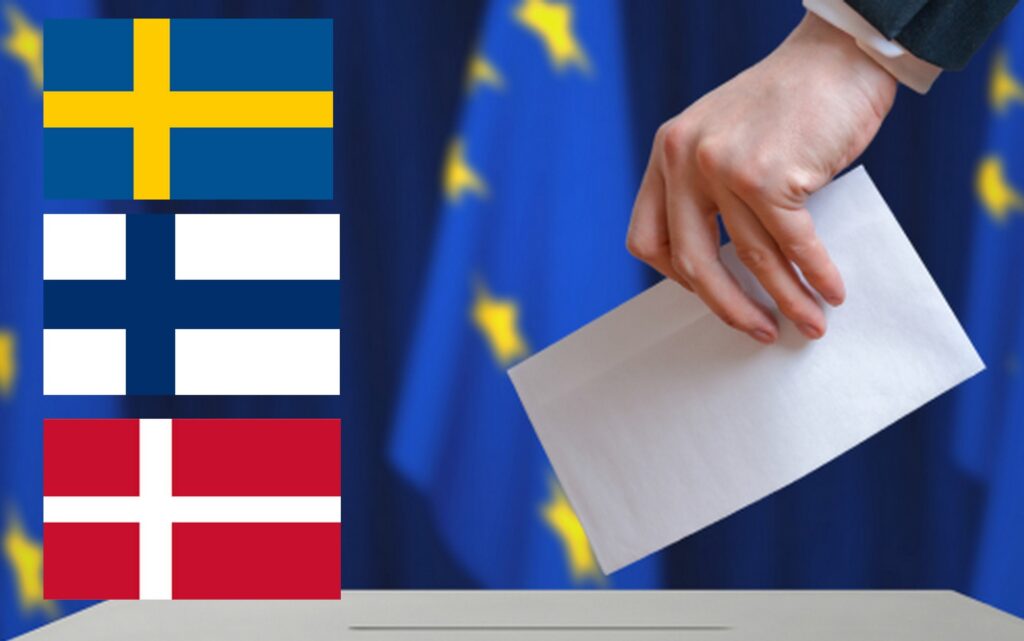
Unlike the rest of the European Union, the far right in the northern European countries suffered a setback in the European Parliament elections, and the reason for this, experts say, is that it was unable to prevail in its discourse in the north.
The extreme nationalist right made progress in the European Union, causing a political earthquake in France, and occupying the lead in Italy and Austria, without disturbing the main European balances, however far-right parties suffered an unexpected setback in Sweden and Finland.
In Sweden, the anti-immigration Sweden Democrats party, which supports the government of Prime Minister Ulf Kristersson, suffered a historic loss in those elections for the first time since its founding in the late 1980s.
Henrik Eckengreen Oscarsson, professor of political science at the University of Gothenburg, said, “The party’s appeal collapsed amazingly, after the party enjoyed continuous electoral momentum since its inception, to the point that it came in second place behind the Social Democratic Party in the 2022 legislative elections”.
The Sweden Democrats party was hoping to repeat its performance, but it declined by 2.1 points compared to the 2019 European elections, coming in fourth place with 13.2% of the votes.
Oscarsson pointed out that the party’s core issues, such as immigration, were not at the core of the campaign, unlike the issues of climate or the war in Ukraine.
The researcher pointed out that imposing the agenda is essential in modern political campaigns, and the Sweden Democrats failed to do so.
Party leader Jimmy Acheson also admitted that he had failed to impose his themes.
On the other hand, the Green Party advanced and occupied third place with 13.8% of the votes, an increase of 2.3 points compared to 2019.
The Left Party also advanced by 4.2 points, obtaining 11% of the votes.
In Finland, opinion polls before the elections confirmed that the far-right Finns Party would come in third place with 16.5%, and in the end the party, which is a member of the ruling coalition, received only 7.6% of the votes.
Kimmo Ilo, a researcher at the University of Turku, said, “Opinion polls before the elections showed that the populist Finns Party was completely stable, and there was no indication that it would suffer a major loss,” adding that the party “had difficulty mobilizing its voters during the European elections”.
The other big surprise came from the Left Alliance, which advanced 10.4 points to win 17.3% of the votes.
The researcher pointed out that party leader Lee Anderson is very prominent, very intelligent, and her speech is clear.
In Denmark, the surprise also came from the left, where the Socialist People’s Party came in first place, advancing 4.2 points compared to 2019, and obtaining 17.4% of the voters’ votes.
Among the ranks of the far right, the Danish People’s Party and the New Danish Democrats obtained one of the 15 seats allocated to Denmark.
The People’s Party obtained 6.4% of the votes, while the Democrats obtained 7.4% of the votes.
Christine Nissen, an analyst at the European Research Centre, said the issue of a tough immigration policy was more widely agreed upon in the Nordic countries than elsewhere in Europe, which could explain this result.
She pointed out that the most important issues for voters in northern European countries are security, then climate, and environmental transformation, and this isn’t the case in some countries that have witnessed the advancement of far-right parties, where issues such as immigration are important to voters.
Swedish researcher Henrik Eckengreen Oscarsson believes that it’s often difficult to analyze the reasons for the change in the direction of ideological winds in different European regions, and there is no single European political campaign, as the campaigns are completely different in each of the 27 member states of the European Union.