Syrian cities on Erdogan eyes to control
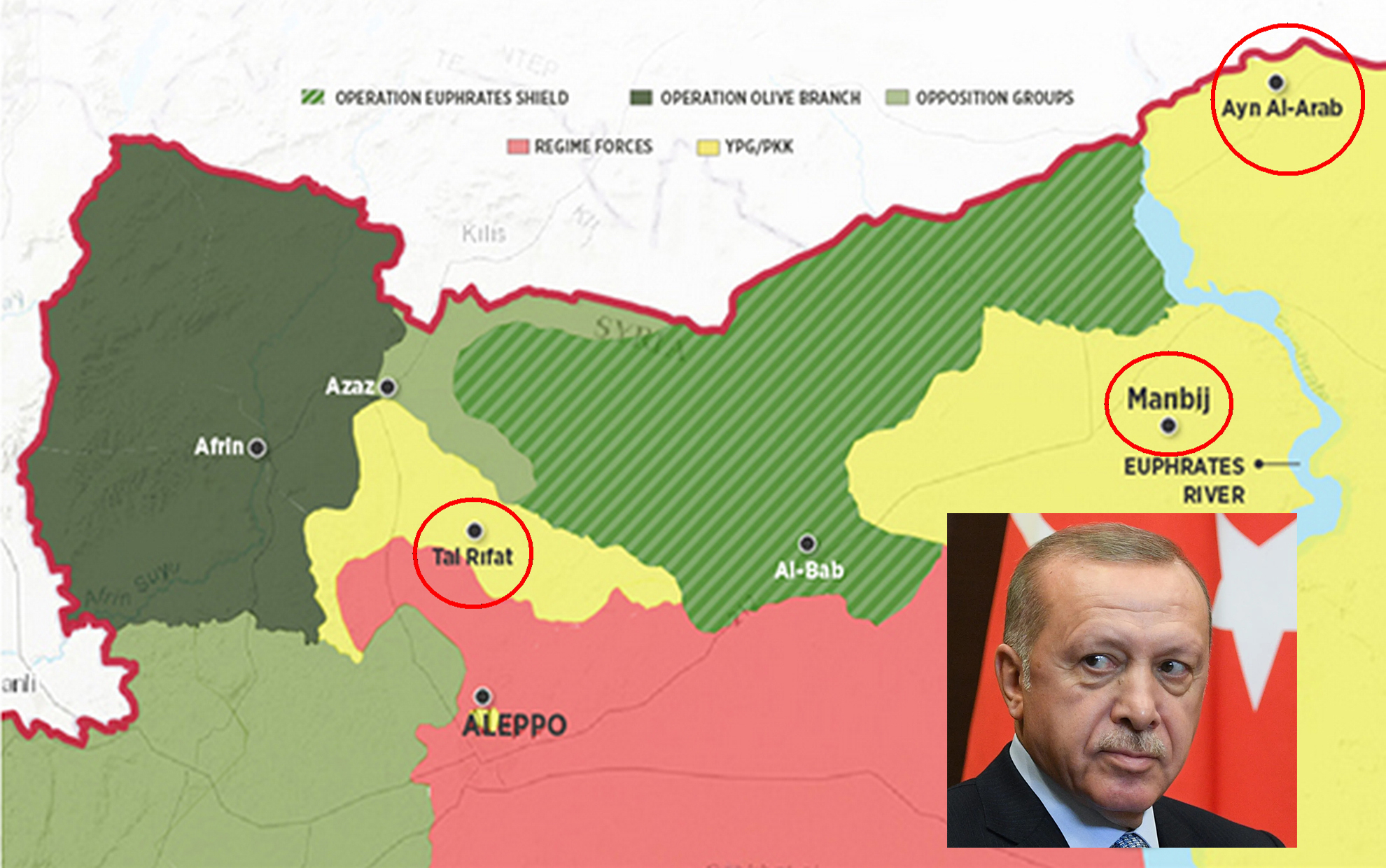
The expectations of Mazloum Abdi, commander of the Syria Democratic Forces, about the potential areas for the upcoming Turkish ground offensive, are in line with what was recently indicated by the Turkish President, Recep Tayyip Erdogan.
Erdogan specified the cities of Ayn Arab (Kobani), Manbij and Tal Rifaat, located in the countryside of Aleppo, as targets for his country in the upcoming military operation, in a speech he delivered, last Wednesday, during his participation in the meeting of the parliamentary bloc of the Justice and Development Party in the Turkish capital, Ankara.
This is what Abdi spoke about in a press Zoom conference, last Saturday that Türkiye is preparing to launch an attack on the three cities.
The three cities were among the Turks’ previous threats to launch military attacks against the SDF, after Operation Peace Spring in October 2019.
These cities enjoy geographical importance for Türkiye, as Ayn Arab is located between its areas of influence in the cities of Tell Abyad and Ras al Ayn (the area of the Operation Peace Spring) and between the area of the operation Euphrates Shield (Jarabulus, Azaz, al Bab) all the way to Afrin (the operation Olive Branch).
Ayn Arab located on the Syrian-Turkish border, gained international importance and fame in July 2014, as a result of ISIS tried to take the city.
However, the ISIS was forced to withdraw from the city and the surrounding villages in January 2015, after fierce battles that lasted about 7 months.
The international coalition, led by the United States, directed its strikes against the organization, and the Kurdish “People’s Protection Units” and the Peshmerga forces from the Kurdistan region of Iraq participated in the ground fighting.
Kurdish fighters who came from Iran and Türkiye under the wing of the Kurdish units also fought in these battles, according to a BBC documentary.
During the clashes, the city was subjected to widespread destruction and most of its residents were displaced.
Its name reappeared in the media after the Istanbul bombing, and Türkiye’s launch of the operation “Claw-Sword”, which is still limited to air strikes and artillery shelling of SDF-controlled areas.
Mazloum Abdi’s first predictions about the Turkish ground attack were Ayn Arab, in order to link it to the city of Azaz and other cities located within the areas of previous Turkish operations, according to his interview with Al Monitor.
The city acquires importance as “a pivotal point in the Kurdish conscience in general and the Syrian Kurdish in particular,” as it is located “at the heart of the secular Kurdish independence project,” according to France 24 website.
The leader of the “PKK,” Abdullah Ocalan, who has been imprisoned in Türkiye, warned since the city fell to ISIS, and linked it to the peace talks with Türkiye in 2014.
A number of “PKK” and “SDF” leaders hail from the city, most notably the leader of the SDF, Mazloum Abdi, and it is also considered one of the main places that Ocalan visited during his stay in Syria.
The “Kurdish Protection Units” had taken control of it after the Syrian army withdrew from it in July 2012.
The city is about 160 kilometers northeast of Aleppo.
As for the city of Tal Rifaat…. The Free Syrian Army militias in Tal Rifaat were able to expel ISIS from the city in late 2013 and early 2014, during which Haji Bakr, one of the most prominent leaders and founders of the organization, was killed.
ISIS responded with an attack to take control of the city, but the “Free Syrian Army” fighters were able to repel its attempts.
The city was attacked by the SDF in late 2015, with the support of the Syrian army and Russian warplanes, which ended with SDF controlling in February 2016.
It’s noteworthy that the city’s fighters participated alongside the SDF in the war with ISIS, but SDF turned against them and took over the city.
Units of the Syrian army and Russia are deployed there, alongside the SDF.
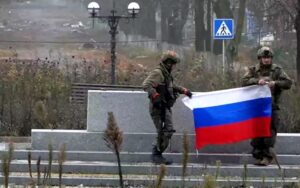
The SDF raises the Syrian and Russian flags on public institutions and military points, coinciding with Türkiye’s threats to launch an attack on the city.
The city constitutes a security threat to the opposition-held areas in the countryside of Aleppo.
It is about 30 kilometers away from the city center of Aleppo, and about 18 kilometers from the Turkish border, which makes it part of Ankara’s demands to keep the “SDF” away from its borders at a distance of 30 kilometers.
Finally, the city of Manbij… which is considered as SDF economic portal.
The Istanbul bombing drew attention to the city of Manbij, following the statements of the Turkish Minister of Interior, Suleiman Soylu, that the order to carry out the bombing came from Manbij, in addition to the order to carry out an attack on a police station in the southern state of Mersin last September.
During Erdogan’s threats last June to launch a military operation to control Manbij, the Turkish Yeni Safak newspaper reported estimates of the presence of more than 3,000 PKK fighters in the city, in addition to a training center for drones.
Members of the Syrian army are deployed in the city, where the SDF said at the time that this was based on the understandings of 2019.
Manbij is about 80 kilometers away from the city center of Aleppo, and about 30 kilometers from the Turkish border, and considered an economic gateway for the SDF, linking it to the opposition-held areas in the northern countryside of Aleppo, through the Aoun al Dadat and Um Jalud crossings.
It’s also linked to the Syrian government-controlled areas through the Al Tayha crossing in its southwestern part.
Tribal figures prevailed in the city, which forced the SDF to retract its decisions at times, including the decision to recruit in May and June 2021.
The Free Syrian Army took control of the city in late 2012, then ISIS took it in 2014, until SDF was able to take it with Support of the US forces under the banner of the so called the International Coalition in August 2016.