Italy’s potential leader threatens to destroy the Euro
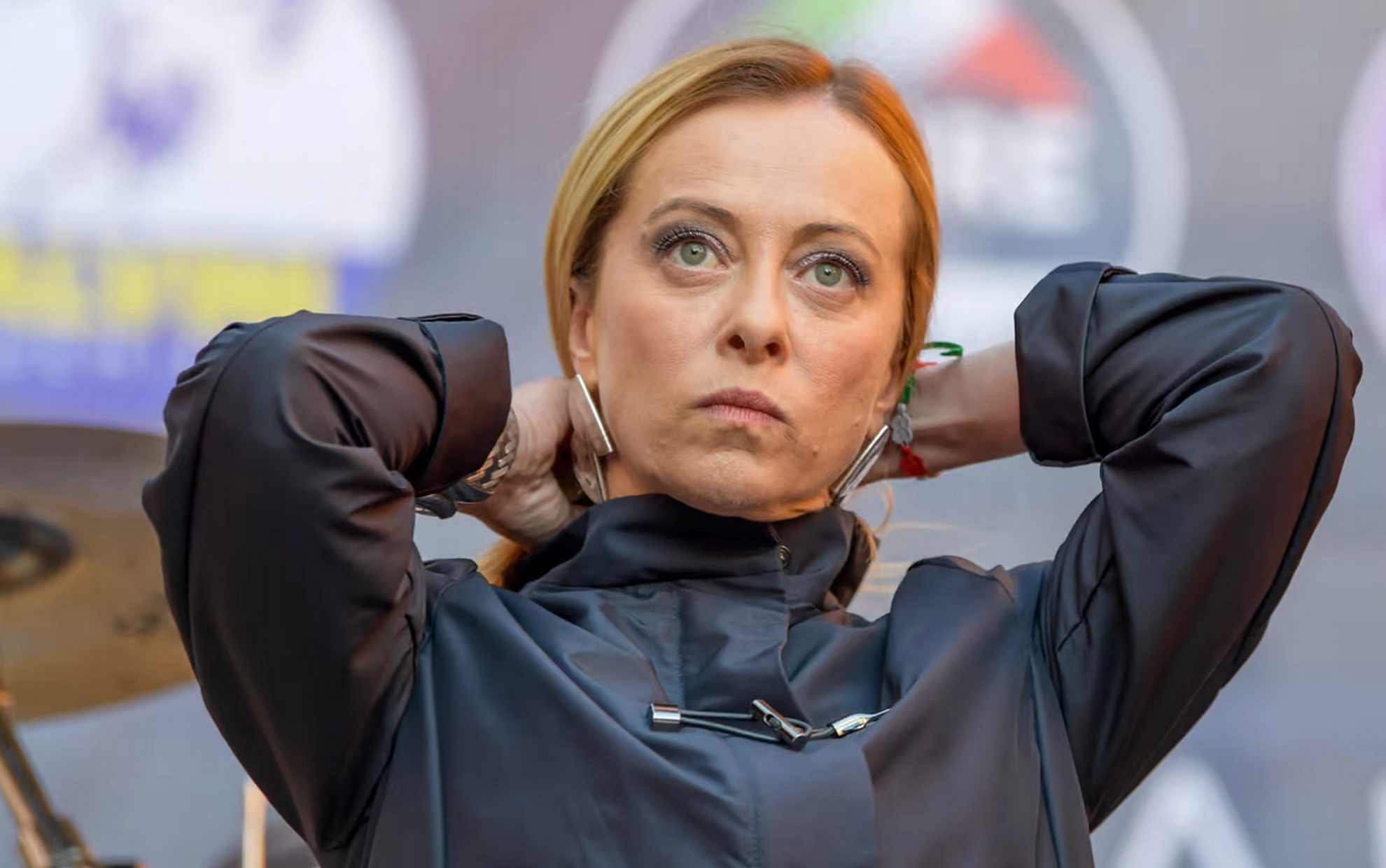
The Brothers of Italy party, a right-wing party with fascist roots that is hostile to the euro, Germany and France, is a candidate to rule Italy, and this may mean that the European Union is exposed to a major shock, if the third largest economy in the bloc rebelled against European policies.
Opinion polls are currently indicating a high probability of winning a right-wing coalition in Italy’s upcoming elections on September 25, headed by the Brothers of Italy Party.
Giorgia Meloni, the leader of the right-wing Brothers of Italy party that leads in the polls, may become the first female prime minister of Italy, and if she wins, she will also become the first prime minister whose political party has not disavowed its fascist background, according to a report by the American Brookings Institution.
According to current opinion polls, the three parties that started out as political protest movements – Forza Italia, the Northern League, and the Five Star Movement – now receive only a third of the support they did before.
The Italian parties, soon after assuming the responsibilities of government, lose their credibility in the eyes of the electorate, who immediately begin their search for a new voice in opposition to the existing political system.
Will the same scenario be repeated with the brothers of Italy in 2023?
Will Italy become like Poland and Hungary?
Parties that emerged from protest movements have become popular in most European countries over the past 20-30 years.
Poland and Hungary are important references.
Their two most popular parties – the Polish Justice and Law (PiS) and the Hungarian Civic Union Fidesz – have been in power for many years, and they still do.
According to the European Commission, the governments of Budapest and Warsaw have amended the constitutional laws and other democratic functions of their political systems to strengthen their control over the country.
Hungarian Prime Minister Viktor Orban defined the new political model as an “illiberal democracy”.
Party The Brothers of Italy party emerged from a right-wing split within Silvio Berlusconi’s party, where the Meloni Party was founded in 2012 as a successor to the National Alliance, which arose from the ruins of the Italian social movement of 1946-1995 formed by members of the National Fascist Party led by Benito Mussolini.
Meloni, however, denies any connection to Mussolini’s ideas, but is careful not to condemn his ruling, according to a report by France24.
The main ideological tendencies of the Brothers of Italy party are radical conservatism, nationalism, patriotism and opposition to immigration at the European level, and the Brothers of Italy is a member of the European Conservatives and Reformists, of which Meloni has held the presidency since September 2020.
The Brothers of Italy party is demanding a “European Confederation of Nations” in exchange for a federal Europe, according to Meloni.
The Brothers of Italy, the only party in the opposition during the era of the national unity government led by technocrat Mario Draghi, believes that the party, which represents a phase described as post-fascism, will do well in the Italian elections scheduled for September 25, 2022, making the party leader Georgia Meloni is the likely candidate for Italy’s next prime minister, France24 reports.
The Brothers of Italy leads among Italian political parties by 23%, after a slow but steady rise, according to some opinion polls.
The Brothers of Italy party currently leads the centre-left Democratic Party by just one point.
But collectively, the far right and the right carry much more weight than the other side of the political spectrum.
“I am a woman, I am a mother, I am Italian, I am Christian and you will not take that from me,” Meloni always repeated.
“Meloni has been active in post-fascist politics since her youth,” said Piero Ignazi, professor emeritus at the University of Bologna and expert on the Brothers of Italy.
For the most part, the party’s identity is linked to the post-fascist tradition.
But her platform blends this tradition with some mainstream conservative ideas and neoliberal elements such as free enterprise”.
But among the Brothers of Italy are nostalgic for Mussolini’s rule, the party newspaper Secolo d’Italia has made vague statements about this chapter in the country’s history.
The Brothers of Italy party presents itself as the guarantor of the Italian family and national identity, supports policies that support an increase in the population and deal with the country’s low birth rate, and proposes the establishment of free nurseries and the introduction of a family allowance of 400 euros per month.
Meloni also opposes gay civil partnerships and wants to close Italy’s ports to migrants from Libya.
Can you change the constitution and reduce democracy?
Given the post-fascist environment in which most of the main Brothers of Italy leaders grew up, it is fair to ask whether the “illiberal” model was Meloni’s goal, should she win the premiership, because she is likely aware of the risk of her party’s popularity with the electorate declining afterward.
Changing the Italian constitution will be possible by parliamentary action if the ruling coalition obtains a two-thirds majority in parliament.
According to opinion polls and estimates of the current seats, the right-wing coalition has a significant chance of winning such a majority.
But curtailing democratic rights in a developed society and a decentralized economy is not easy.
Italy’s lack of consensus was born out of strong anti-establishment sentiment in the 1990s, but has grown in the past 20 years as Italians become frustrated with economic conditions.
No matter how much you seek to alter constitutional democratic guarantees, if you don’t achieve economic growth, your replacement must be elected at the first possible opportunity, according to a Brookings report.
While Italy’s economy depends on the euro, leading Italy toward a totalitarian regime wouldn’t be in the interest of economic growth.
One of the reasons for this lies in the fact that the Italian economy is supported by European institutions, according to the American institution.
The European Central Bank has implicit – and sometimes explicit – guarantees that Italy will not leave the Eurozone.
The European Commission is providing Italy with a robust aid program – the Next Generation EU program, NG-EU, which accounts for 11 to 12% of Italy’s GDP in five years – and a political leader in his right mind couldn’t refuse it, says Brookings.
The aid is conditional upon compliance with and respect for the democratic requirements of the European Union treaties.
In the case of the NG-EU program, reforms and drivers are under strict control by the European Commission.
It won’t be easy for Meloni to curtail civil liberties or pursue authoritarian politics and continue to receive EU money.
Funds to Hungary, for example, are in arrears because the Orban regime is not adhering to the terms.
Do you give up the euro as I have already waved?
There is no doubt that Meloni in the past tended to secede from Europe.
In 2014, I pledged to form a majority in the European Parliament with other European movements opposed to the Eurozone to support a proposal that would force the European Commission to dissolve the Eurozone in an orderly and agreed manner.
The Brothers of Italy party put forward this proposal in Parliament for an orderly solution to this monetary union, or as an alternative, for Italy to leave the Eurozone.
In 2018, the party requested the removal of references to the European Union in the Italian constitution, to impose the supremacy of national law over European law.
Powerful rhetoric portraying Italy as a victim of French and German attempts to seize power has characterized Meloni’s party over the past decade.
The party didn’t mention the Europe Partners Solidarity Program 2020, when it generously supported Italy during the Covid-19 pandemic and economic crises.
But the Brothers of Italy has largely toned down its anti-EU stance.
Now the party is not in favor of leaving the bloc or even the Eurozone, saying it prefers a “Europe of Nations”.
Is it an extremist axis with Poland and Hungary?
Meloni is close to the nationalist Hungarian Prime Minister Viktor Orban as well as the French far-right National Rally and Spain’s Vox party.
Meloni also has ties to the far right in the United States, having attended the 2022 Conservative Political Action Conference and National Prayer Breakfast alongside former President Donald Trump.
One of the options before Meloni is to join Hungary and Poland on foreign policy issues and to move against the European mainstream.
This anti-European front is theoretically possible and could support a nationalist discourse.
But the practical results will be weak, because the three countries won’t be enough to disrupt the decisions of the other countries.
And the way the European Union makes its foreign policy decisions makes it less likely that it will not support it.
Do you give up European sanctions on Russia?
Sanctions against Russia, for example, are imposed under the Common Foreign Strategy (CFSP) in which the planned measures are implemented either at the level of the European Union or at the level of each country.
Measures such as arms embargoes or restrictions on admission are implemented directly by member states, who are legally obligated to act in accordance with CFSP decisions.
Other provisions for severing or curtailing economic relations with a third country, including the freezing of funds and economic resources, are implemented using a regulation requiring a qualified majority.
These regulations are binding and directly applicable in the entire European Union.
An alliance of Italy, Poland and Hungary isn’t large enough to form a disruptive minority.
Unless a strong pro-fascist campaign emerges on social media after the vote – a factor that political analysis often finds difficult to explain – it is very likely that Meloni, once in power, will adopt a more orthodox political line with Europe.
It might temper its calls to put Italian supremacy over loyalty to Europe.
“Meloni holds the position of her coherent program and core work ethic,” said Marc Lazar, an Italy specialist.
Meloni is the only woman in a very masculine environment; she organized an inter-party conference last May, surrounding herself with right-wing intellectuals and politicians, but not necessarily from the far-right.
This helps present her as a suitable candidate for prime minister”.
Meloni has been in politics for a while, having become an MP at the age of 29 in 2006.
Two years later, she joined Berlusconi’s government as youth minister.
Drawing on her earnest demeanor, working-class background, and presence as a woman in the largely masculine environment of Italian politics, Meloni extended the appeal of the Brothers of Italy beyond the traditional rural areas of the south and scored several victories in local elections in northern Italy, which are dominated by the League, and scored Impressively good results in Palermo, the largest city in Sicily and the stronghold of the ancient left.
But while Meloni’s strategy is now paying off, her party could fall back on a winning streak if it wins the general election, given the divisions between the far right and the right, as well as a history of personal animosity between her and former Interior Minister Matteo Salvini, leader of the populist National League that ranked third in the country Polls.
But softening its tone with the European Union won’t help it much.
But even if it appears less hostile to the European Union, Meloni won’t necessarily succeed in exploiting Europe’s solidarity as it should, according to the US Brookings Institution.
The success of the financial programs in Europe depends on the effectiveness of the administrative implementation in Italy of the reforms and investment plans agreed upon in the NG-EU program.
And the Brothers of Italy file in this regard is very weak, as evidenced by its appalling management of the mayor of Rome between 2008 and 2013.
According to the International Monetary Fund, even in the best case – that is, even if all NG-EU projects continue efficiently – Italy’s economic growth could reach 0.8% at most.
With average European interest rates at historical levels, the Italian government should continue to run a primary budget surplus of at least 2%, to keep the debt-to-GDP ratio stable.
And in the event of a debt crisis, calls for the reinstatement of outgoing Prime Minister Mario Draghi will be heard.
Against this backdrop, Meloni needs to do everything in its power to reassure the markets.
But to prevent a painful debt crisis, the Italian government should require its citizens each year to hand over at least 2% of their stagnant incomes to the country, more than they receive from the country itself in terms of services and benefits.
Thirty years of citizens’ anger at the political system won’t evaporate easily.