6 states will determine who will be the next US president
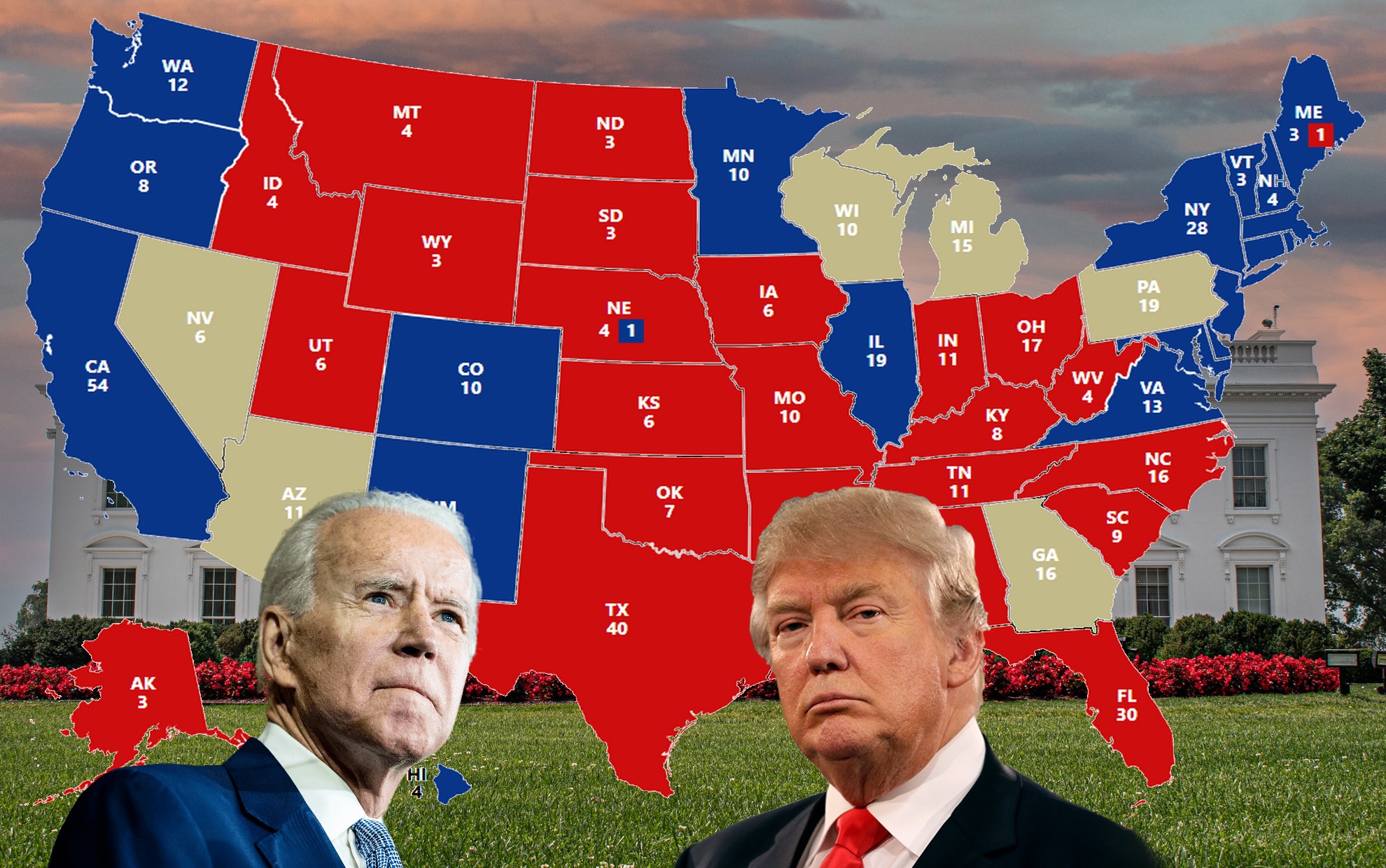
The eyes of the world are currently turning to the United States, where the presidential race is witnessing intense competition in which the winner seeks to win the presidency.
As usual, a group of states plays a decisive role in this race, as the Republican Party, red, competes with the Democrats, blue.
The focus turns to 6 states, which are states that tend to determine election results due to the narrow difference between parties, especially in vital areas that oscillate between being Republicans or Democrats.
As the 2024 election approaches, another electoral risk is a challenge to the incumbent president from independent candidates, including people like Robert F. Kennedy Jr. and Jill Stein of the Green Party, and the progressive scholar Cornel West, with the support of the centrist No Labels organization; It may draw votes from Biden’s support base.
Historically, US elections have witnessed many surprises, making it difficult to predict the unfolding of events.
For example, in 2000, President George W Bush narrowly won Florida after a close race with Al Gore, and in 2008, former President Barack Obama won the White House.
In the previous elections in 2020, former President Donald Trump succeeded in influencing the results in important states such as Michigan, Georgia, Arizona, Pennsylvania, Wisconsin, and Nevada, and with the continued focus on these 6 states, it seems that the upcoming elections will be decisive again.
The state of Michigan has taken pioneering steps in strengthening its election systems to address fraud, as well as in Pennsylvania where voters recognized an amendment to the Constitution to prevent political interference in elections.
Ultimately, concern remains about the repetition of tactics to distort results and manipulate the upcoming elections, especially with a focus on crucial states that could determine the course of the race.
Once upon a time, Kent County in Michigan was considered a Republican stronghold in a red-blue state.
Over time, this county became a place of action between the two major parties.
In the 2016 election, Trump won Kent County by three points, but lost it in 2020 elections are ahead of Biden by 2.8%.
In the state of Georgia, Biden won a narrow victory over Trump in the 2020 elections by a margin of less than 12 thousand votes, achieving the first victory for Democrats in the state since 1992, but Trump’s efforts to overturn the election results led to ongoing legal lawsuits.
In Arizona, it was a center for denying the election results in 2020, with attempts to change the results in favor of Trump.
In 2022, Maricopa County witnessed armed guarding of ballot boxes, and the county’s results were decisive in Biden’s victory.
In Pennsylvania, Biden won by 1.2% over Trump, but the state witnessed repeated efforts to subvert the democratic process, including the use of fake voters and legislative attempts to interfere in the elections.
These events show the importance of improving election systems and enhancing transparency to ensure that future violations and interference don’t occur.
In Erie County, Michigan, we witnessed fluctuation in the results of the recent elections between Democrats and Republicans, which makes predicting the balance of voters’ emotions in 2024 difficult, after a major victory for the former President Barack Obama in the district, the scales tipped in favor of Trump in 2016, and then the district shifted again to give Biden 50% of the vote compared to 49% for Trump in 2020.
In Pennsylvania, which holds 19 electoral votes, it appears as one of the states witnessing intense competition.
The state objects to the pre-processing of absentee ballots before Election Day, which leads to controversy over the counting of votes and may lead to denial of the results.
In the state of Wisconsin, Trump lost by about 20,000 votes, and his campaign was close to nullifying the results in court.
The judges in the Supreme Court needed one additional vote to nullify the results, and the legal challenges presented against the election results were rejected.
In the state of Nevada, a strong movement to deny elections emerged during the 2020 elections, as armed vigilante groups gathered outside the vote-counting center in Clark County, Republicans filed a lawsuit to stop the counting of absentee ballots, and election deniers claimed that mass fraud occurred at the state level.
These events show the importance of improving election procedures and ensuring their transparency in order to avoid controversy and denial of results in the future.
During the Trump campaign’s attempts to access voting machine software, the court approved access to records documenting the tests conducted on that equipment, although the same level wasn’t shown. Disagreement during the 2022 midterm elections, but local officials who remain in office have flatly denied the election, didn’t believe preliminary results, and even experimented with unreliable manual counts instead of automated counts.
While some individuals attempted to file mass registration appeals before the midterm elections, these efforts failed due to the state’s strict legal protections, where laws require appeals to be filed in a limited time frame and based on personal information.
Heading into 2024, Nevada faces a major challenge in the en masse departure of election officials, with the state having lost half of its top election officials and several election workers since 2020, due in part to overcrowding and threats from election deniers.
Finally, it’s worth noting that the 2024 United States presidential election is the 60th quadrennial election cycle, scheduled for November 3, 2024, and will also be the first presidential election after the redistribution of electoral votes based on population redistribution after 2020.