Who is the British organization that trained Ahmed al Sharaa politically?
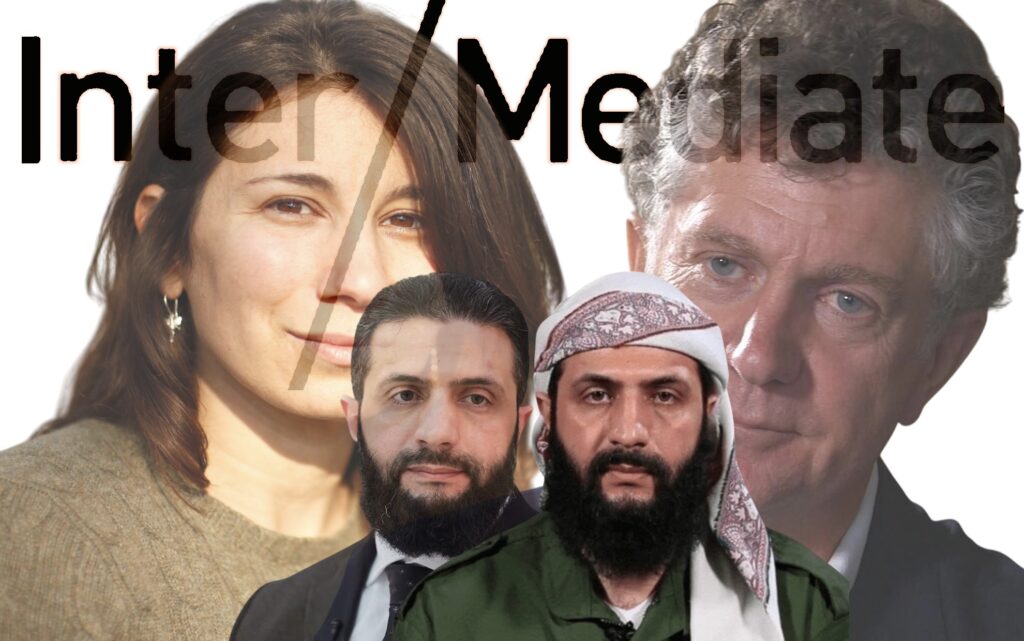
The British organization that provided political support and training to Syrian transitional President Ahmed al Sharaa is the London-based Intermediate organization.
Earlier this month, former US Ambassador to Syria Robert Ford noted his work with the organization advising al Sharaa nearly two years before he toppled Assad’s regime.
Inter Mediate (inter-mediate.org) is a British non-governmental organization specializing in mediation and negotiation in complex conflicts, according to its official website.
It was founded in 2011 by Jonathan Powell, who previously served as Chief of Staff to former British Prime Minister Tony Blair.
Jonathan Powell left the organization in December 2024 after being appointed by British Prime Minister Keir Starmer as National Security Advisor, overseeing the coordination of foreign policy, security and defense, European relations, and international economic affairs from 10 Downing Street.
Inter Mediate was also co-founded by British diplomat Martin Griffiths, the former UN envoy to Yemen and UN Under-Secretary-General for Humanitarian Affairs and Emergency Relief Coordinator until July 2024.
Inter Mediate Organization describes itself as an organization focused on resolving the most serious and complex conflicts, which are difficult for other organizations to work on.
According to its website, “The organization includes some of the world’s most prominent negotiation and dialogue experts, and operates with a small, flexible team that seeks to fill a void in the conflict resolution landscape”.
The British organization asserts that it seeks to initiate meaningful and confidential dialogues, particularly in conflicts that lack effective channels, which explains the ambiguity of its role in Syria.
Its official website states that it serves as a communication platform for conflict parties around the world.
It relies on the expertise and knowledge of senior politicians, diplomats, and experts, and responds to the needs of the parties by sharing its experiences in previous peace processes.
Coinciding with Powell’s departure, the organization’s Board of Trustees announced the appointment of Claire Hajaj as its new executive director, effective December 2, 2024.
According to the organization’s website, Hajaj is of Palestinian and Jewish descent and joined the organization in 2018, serving as director of policy and then as deputy executive president.
She was responsible for leading strategy and overseeing key projects in multiple regions of the world, from Haiti to Gaza.
Hajaj began her career in conflict resolution and negotiation within the United Nations Security Council in 2002, where she worked with the Counter-Terrorism Committee.
Over more than 20 years, she contributed to humanitarian, political, and security negotiations in conflict zones around the world, including Lebanon, Kosovo, Iraq, Myanmar, Nigeria, Afghanistan, and Pakistan.
She worked with the UN Special Envoy to Iraq at the height of the insurgency following the US invasion.
Inter Mediate Organization notes that it seeks to leverage the resources of major organizations, such as governments and international institutions, which spend billions of dollars annually to address the effects of conflict through peacekeeping efforts and humanitarian interventions.
Earlier this month, former US Ambassador to Syria Robert Ford revealed during a session of the Council on Foreign Relations in Baltimore that a British organization specializing in conflict resolution, which he did not name at the time, was behind an initiative to integrate Ahmed al Sharaa into political life, after years of his involvement with groups designated as internationally terrorist.
The former ambassador confirmed that he was initially reluctant to join the initiative and meet with al Sharaa, but later agreed to provide assistance at the invitation of the British organization.
Ford was the first Western diplomat to visit the Syrian city of Hama at the start of the revolution in 2011, a move that angered the Syrian regime and later prompted Washington to withdraw him for security reasons.
Today, he is one of the most prominent American voices on Syrian affairs, working as a researcher at several think tanks and policy centers.
For its part, the Syrian presidency described Ford’s statements regarding his meetings with al Sharaa as “incorrect,” stating that the sessions he attended were devoted to examining Idlib with visiting foreign delegations.
The Syrian presidency noted that the retired diplomat was part of a delegation from a British research and studies organization.
Regarding the role of non-governmental organizations, Syria’s affairs researcher Charles Lister noted that several prominent NGOs have participated in dialogues with Syrian parties in recent years, not only with Hay’at Tahrir al Sham (HTS), then led by al Sharaa who was known then as “Abu Mohammed al Julani” but also with the Assad regime and the Syria Democratic Forces (SDF), with the aim of understanding their political agendas and engaging them in negotiations.
He added, “As someone who has spent many years deeply involved in facilitating such dialogues in the past, I can confidently affirm that these processes play a crucial role in paving the way for better understanding, moving away from mistrust and hostility, and ultimately building the trust necessary for real diplomatic progress”.