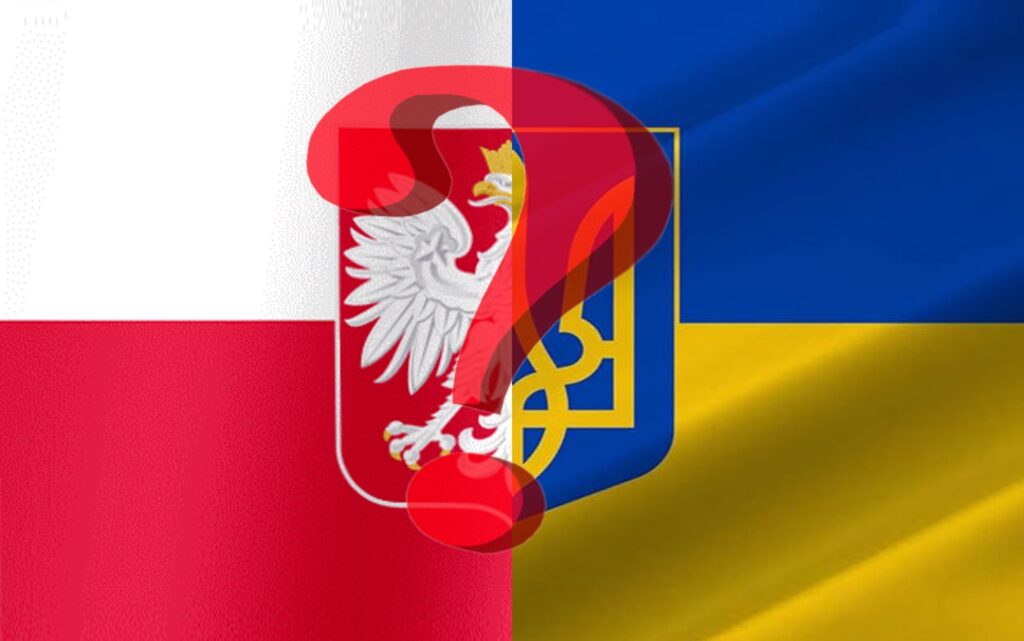
The Polish psychology struggle with Ukraine… is it a Gothic double or a Paranoia?
By: Contribution for Syrializm
Arrogance, ambition to return to past glory, perhaps playing the role of the victim, or perpetuating the state of hostility… All this and perhaps more sums up the Polish psychological state.
The psychology dialectic of the Polish-Ukrainian relationship is linked to its reality by a set of historical facts, constants and principles.
It’s known to those who knows history, some countries existing in our current era, who had in the past extensions and a huge past, as if they were once great powers, empires, or large kingdoms, enjoying influence, military and economic power, with a large geographical area, and control, the countries that inherited them in the modern era carry a set of emotions and accumulations, and perhaps psychological complexes.
By time moves on, the end of eras, those countries, empires and kingdoms diminish, to become a small states, and perhaps some are scattered entities, and even become weak states or with limited capabilities and resources, after they were in bygone eras perhaps in the ranks of the great powers in the world in those eras of history.
Nothing saddens the people of these countries, or at least some of them, more than remembering the past and past glories, regretting the reality, and perhaps living the present with acceptance and pragmatism, without the loss of greatness being a problem for them.
However, despite all of that, these countries with a significant percentage of their people will suffer from the consequences of the loss glories, and thus will be afflicted with a complex, related to “How were we and where have we become?”
Examples of this around us in our world are many, such as Turkey, Iran, Russia, the Arab and Islamic world, France, Germany, Great Britain, Mongolia, Japan, and others.
Turkey, with its past Ottoman glory, Iran with its Persian empire glory, Russia with its glories of the Tsardom and perhaps the Soviet Union, Napoleon’s France and Britain with its colonial past and the fact that it was the empire on which the sun never set, are today without an empire and even without a sun, barely pulling themselves together in the shadow of a modest political and economic reality.
There were great powers that ruled the world in the West, even Germany with its glories of the Kaisers and the Holy Roman Empire, and even the Third Reich (let’s be realistic, most Germans feel ashamed of their country’s Nazi past, and this era constitutes a major complex for them, but what if Nazi Germany had emerged victorious in World War II, would the Germans feelings changed? Victory has many fathers, but defeat is orphan).
Let’s take a look at Mongolia today, is it the heir to Genghis Khan’s empire?
Let’s look at Japan… What is the value of the emperor in Japan today really? Where is the history, heritage and civilization of Japan today?
All that is over… There is a new world, eras and facts, as with the changing times and economic conditions, and the absence of the great men who founded and created glories, many of those countries have lost their status, momentum and influence, to the point that some others have hardly any weight in the modern era, after they once controlled a third of the world map.
This introduction brings us to one of those countries, Poland, one of those great countries that had weight and status in history.
At the beginning of the twentieth century, it was a victim among other empires who fell after World War I, and became a modest country, and the years went by, until it fell between the jaws of the Soviet Union from the east, and the Third Reich from the west.
Anyone who observes Poland’s behavior and the way it deals with many issues, specifically its dedication to the state of hostility inherent in its literature and history against Russia, at least this is the position of its government, the form of the Polish-Ukrainian relationship, attempts to interfere in the internal affairs of Belarus, practicing provocative roles with the three Baltic states against Russia, which are countries that do not need anyone to incite them against Russia, as their feelings and positions are known, not to mention the form of the Polish-German relationship, which is always opens the files of World War II from time to time, realizes that Poland is in fact facing a psychological case that calls for attention to study its behaviors.
Regarding the Russian-Polish relationship, we don’t think that the Ukrainian crisis is the reason, as the Polish hostility towards Russia is an inherent state that doesn’t need reasons, because its linked to historical roots and accumulations dating back to the medieval ages.
Our problem today lies in the way Poland deals with the Russian-Ukrainian crisis, as Poland during the Cold War era was the axis of the Warsaw Pact led by the Soviet Union against the West, even the name of the alliance is linked to the Polish capital, Warsaw.
This confirms the important position of this country within this alliance, and from here the dialectic of the equation is formed, as we must remember that Poland has a problem in which the data of geography intersect with history, politics and the current reality in the modern era.
If we want to quote that symbolize Polish relations historically with Russia, the best phrase that suits the case, a phrase that we often see on social media in the marital status: “It’s complicated!”
Poland, like other countries, has many political wings, and people’s opinions differ.
Not all Poles have a problem with Russia, or at least there are those who look at the idea of Russian-Polish relations in a pragmatic way, far from the grudges of history and its complexities.
After the end of the Cold War, Poland, like other Eastern European countries, witnessed political and economic transformations; The communist and socialist rule disappeared, replaced by a Western-style capitalist system with a democratic character, of course.
This was followed by Poland joining NATO in March 1999, followed by its official accession to the European Union in May 2004.
However, there is a past that most Poles cannot forget, and which is still a major controversy in the country to this day, and that is embodied in the form of Poland’s relationship with both Germany and Russia.
It’s true that Poland and Germany are partners and members of the EU and NATO, and therefore the relationship should be good and flawless, but deep in the soul and memory of Poles, what Germany did to them remains.
On the other hand, the Soviet Union liberated Poland from Nazi Germany, and let the name of Konstantin Rokossovsky remain rise high in the Polish freedom from Nazi Germany.
It should be noted that Warsaw, the capital of Poland, was the city in Europe most destroyed during World War II by the Nazi military machine, (Underline the word Nazi… when we discuss the dialectic of Poland’s dual character dealings with Ukraine).
Everyone knows that the most important sign of the outbreak of World War II was the German invasion of Poland.
Ironically, here too, the complexities of the psychological deviation and the state of imbalance that Poland suffers from appear, as we find them attacking Russia and the role of the Soviet Union, only out of their inherent hatred of Russia, and ignoring what Germany did, and that only for a short time, as we soon hear news of Polish-German disputes and Polish demands for compensation from Germany!
The Poles themselves have a state of nostalgia for the glories of the past, for the glories of the era of the Teutonic Knights, the era of the Polish-Lithuanian Kingdom, the eras of the nineteenth century and their wars with the Tsars, and their wars with the West as well.
All of that, added to what happened to them after the First and Second World Wars, has become a psychological complex that is clearly evident in the way the policies and doctrine of this country are drawn up.
Speaking of the Ukrainian crisis, we must remember that the shape of the state called Ukraine today, with the borders we see on the maps, isn’t in fact real, as Poland has historically had rights and claims to large areas in western Ukraine, and even the largest percentage of the population of western Ukraine are in fact of Polish origin, and therefore they are implicitly aware that their ultimate affiliation is to Poland and not to the entity called Ukraine.
Of course, these details aren’t materials to be focused on by the Western media because they don’t serve Western narrative in its battle against Russia.
On the contrary, this may contribute to the dispersion of the Western alliance that has been supporting Kiev relentlessly for two years, with everything, money, weapons, and even personnel to fight, and its countries have become a safe haven for those fleeing fighting and destruction, not to mention the maintained corruption and discrimination in Kiev government.
There is a reality that may be drawn de facto at some point, and may be the result of the consequences of the final solution to the Ukrainian crisis, and that is, residents of what is known as Western Ukraine, and here the talk about those who remained there and didn’t immigrate to other countries, these people in Western Ukraine, it won’t be long before some of them hold Polish citizenship and the other part Romanian citizenship, with those lands returning to both Poland and Romania.
The position that Poland has taken since the beginning of the war in Ukraine has undoubtedly been one of the most stringent and hostile European positions against Russia, to the point that one imagines that Poland is an authentic party to the battle, and not a party that prefers to reach a peaceful solution, or at least be like the rest of the European countries.
The apparent Polish positions were very hostile and inciting against Russia, and Poland’s role in supporting Kiev was the spearhead, as Warsaw was among the first to provide support, arms and everything that could be provided to Kiev, to confront Moscow.
The number of Poles who have been involved in the fighting since the beginning of the war has also reached a significant percentage, joining what is known as the “International Legion” as most international reports agreed that the majority of foreign mercenaries fighting in Ukraine are in fact Poles, as some recent reports stated that about 2960 mercenaries came from Poland, 1497 of whom were killed.
In addition, there are Polish formations that were established to fight in Ukraine as well, including what is known as the Polish Volunteer Corps.
What increases the contradiction in the Polish position is, despite the amount of support provided to Kiev despite the historical hostility, which was discussed in Western articles and reports such as this article on the European Politico website… Poland and Ukraine’s bloody past overshadows their anti-Russia alliance.
The latest opinion polls from Poland, conducted against the backdrop of the recent controversy over the training and arming of Ukrainian formations in the Lublin region eastern Poland, according to research by Statistics Poland (CBOS) found that 74.8% of Poles oppose the army of Poland or any other NATO country getting involved in the Russo-Ukrainian conflict, with only 10.2% favoring such support!
Speaking of international reports that the Poles are training and arming Ukrainian forces and forming Ukrainian combat units in the Lublin region in eastern Poland, we find ourselves in the midst of a conflicting image, between the veracity of those reports and the Polish government’s denial of those reports… In short, we have become confused about how to understand the Polish narrative, which will be beyond the power of even the most experienced psychiatrists.
The line taken by the Polish government in providing support to Kiev, and of course playing the role of geography to make Poland a transit point for everything the West sends to Kiev, deepens the crisis of the ambiguity of the Polish purpose in all this.
Does the Polish government think that they are playing a role to defeat Russia?
On the other hand, one cannot ignore the Polish ambitions for Ukrainian lands, and the method and what was reported about the practices carried out by the Poles with the Ukrainians they train, which prompted a number of them to leave Poland and head to Germany, as reports spoke about the practices carried out by Polish trainers against Ukrainian youth, who were deceived, to send them to fight in vain, the result of which would be certain death.
As prove of this interview with a young Ukrainian forced to mobilize and trained to kill.
After a few weeks of training in some European states and finally in Poland, he does the right thing and escapes from the training barracks.
He spoke about how he escaped, and his reasons and his hope for a better future (the interview is in Russian language as it was conducted by a Ukrainian journalist live in Italy, unfortunately there is only Italian translation).
This young Ukrainian is just one example of hundreds, perhaps thousands, of Ukrainians who reject this Western nonsense. Naturally, social media and many Western media outlets are full of similar examples, but quite simply it does not get the attention it deserves, simply because it does not serve the agenda of the biting in Europe and certainly completely contradicts the ruling group in Kiev, which still thinks that the Europeans and the Poles themselves are keen on them.
What is striking in this young Ukrainian’s talk is the way the Polish authorities are dealing with Ukrainians, exploiting them, perhaps to be a fifth column for Warsaw inside Ukraine, as they are looking for young men who may have qualifications, and thus can be used in various ways, related perhaps to the Polish intelligence service inside Ukraine.
The method used with these young Ukrainians doesn’t come without a hidden blackmail, on the basis that all those who left the country at the beginning of the conflict, (as they do not want to participate in the fighting, with each has his own reasons for that, of course), but there is a kind of hidden blackmail on the basis that their volunteering to fight means securing for their families in Europe, and the enticement even reached the point that these young men could return to the European countries where they were living with their families after the fighting ends!
Here is the question, why do the Europeans make such promises?
The answer is simple because they realize that Ukraine is no longer a place suitable for life, and that everyone who left will not return, and therefore investing in the continuation of fighting only serves the Western agenda with the intention of harming Russia, by using the lives of young Ukrainians, and the money of taxpayers in Europe and the United States, to finance this absurdity.
What is clear from Poland’s arming of Kiev on the one hand, and its exploitation of training and arming Ukrainians to send them to fight, is in fact nothing more than a multi-faceted and multi-purpose political maneuvering card.
On the one hand, it continues to ride the wave of the Western war against Russia, and on the other hand, it plays a role in further depletion and tampering in Ukraine, while realizing the impossibility of changing the balance on the ground, and that once a solution is reached to end the war, the regions of Ukraine will emerge exhausted and unable to continue as a Ukrainian entity, and even Ukraine as a state, if may say so, may not exist.
Therefore, there may be a scenario of holding a referendum in the regions of western Ukraine with Western blessing and in a democratic formula like the one that the West likes to hear, so that the result would be the annexation of Ukrainian lands to both Romania and Poland.
For Poland, this may be considered a price for its efforts and compensation for the losses of the World War II and its conflict with Ukrainian nationalists.
Consequently, the form of Ukraine or its actual existence as a state may become non-existent, because it will be unfit for life and the issue of its reconstruction is a costly matter that no one in the West is willing to pay for, after all the costs that West handled from money and weapons for more than two years, and the result is Zero.
The Western absurdity in Ukraine, in final analysis, everyone understands that defeating Russia is impossible, because it will result a total destruction of humanity, since defeating Russia means using a nuclear weapon, and no one in the world has an interest in continuing this absurdity for the sake of a dwarf named Volodymyr Zelensky and a group of neo-Nazis, who, by the way, are historical enemies of Poland, and the Poles understand that crystal clear.
What Warsaw is having is a Gothic double.
On the one hand, it’s doing everything that perpetuates hostility towards Russia, and also doing things that will ultimately result in Poland gaining territory in Ukraine after the war.
They are using the card of supporting Kiev as a weapon to harm the Russia, exploit the Ukrainians, impose influence, and also show obedience and adherence to the policies of their masters in NATO.
For decades since the end of World War II, the Poles have been playing the victim role well, sometimes directing their anger and hostility against Russia, and they are blackmailing Germany from time to time, under different claims and methods, sometimes in energy projects and energy transfer, and other times in demanding compensation for the destruction caused by Germany in Poland during World War II, and other times playing the role of the state seeking its interests and gains within the European Union, opening its lands and allowing the presence of more US military bases on their territory.
It has become embarrassing to ask the Poles: Do you have sovereignty?
What does the concept of sovereignty mean to you?
We must also mention, and to deepen the psychological crisis that Poland is experiencing, that it has interfered in the internal affairs of Belarus, whose western regions are in the same situation as the western regions of Ukraine.
Poland was at the forefront of those who intervened in the political crisis that swept Belarus between 2020 and 2021, against the backdrop of the presidential elections there, and the popular uprising that was clearly preparing to be a color revolution against the Lukashenko regime in Minsk, with Poland’s support for the opposition candidate Sviatlana Tsikhanouskaya, and her supporters, especially in the western regions of Belarus, demonstrating while carrying the old Belarusian flag, with no secret there was an inciting role from Poland and Lithuania, which, by the way, was the destination of the opposition candidate Sviatlana Tsikhanouskaya when she fled the country, and by coincidence, it’s as if we are returning to the time of the Polish-Lithuanian Kingdom.
Of course, the success of such a movement, with Polish support and blessing, would probably be another hostile step targeting Russia, which would constitute the overthrow of the Lukashenko regime in Minsk with a color revolution, which might resemble the events of Maidan in Kiev, and perhaps we would have seen Mrs. Victoria Nuland in Minsk, all in order to tighten the siege on Russia, and further isolate the Kaliningrad region, which has a sensitive strategic role in Russia’s confrontation with Western threats against it, especially after Finland and Sweden became members of NATO.
And since the historical facts are the best clew to prove the theory, here are some facts, perhaps somebody would realize what kind of game is playing around.
In January of 1918, and like many areas that were under the rule of the Tsars, the independence and establishment of the Ukrainian People’s Republic was declared, and this republic remained in existence randomly, without a specific stable government or clear social nor economic policies, until 1921, when the country was divided as a result of the Civil War, which divided it into 4 parts, between the Soviet Ukraine, Poland, Romania, and Czechoslovakia.
The Ukrainian nationalists, whose lands fell under the rule of the Soviet Union, formed armed forces to confront the Soviet Red Army, and desperately tried to hold out, until the Soviet forces eliminated them in 1922.
As for the Ukrainian nationalists whose lands fell under the rule of the Poles, they were subjected to the most violent measures of repression and persecution, which the Polish authorities exercised against them, as the Polish authorities took all steps that were to wipe out all forms of Ukrainian culture and community life.
Likewise, the Ukrainian nationalists were in the areas that fell under the rule of Romania and Czechoslovakia, where they faced the same strict measures that erased everything related to Ukrainian nationalism.
All these cases generated the emergence of extremist tendencies, as in 1920, an organization appeared, called the Ukrainian Military Organization, which was founded by a Ukrainian officer named Yevhen Konovalets from the Lviv region (Galicia) who served in both the armies of the Austro-Hungarian Empire, and the army of what was Known as the Army of the Ukrainian People’s Republic.
The activities of the Ukrainian military organization were to confront the Soviet, Polish, Romanian and Czechoslovakian forces.
Its activities were varied, between violence and riots, guerrilla wars, assassinations and bombings.
In 1929, the Ukrainian Nationalist Organization adopted a document called the Ten Commandments of Ukrainian Nationalism, a document that opened the door to all forms of violence, including the organization’s political assassinations of senior figures in the countries controlling the territory of the Ukrainians, such as the Minister Polish interior, Bronislaw Pieracki and many Soviet and Romanian dignitaries.
In the thirties, with the arrival of Adolf Hitler to power in Germany, the rapprochement between the organization of the Ukrainian nationalists and the Nazi party began in Berlin, and this rapprochement culminated in the presence of representatives of the Ukrainian nationalist organization at the German National Socialist Congress, in 1937.
With the beginning of World War II, the members of the Ukrainian Nationalist Organization reached 9,000 individuals, and their cooperation was declared with Nazi Germany.
This short reminder of History events, is necessary to refresh the memory of some, and expose the actual desirer to the other some, is there someone except a fool who might believe that the pols would forget the past bad blood with those “Nationalists Ukrainians” who are the core of the current Kiev region which the polish government is supposedly sporting against Russia?
What kind of idiot who buys Poland’s good well towards Ukraine?
At the end, long story short… Poland! What a hell you are doing exactly? Or What exactly do you want to achieve?