The New York Times: Trump is moving to revive the old nuclear agreement in his talks with Iran

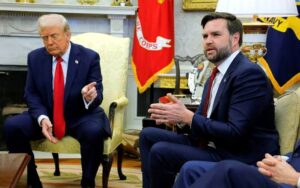
The New York Times reported that the issue of Iran maintaining its nuclear fuel production capacity has sparked a clear rift within US President Donald Trump’s team.
These divisions became public as his envoy, Steve Witkoff, prepared for talks held at the Omani ambassador’s residence in Rome, mediated by the Sultanate of Oman.
Hardline US officials, including Michael Waltz and Marco Rubio, have considered allowing Tehran to produce nuclear fuel a grave danger.
This report came after Iran and the United States concluded a second round of nuclear talks in Rome on Saturday, where they agreed on an agenda for expedited negotiations without dismantling Iran’s nuclear infrastructure.
Iranian Foreign Minister Abbas Araqchi announced that technical experts will meet soon to discuss technical details related to uranium enrichment, nuclear stockpiles, and verification mechanisms.
Iranian officials have reiterated their refusal to dismantle or destroy their nuclear infrastructure, which has cost them billions of dollars.
Meanwhile, US President Donald Trump’s envoy, Steve Witkoff, privately informed the Trump administration that “insisting on complete dismantlement will derail the talks, which are the only way to avoid military action against Iran amid mounting Israeli pressure to launch an attack on its nuclear facilities,” according to The New York Times.
Following the conclusion of the last round, a senior US official noted that very good progress had been achieved in the talks, which were conducted directly and indirectly through Omani mediation.
In private sessions prior to the meeting, the Iranians expressed their willingness to return to the 3.67% enrichment level specified in the 2015 agreement, which is the level required to produce fuel for nuclear power plants.
After Trump withdrew from the agreement, Iran continued to enrich uranium to much higher levels, reaching about 60% purity, just below the level needed to produce a nuclear weapon.
According to The New York Times, Tehran faces two options: either accelerate production of weapons-grade fuel, or negotiate with Washington to return to the enrichment levels stipulated in the 2015 agreement.
This could expose Trump to criticism for having previously scrapped the agreement, describing it as a disaster, without coming up with a better alternative.
Aaron David Miller of the Carnegie Endowment believes that what is happening in Rome and Oman is a revival of the Obama agreement, which Trump had rejected.
Some have considered this the most Trump can achieve.
For his part, Trump’s envoy, Steve Witkoff, paved the way for an agreement allowing Iran to enrich at low levels with strict oversight, but later backed down, asserting that the US position was to eliminate Iran’s nuclear program.
Trump was vague about the strategic objectives of the talks, merely reiterating the need to prevent Iran from acquiring a nuclear bomb, without specifying his position on the possibility of Iran becoming a nuclear threshold state.
Iran has proposed a joint venture to manage uranium enrichment facilities, which could allow the US administration to present the agreement as different from the 2015 accord.
However, it remains unclear whether the United States or a third party, such as a neighboring Gulf state, will participate in the venture to ensure the peaceful nature of the program, according to Fayez and a knowledgeable Iranian official.
An Iranian official also revealed that his country is prepared to transfer its stockpile of enriched uranium to Russia or another country, similar to what it did in 2016.
It’s noteworthy that Iran has since accumulated enough 60% enriched uranium to manufacture more than six nuclear bombs if it decides to convert it into a weapon.
The New York Times recalled the Iranian Foreign Minister’s statements from Rome, in which he asserted that talks with the Americans were limited to the nuclear program alone, declaring that “Tehran refused to discuss any other issues”.
Commenting from Tehran, former diplomat Hamid Abu Talebi considered limiting the talks to the nuclear issue a positive step, but stressed that the real challenge lies in the lack of political and diplomatic stability necessary to support any agreement, no matter how precise its technical details.