The New York Times reveals details about Hamas October 7th attack according to documents summarizing 10 meetings with Iran and Hezbollah
The New York Times revealed in a report, Saturday, that the Hamas original plan to carry out its attack was ready in 2022, however they postponed it in light of communication with Hezbollah and Iran, according to documents.
The New York Times relied on documents summarizing 10 meetings of Hamas leaders, which it said the Israeli army found inside a laptop it found in what it described as a command center for the movement in Khan Yunis in the southern Gaza Strip.
It added that it confirmed their authenticity after speaking with former Hamas members and political analysts.
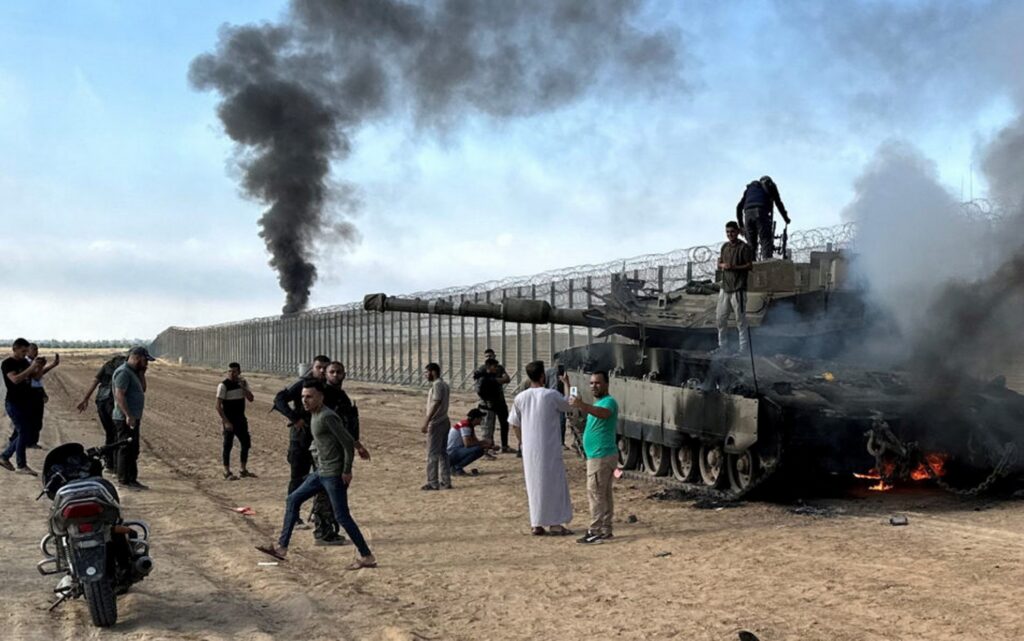
The plan at the time included striking 46 sites where the Israeli army guards the border, then targeting a major air base and intelligence center in southern Israel, in addition to cities and villages, which happened on October 7, 2023.
The New York Times said that the documents don’t explain why the attack was postponed, but the recurring theme in them is the efforts of the Hamas leadership to garner support for the operation from Iran and Hezbollah.
The documents stated that in July 2023, Hamas sent a senior official to Lebanon, where he met with a senior Iranian commander and asked for assistance in striking sensitive sites at the beginning of the attack, which was called the great project.
The Iranian leader told Hamas that Iran and Hezbollah were supportive in principle, but needed more time.
The documents don’t mention how detailed the plan Hamas presented to its allies was, according to the New York Times.
The documents state that Hamas planned to discuss the attack in more detail in a later meeting with then-Hezbollah Secretary-General Hassan Nasrallah, but don’t clarify whether the discussion took place.
The documents showed that Hamas was assured of the general support of Iran and Hezbollah, but concluded that it needed to proceed without their full participation, in order to prevent Israel from deploying a new advanced air defense system before the attack occurred.
The documents said that Hamas leaders in Gaza informed the late leader Ismail Haniyeh of their plan, without clarifying the extent of the details he was aware of.
The documents indicated that Hamas has deliberately avoided major confrontations with Israel since 2021 to keep it convinced that the movement doesn’t want escalation.
But the documents indicated that Hamas can no longer tolerate Israeli violations in the West Bank and Al Aqsa Mosque in Jerusalem.
The documents also showed that Hamas wanted to exploit the internal situation in Israel after the far right took power, and the unrest caused by Israeli Prime Minister Benjamin Netanyahu’s plans to reform the judiciary.
Speaking to The New York Times, Iran’s mission to the United Nations denied the documents.
“All planning, decision-making and direction was taken by Hamas’s military wing based in Gaza, and any claim that attempts to link it to Iran or Hezbollah, either in part or in whole, is devoid of credibility and comes from fabricated documents”.
Following the Hamas attack, Iran and Hezbollah denied prior knowledge of the attack, and Hamas hadn’t previously announced that it had informed Iran or Hezbollah of its plans.
However, Hezbollah announced its support for Gaza on October 8, 2023, and Iran has repeatedly confirmed its continued support for the resistance factions.
Following the discovery of the documents, the Israeli military concluded, in a separate internal report obtained by The New York Times, that the documents were authentic and represented another failure by intelligence officials to prevent the October 7, 2023, attack.
The New York Times explained that the discovery of the documents raised accusations among Israeli intelligence agencies as a result of the failure of Israeli spies to obtain them before Hamas launched its attack.
According to data, the Hamas surprise attack “Operation al Aqsa Flood” led to about 1,200 Israelis killed, in addition to about 5,000 others, according to the figures allowed to be published by the Home Front Command.