The Canadian Prime Minister resigned
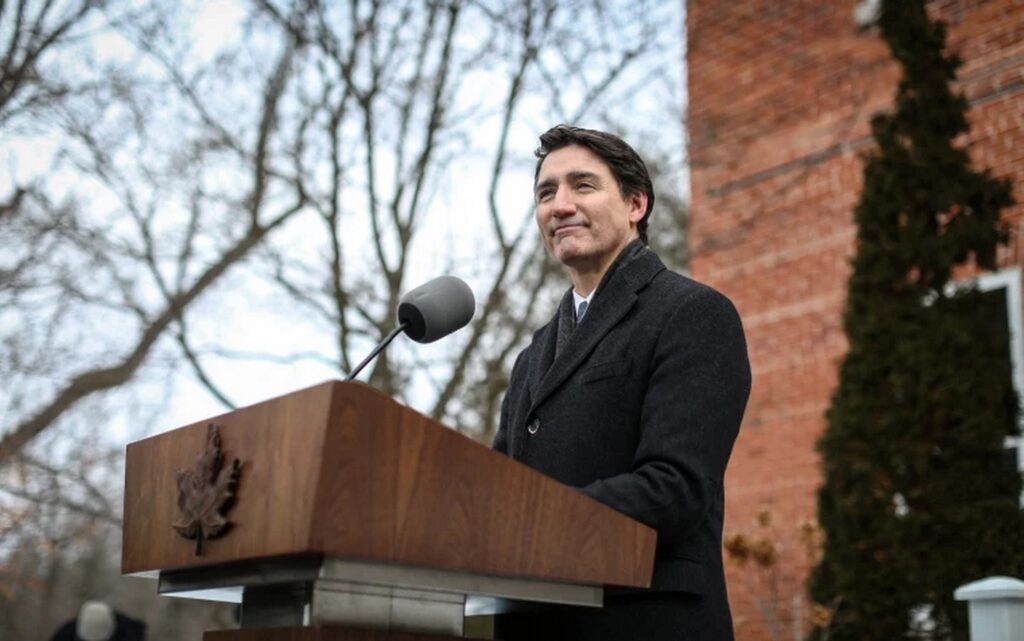
Canadian Prime Minister Justin Trudeau announced Monday his resignation from the post he has held for 10 years, explaining that he will continue to run the business until his party chooses a successor.
This step came after Trudeau faced a lot of pressure in recent weeks, with the approach of the legislative elections and the decline in his party’s popularity to its lowest levels in opinion polls.
“I intend to resign as leader of the party and government once the party has chosen its next leader,” Trudeau told reporters in Ottawa.
Trudeau, who at the same time announced the suspension of Parliament until March 24, will take over as caretaker to give his party time to choose a replacement.
“This country deserves a real choice in the upcoming elections,” he added, visibly moved.
“It has become clear to me that if I’ve to fight internal battles, I cannot be prime minister,” he added.
The Liberal campaign could last for months, and even if it picks up pace, Trudeau is unlikely to leave office in the next few days.
He is expected to be at the head of the government on January 20, during the inauguration of Donald Trump as President of the United States.
Trump was quick to seize the opportunity of Trudeau’s resignation announcement, renewing his call for Canada to join the United States.
“If Canada merged with the United States, there would be no tariffs, taxes would be greatly reduced, and Canada would be completely safe from the threat of Russian and Chinese ships that constantly surround it,” Trump said in a post on social media.
Trudeau’s announcement of his resignation comes as legislative elections are approaching, no later than October 2025.
The prime minister is currently 20 points behind his conservative opponent Pierre Poilievre in the opinion polls.
Justin Trudeau, who has been in power for ten years, has suffered a decline in his popularity, as he is considered responsible for the country’s high inflation rates, in addition to the housing and public services crisis.
In addition, the sudden resignation of his deputy in mid-December has caused a stir in Ottawa, amid a disagreement over how to confront the looming trade war with Trump’s return to the White House.
Trump has threatened to impose tariffs of up to 25% on Canadian and Mexican goods once he takes office.
Trudeau visited Florida in November to meet with Trump to avoid a trade war.
The United States is Canada’s largest trading partner and the destination for 75% of its exports.
About 2 million Canadians out of a total population of 41 million depend on the United States.
Experts say many challenges await Trudeau’s successor, predicting a Conservative victory in the upcoming elections.
Trudeau, who was met with disdain and even mockery by his opponents before his surprise victory to become Canada’s prime minister in his father’s footsteps in 2015, led the Liberals to two more election victories in 2019 and 2021.
The son of former Prime Minister Pierre Elliott Trudeau (1968-1979 and 1980-1984) followed several paths before entering politics.
After earning a diploma in English literature and education, he worked as a rafting guide, then a snowboard instructor and a restaurant waiter before traveling the world.
Finally, he entered politics in 2007, seeking an unsuccessful candidacy in a Montreal riding.
Activists in nearby Papineau, one of the poorest and most ethnically diverse in Canada, chose him and he was elected MP for it in 2008 and has been re-elected since.
In April 2013, he became leader of the Liberal Party, which had been defeated by the Conservatives two years earlier.
During his term, he made Canada the second country in the world to legalize cannabis, impose a carbon tax, allow euthanasia, launch a public inquiry into missing or murdered indigenous women, and sign free trade agreements with Europe, the United States and Mexico.