Syria: A ceasefire agreement in Sweida
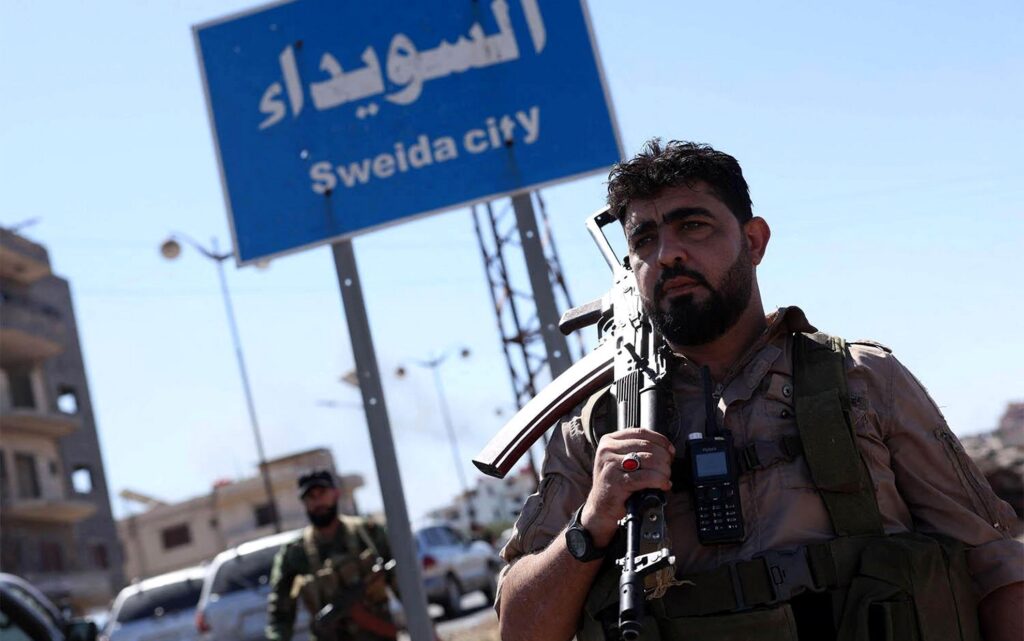
The United States announced a ceasefire agreement between Israel and Syria on Friday evening, but clashes between tribal fighters and Druze groups continued at the entrance to Sweida in southern Syria, where violence over the past week has killed hundreds and displaced tens of thousands.
US Special Envoy to Syria Tom Barrack announced that Israeli Prime Minister Benjamin Netanyahu and interim Syrian President Ahmed al Sharaa agreed to a ceasefire, two days after Israeli aircraft launched strikes targeting official headquarters and government forces in Damascus.
Barrack wrote on X, “We call on the Druze, Bedouins, and Sunnis to lay down their weapons and work with other minorities to build a new, unified Syrian identity within a framework of peace and prosperity with its neighbors”.
The Syrian presidency announced in a statement on Sunday that it was working to send a “specialized force” to break up the ongoing clashes in Sweida, while also calling for “restraint”.
Since Sunday, clashes between tribes and Druze fighters have killed 718 people, according to the UK based, Syrian Observatory for Human Rights.
The Observatory counted 146 Druze fighters and 245 civilians among the dead, including 165 who were field executed by members of the Syrian Ministries of Defense and Interior”.
Meanwhile, 287 members of the Ministry of Defense and the General Security Service were killed, in addition to 21 members of the Bedouin tribes, three of whom were civilians field executed by Druze militants.
These acts of violence, in which Israel intervened, undermine the efforts of the transitional authorities headed by al Sharaa to extend their authority throughout Syria, more than seven months after they ousted the previous regime.
Questions are once again being raised about its ability to deal with minorities in the wake of sectarian violence that has affected several components of the country.
Syria’s Supreme Fatwa Council warned against sliding into “internal strife” in light of developments in the southern province of Sweida.
This came in a statement issued by the council early Saturday morning, as clashes escalated between Arab tribal forces and some Druze groups in Sweida province following the withdrawal of government forces under an agreement with local groups in the province.
The Council emphasized a set of “Islamic principles that prohibit the shedding of blood and the descent into internal strife,” warning of “the danger of sectarian incitement and reliance on the occupying Zionist enemy,” it said.
The Council also highlighted the “sanctity of killing children and women, and the sanctity of aggression against civilians and the weak, and their displacement from their homes, regardless of their sect”.
In this context, the statement called for distinguishing between those who seek strength from the enemy (referring to Israel) and Syrian citizens, partners in the homeland from all sects and components.
The Supreme Fatwa Council emphasized the prohibition of sectarian, inciteful speeches, noting their potential to tear apart the national fabric.
The Council explained that the state’s legitimate duty is to “protect all citizens, establish security, prevent sedition, deter aggressors, and provide relief to the displaced and the afflicted, without any sectarian or regional discrimination”.
On Friday evening, at the western entrance to Sweida, around 200 tribal fighters clashing with fighters inside the city using machine guns and rockets.
The Syrian Observatory for Human Rights confirmed the clashes between tribal gunmen and Druze fighters, adding that “there is shelling on neighborhoods in the city of Sweida”.
Syrian authorities withdrew their forces from Sweida province on Thursday, as al Sharaa announced his desire to avoid a “large-scale war” with Israel, which threatened to escalate its airstrikes after asserting that it wouldn’t allow the targeting of the Druze minority or the deployment of government-affiliated military forces in southern Syria.
In Sweida, the city’s only government hospital is facing extremely difficult conditions.
Renewed clashes erupted Friday around the city of Sweida between tribal fighters and Druze fighters, according to fighters from both sides and the Syrian Observatory for Human Rights.
The city of Sweida remains deprived of electricity and water, amid a weak telecommunications network.
Israel on the other hand, announced on Friday that its sending approximately $600,000 in humanitarian aid to Sweida, including food rations and medical supplies, according to a statement from the Foreign Ministry.
The violence has forced approximately 80,000 people to flee their homes in Sweida, the International Organization for Migration announced Friday.
Israel denied on Friday reports carried by the official Syrian news agency (SANA) that it had carried out further airstrikes near Sweida on Thursday night.
Last Wednesday, Israel threatened further escalation against government forces unless they withdrew from Sweida province, after bombing several sites, most notably the General Staff complex and the vicinity of the presidential palace in Damascus.
The Druze population in Syria is estimated at around 700,000, most of whom live in the south of the country, particularly in the Suwayda Governorate,
The Druze are also distributed between Lebanon and Israel.
The International Committee of the Red Cross expressed its deep concern over the rapid deterioration of the humanitarian situation in Sweida.