Survey: About one-fifth of Germans are open to authoritarian ideas!
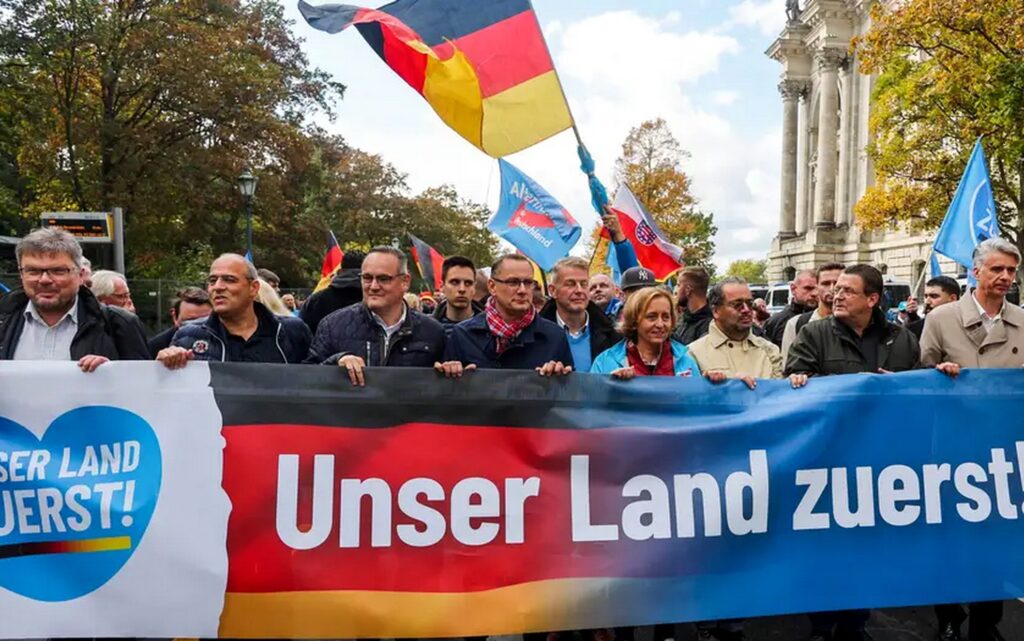
A recent study revealed that about one-fifth of citizens in Germany are receptive to authoritarian ideas, and the proportion in eastern Germany rises to a quarter of the population, according to the Germany Observatory, a large-scale study of about 8,000 participants.
The government’s commissioner for East Germany, Elisabeth Kaiser, will present the results in detail on Thursday in Berlin.
The researchers in the survey didn’t only ask direct questions about democracy and dictatorship, but also tried to explore the gray area through indirect questions.
According to the results, 31% of Germans agreed with the statement: “What Germany needs now is one strong party that embodies the will of the entire people, and another 23% expressed at least partial approval.
In East Germany, 35% fully approved of the phrase, while 26% said they approved it partially.
The idea that political decisions should be made by a strong leadership figure without regard for the parliament was fully supported by 11% in Germany, while 21% partially supported it… In East Germany, 15% were fully supported, while 22% were partially supported.
In East Germany, 35% fully approved of the phrase, while 26% said they approved it partially.
As for the hypothesis that “under certain circumstances dictatorship is the best form of state,” 4% supported it in full and 7% partially supported… In eastern Germany, 6% fully approve, while 12% supported it partially.
Since 2023, the Germany Observatory has been prepared annually with the support of the East German Commissioner.
The study is supported by research teams from the Social Research Center in Halle, the University of Jena and the Leibniz Institute for Social Sciences in Mannheim.
Last year, researchers surveyed 4,000 people over the age of 16 in Germany, with another 4,000 in a regional sample to provide assessments by city and countryside as well as wealthier and less prosperous areas.
Direct questions about democracy and dictatorship showed clear answers, with 98% supporting the idea of democracy and 89% rejecting dictatorship under any circumstances.
However, only 60% in Germany were satisfied with the performance of democracy, and in East Germany only 51%, and overall, 71% see a negative development of democracy in Germany.
Kaiser said initial support for democracy was a good thing, adding: “But the low level of satisfaction with the way democracy works is worrisome”.
The SPD politician sees a link between this and a sense of social injustice: “I understand this as a call to put social aspects at the center of attention, to confront fears of social regression, and to give people prospects… The expected changes aren’t only useful, but also actionable”.
The readiness of citizens for change in Germany was a central aspect of the study, with 23% of Germans saying they were open to societal change and saw it as an opportunity.
Around 52% believed that the change has both positive and negative aspects, while 26% clearly expressed a monetary stance and focused mainly on risk.
This category is particularly prominent in structurally weak areas of eastern Germany.
On the topics of defense, economics, digitalization, demographic development, climate and migration, the researchers explained that the majority of Germans are willing to shoulder full or partial personal burdens.
The researchers pointed to one exception, where 58% of Germans rejected calls to work longer periods to maintain the same pension level as society ages, considering it a significant burden.