Protests escalate in Iran: Death toll rises

Iran is witnessing new anti-government protests on Friday evening, particularly in Tehran where demonstrators marched on several main roads.
On the thirteenth day of a protest movement that is gaining increasing momentum, demonstrators in the Saadatabad area of northwest Tehran banged pots and pans and chanted anti authorities’ slogans.
Among the slogans that can be heard in videos posted on social media is “Death to Khamenei”.
Several cars gathered at the scene and honked their horns in conjunction with the chants of the demonstrators, and other footage also showed demonstrations in other parts of Tehran.
Persian-language television channels based outside Iran broadcast videos of large numbers of protesters in Mashhad (east), Tabriz (north), and Qom (central).
Iranian Nobel Peace Prize laureate Shirin Ebadi warned that security forces might be preparing to commit a massacre amid widespread communications blackout.
The activist, who is currently living in exile, said via her Telegram channel that she had received information that hundreds were taken to a hospital in Tehran on Thursday due to serious eye injuries caused by being shot with shotguns.
Meanwhile, NetBlocks, an internet monitoring organization, said that Iranian authorities have been blocking the internet across the country for 24 hours in violation of Iranians’ rights and to cover up the regime’s violence.
Abadi argued that the internet blackout isn’t the result of a technical malfunction… it’s a tactic used by the authorities.
Iran Human Rights, a Norway-based organization, reported on Friday that at least 51 protesters, including nine children, have been killed and hundreds injured across Iran since the protests began on December 28.
On Thursday evening, crowds of people walking in Tehran, while Iranian television on Friday showed damage to buildings and property that it said was caused by acts of sabotage.
The mayor of Tehran was quoted as saying that more than 42 buses, public vehicles and ambulances were set on fire, in addition to 10 government buildings.
According to the judiciary, a public prosecutor was killed in the city of Esfrayn (east), in addition to a number of security forces personnel, during protests on Thursday night.
The Supreme Leader Ayatollah Ali Khamenei asserted on Friday that the Islamic Republic won’t back down in the face of saboteurs and rioters.
In front of a crowd of supporters chanting “Death to America,” Khamenei adopted an aggressive tone in a speech broadcast on state television.
He said, “Everyone knows that the Islamic Republic was established with the blood of hundreds of thousands of honorable people, and it won’t back down in the face of saboteurs”
The intelligence division of the Iranian Revolutionary Guard Corps deemed the continuation of this situation unacceptable, stressing that protecting the revolution is a red line.
From his part, Iranian Foreign Minister Abbas Araghchi, speaking from Beirut, accused the United States and Israel of interfering in the protest movement, while ruling out the possibility of foreign military intervention.
Washington on Friday described as illusory accusations by Iranian Foreign Minister Abbas Araghchi that it was fueling the widespread protest movement in Iran.
In a statement responding to remarks made by Araghchi during a visit to Lebanon, a US State Department spokesman said, “This statement reflects a disingenuous attempt to distract from the serious challenges facing the Iranian regime at home”.
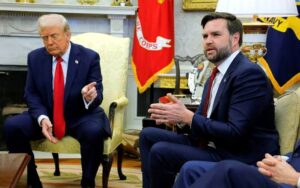
From his part, the US President Donald Trump said on Friday that “Iran is in big trouble”.
He added, “It seems to me that the people are taking control of certain cities; nobody thought that was possible just a few weeks ago”.
Trump again threatened on Thursday to hit Iran very hard if the authorities kill protesters.
In related context, Reza Pahlavi, the US-based son of the deposed Shah, called on protesters in Iran on Saturday to “prepare to take control” of city centers, on the 14th day of the nationwide protest movement sparked by deteriorating living conditions.
Pahlavi said in a post on X, “Our goal is no longer just to control the streets; the goal is to prepare to seize and control city centers”.
He called on Iranians to take to the streets on Saturday and Sunday evenings, asserting that he is preparing to “return to my homeland” on a day he believes is “very near”.
Reza Pahlavi, the son of the Shah overthrown by the Islamic Revolution and a resident of the United States, called on Trump on Friday to intervene without delay in Iran.
These demonstrations are the largest in Iran since the protest movement that followed the death of Mahsa Amini in 2022 while she was in detention for violating strict dress codes.
These protests come at a time when the Islamic Republic hasn’t yet recovered from the fallout of a 12-day war with Israel in June that specifically targeted its nuclear facilities, and from strikes against its regional allies, most notably Hezbollah, and from the United Nations re-imposing sanctions on it in September in response to its failure to comply with restrictions on its nuclear program.
Amnesty International and Human Rights Watch condemned in a joint statement the methods used to disperse, intimidate and punish largely peaceful protesters, citing the use of guns, water cannons, tear gas and beatings.
French President Emmanuel Macron, British Prime Minister Keir Starmer and German Chancellor Friedrich Merz condemned the “killing of protesters” in Iran in a joint statement.