Poland confirms major South Korean defense deliveries
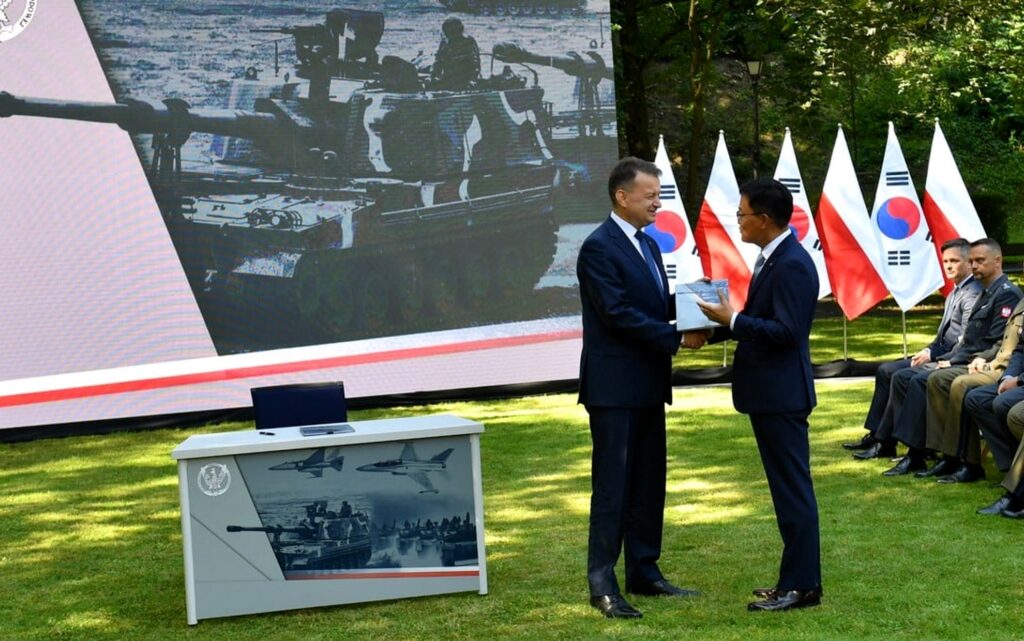
Poland has officially confirmed the delivery of 160 K2GF main battle tanks, 192 K9A1 self-propelled howitzers, and 126 Homar-K multiple rocket launcher systems from South Korea.
This announcement clears up parliamentary uncertainty and underscores the unprecedented speed at which Warsaw is modernizing its ground forces to counter emerging threats on NATO’s eastern flank.
These deliveries are part of a sweeping rearmament plan initiated after Russia’s war in Ukraine in 2022.
At its core, the program seeks to replace aging post-Soviet equipment with cutting-edge, NATO-compatible platforms—positioning Poland as one of the most formidable land powers in Europe.
The confirmed acquisitions stem from the strategic framework agreements signed in 2022 between the Polish Ministry of National Defense and South Korea’s leading defense companies—Hyundai Rotem and Hanwha Aerospace.
Initially valued at over $12 billion, these multi-phase contracts cover not just deliveries but also technology transfers, joint production, and future upgrade paths.
This allows Poland to develop a sovereign industrial base, train domestic crews and engineers, and ensure long-term sustainment of its new arsenal.
Extra context: Such agreements mirror South Korea’s broader push to become a global arms exporter. In 2023 alone, Seoul’s defense exports surged past $17 billion, making it one of the fastest-growing arms suppliers in NATO’s orbit.
The K2GF main battle tank, a modified variant of South Korea’s K2 Black Panther, is among the most advanced MBTs in the world. It features a 120mm L/55 smoothbore gun, advanced composite armor, and an autoloader, ensuring superior firepower and crew survivability.
Under the 2022 deal, Poland was to receive an initial batch of 180 tanks, with full-scale local production of the K2PL variant scheduled for 2026.
The 160 units now confirmed as delivered form part of this first production phase, manufactured in South Korea and customized for Polish service.
These tanks will replace legacy T-72 and PT-91 Twardy tanks, integrating seamlessly with NATO’s digital command-and-control networks.
Extra context: Analysts note the K2’s advanced suspension and modular armor systems offer superior mobility in Eastern European terrain compared to many Western MBTs.
Poland’s eventual K2PL version is expected to feature heavier armor and domestic battle-management software.
Poland’s acquisition of 192 K9A1 self-propelled howitzers represents the artillery element of the modernization plan.
Originally, Warsaw aimed to purchase 212 K9A1s with the option of local production under the K9PL designation.
The 155mm tracked howitzer can fire NATO-standard munitions beyond 40 kilometers, featuring improved navigation, automation, and fire control over earlier versions.
Three initial units were delivered to Huta Stalowa Wola (HSW S.A.) for testing, adaptation, and repainting before final certification.
The K9A1’s rapid “shoot-and-scoot” capability makes it especially effective in counter-battery warfare.
Poland’s integration of these systems dovetails with its domestic “Krab” howitzer program, creating a two-tier artillery force with both imported and indigenous platforms.
The Homar-K multiple rocket launcher system (MLRS), derived from South Korea’s K239 Chunmoo, forms the third pillar of the arms package.
Poland plans to acquire 288 modules, with 218 launchers eventually produced domestically under license.
This system can fire 239mm and 600mm guided rockets with ranges of 80 km and 290 km respectively, extending Poland’s strike envelope deep into adversary territory.
The 126 launchers delivered so far include 72 already integrated with Polish Jelcz 8×8 tactical trucks, creating a mobile, survivable long-range fires capability.
The Homar-K complements the US-supplied HIMARS system, giving Poland a dual-sourced precision fires architecture.
This reduces dependency on a single supplier and bolsters NATO interoperability for joint operations.
This South Korean arms package represents more than procurement—it is a fundamental transformation of Poland’s armed forces.
By transitioning away from Warsaw Pact-era systems, Poland accelerates its evolution into one of NATO’s most modern and mobile land armies.
The modernization aligns with Poland’s decision to raise defense spending to over 4% of GDP in 2024, the highest among NATO members proportionally.
This investment includes expanding the army to 300,000 personnel, improving logistics, and upgrading air defense networks.
Rapid integration of these systems strengthens NATO’s eastern flank with highly mobile, survivable, and interoperable combat assets.
Replacing T-72 tanks and Dana howitzers with K2 and K9 platforms significantly enhances battlefield mobility, target acquisition, and survivability.
Combined with the Homar-K and HIMARS, Poland gains a scalable long-range fires capability to strike deep targets, reinforcing NATO’s deterrence-by-denial posture.
Analysts view Poland’s approach as a template for other front-line NATO states, demonstrating that partnering with non-Western defense suppliers can accelerate modernization and reduce costs, especially as US and European production lines face capacity limits.
By leapfrogging procurement delays in the US and Europe, Poland is emerging as a military bulwark on NATO’s eastern flank.
With one of the fastest-growing and most modernized land forces on the continent, it sets a new standard for allied readiness and deterrence in Europe.
Poland’s defense industrial partnership with South Korea is also expected to deepen over time, with joint ventures potentially expanding into unmanned systems, air defense platforms, and even next-generation armored vehicles—further reinforcing its status as a regional security leader.